
• The move to the new server is done. There are some software and database maintenance updates in process. This has us passing the hat around to help out. We appreciate any donations. Seriously, even a dollar helps. The payment page may be found here - https://www.audiokarma.org/support.html

Gravestones

TheRed1

Console Conservationist
When the color drains from the landscape in late fall I often find myself drawn to picturesque old cemeteries. The crisp lines and deep shadows of the memorials against a background of stark, naked trees and grey skies can be good metaphor for this often melancholy time of year. The names, dates and epitaphs representing lives lived - carved in stone or cast in bronze - can add further poignancy. I think of these people as my cemetery acquaintances.


Cemeteries are full of interesting people - both living and dead. I've had some really interesting encounters, (mostly with the living, thus far.) Years ago, in Congressional Cemetery in DC, my wife and I observed a very well-dressed man sitting on a memorial bench with a boombox. He seemed to be talking to himself while playing some tape-recorded conversations and Sousa marches, though we couldn't hear much of what was being said. Later, when he had gone, we walked up to the bench - it was J. Edgar Hoover's.

Just last week I had a very nice chat with a Churchwarden who was probing to locate some of his cemetery's residents with a gentle tap-tap on the coffin. He had a neat old map showing where everybody was supposed to be but he said you could never tell for sure with graveyards as old as this.


It can be a bit startling when the dead address you directly. Recently, George Richardson, a stone cutter from Fredericksburg, Va. who died in 1807, admonished me to take stock of my life with these words:


Stay passenger; thy steps; reflect awhile:
Tho' now in health and vigour thou may smile
Tomorrow's sun thy obsequies may see
The silent grave may then thy mansion be . . .​

Or Capt. Georg Mumford from New London in the Colony of CONNECTICUT whose beautiful and intriguing slate slab bears this timely quote from the Scottish poet James Thompson:

Behold Fond Man
See here thy Pictured Life
Pass some few years thy flow'ry Spring.
Thy sober Autumn fading into age
pale concluding Winter comes at last
& Shutts the scene.​


Some stones put it rather less delicately with the unequivocal message, "momento mori" (remember death):


And some have even made me chuckle:
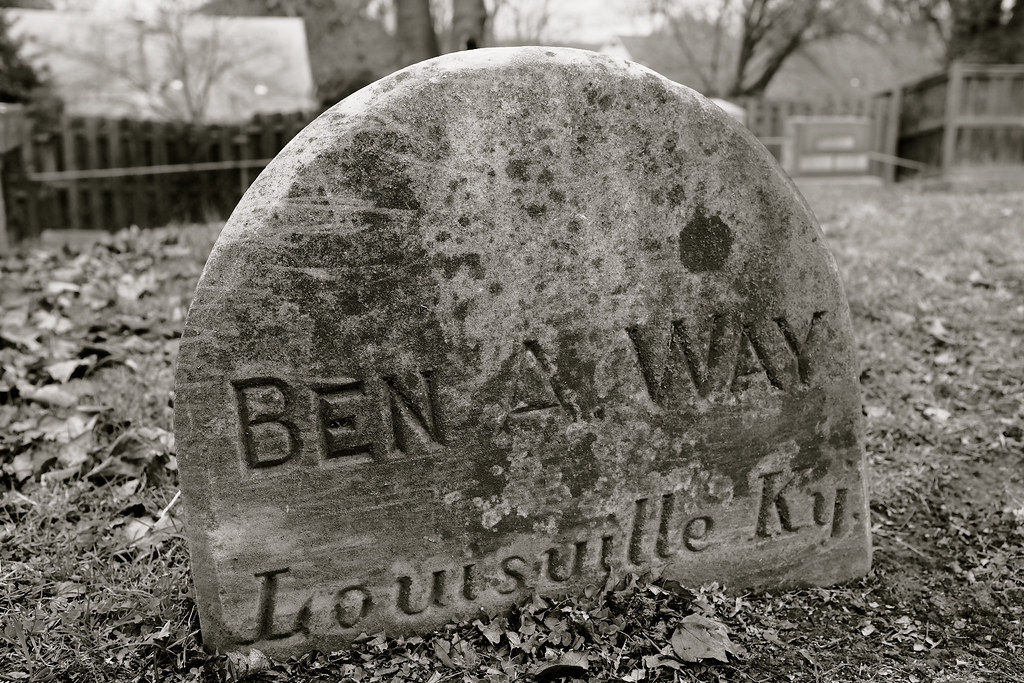


I thought for a moment this was meant as a joke but the surrounding stones for other members of the Way family showed the humor was unintentional.

Do any of you all find cemeteries similarly evocative and a worthy subject matter for photography?
 
Last edited:
Register to hide this ad
Simplicity: no name, no dates - just a granite slab and this enigmatic bronze figure (by Augustus Saint-Gaudens) marks the grave of photographer and Washington socialite, Clover Adams. This monument is enclosed by a ring of large shrubs such that visiting feels very intimate and personal. The granite benches opposite the sculpture seem an open invitation to linger which is what I tend to do. This is in Rock Creek Cemetery in NW DC - one of my favorite places.


Jane Selden's name is all that is carved on her large stone in the shadow of Christ Church, Alexandria, Va. Was that how she wanted it - elegant, understated with no extraneous information - or was it all that was known about her? Perhaps someone was supposed to get back in touch with the stone carver after the funeral with all of the other information and that never happened.


In stark contrast is Bethanath McLean's elaborately carved stone. His parents wanted every hour of his short life recorded: born [Nov 25th 1795] / a[t] 2 ºClock AM & Departed / this Life Aug ᵗʰ 15 1798 a[t] 11 ºClock / PM - and who can blame them.


Then there is the anonymity which comes with the passage of time and the erosion of stone. Marble seems to fare worst but some types of sandstone are quite fragile as well. Acid rain dissolves the softer parts of the marble leaving an almost flesh-like veining:


And the surface of some softer sandstones just spalls away taking the names and dates with it.


Give me slate which seems as crisp and legible as the day it was carved - even if that was centuries ago. Here is my own Great X9 Grandmother's stone in the Elm Grove Cemetery, Mystic, Connecticut. You can still see the stone carver's guide lines. Her name was Ann Borodell Denison and she was from Cork, Ireland. I used to count her as my lone Irish ancestor so I would have a legitimate reason for celebrating St. Paddy's Day with my bona fide Irish-descended wife. I have since learned that Ann Dension - they called her Lady Ann when she moved to the Colonies - wasn't Catholic and her family back in Ireland owned land and had money. Her husband, George, was a Captain in Cromwell's Cavalry for goodness sakes! So I'll be laying low come March 17th.

 
Last edited:
Very nice. Thank-you for sharing.

Have always enjoyed old cemeteries for the same reasons mentioned. They are quite, serene and have a history to tell of individuals. Oldest one I have been to is Burial Hill, resting place of William Bradford of Plymouth Colony.

There is also something about the decay of the broken and leaning headstones that give a reverence to the passage of time and what little we have here.
 
Great stuff. I love old cemeteries. After working in them for a season, the creepiness is gone. Now I enjoy the quiet.
 
There's one tombstone in our church cemetery that has a died date of Feb 31, 18twenty-something..Cemeteries ARE fascinating, if kinda creepy... There is a BIG one up behind the farm, you can go there & learn a lot...HUGE families back then, but there was also a high mortality rate.. If you managed to live til approx. 20 or so, you'd likely live to an old age..LOTS of "Infant" & then the family name.. Kid would be a week or 2 old, maybe a month or 2.. LOTS of 'em died in the cold months.. By the late twenties/early thirties, w/the availability of better medical care, & automobiles, you stopped seeing quite so many "Infants" or babies checking out..
 
What length lens are you using? To my untrained eye it looks like 50mm. Great photos, I love your fifth image with the skull & cross bones.
 
Last edited:
I don't have many, but always liked this one. Lo rez scan but the bottom line is, "Ye living men come view the ground where you must shortly lie."
 

Attachments

  • Ye Men01_sm.jpg
    Ye Men01_sm.jpg
    51.9 KB · Views: 277
Have always enjoyed old cemeteries for the same reasons mentioned. They are quite, serene and have a history to tell of individuals. Oldest one I have been to is Burial Hill, resting place of William Bradford of Plymouth Colony.

There is also something about the decay of the broken and leaning headstones that give a reverence to the passage of time and what little we have here.
Have not been to Burial Hill despite having a probable ancestor there. However, it is my understanding his stone was a much later addition. I did once drag my wife all over New England - from graveyard to graveyard - visiting my mother's people. We had a great time since she loves cemeteries as much as I do. Of course she's a funeral director's daughter and would have been the 5th generation of her family in the business had she chosen to carry on the tradition. Her father just recently retired and sold the business. It was always interesting visiting and staying with him when he still lived upstairs above the parlor.

This is the oldest stone in my neck of the woods - William Herris (Harris) who died in 1698. It is not in its original location, though. The stone was relocated to the Pohick Episcopal Church's Cemetery when I-95 was constructed. William was not exhumed - instead a representative jar of soil from beneath the stone was taken. This has been a difficult stone to photograph. I'm still not satisfied with the results. I even tried a low angle flash (you can see it on the left) to highlight the inscription in the second photo.


Despite Virginia having been first settled in 1607, it took quite some time for this particular part (northern) to be settled. Most of the earliest stones are down in the Tidewater region. I have visited many cemeteries there but mostly those associated with my father's family and those tend to be much more recent. It has been very difficult to trace my paternal ancestry prior to the Civil War due to court records having been sent to Richmond for safe keeping - which didn't work out so well. Many cemeteries were severely damaged during the War as well. The Willis Family Cemetery on Mayre's Heights was nearly reduced to rubble by Union artillery. The damage is still visible today:

 
Last edited:
I don't have many, but always liked this one. Lo rez scan but the bottom line is, "Ye living men come view the ground where you must shortly lie."
attachment.php


That is a great stone. I would love to see a higher resolution scan as it appears to be an excellent photograph.
 
There's one tombstone in our church cemetery that has a died date of Feb 31, 18twenty-something...
Well that trumps the Feb. 30th I found in Lewes, Delaware. At least yours was a death date - poor Elizabeth Cullen never got to celebrate her birthday and yet still lived to be 78. I guess carving tombstones eventually got pretty boring after certain number of years - leading to the odd typo (or chisel-o).

 
Last edited:
What length lens are you using? To my untrained eye it looks like 50mm. Great photos, I love your fifth image with the skull & cross bones.
Most are taken with a 35mm equivalent (23mm/1.5 crop factor) at f/2.8. The first and last of the above are scans from old 35mm film which might well have been taken with a 50mm.

The skull and crossed bones were startling to see in person. I had known of their existence for some years before finally visiting them recently. It was one of a group of three graves with stones thus decorated at the old Episcopal church in Aquia, Va. Apparently it was a popular motif in funerary art during the mid 1700's. Here is the adjacent table slab with a very unusual cherubs and death's head combination:


That is a great stone. I would love to see a higher resolution scan as it appears to be an excellent photograph.

Alas, I don't have the original scan handy, though it's on a backup disk somewhere. It was a nice shot, probably with a Yashica or Mamiya 2 1/4 on FP4+. Today people talk about "silver gelatin" prints. Heck, when I started printing that was all there was! Not even RC paper yet.

There's another stone in the same small cemetery that just says "Elvira" but I could never get it lit and framed just right.
 
Last edited:
Growing up in New Orleans, cemeteries played a significant role in our lives. On All Saints Day each year, we would visit our families tombs and whitewash them (in rotation.)

It was always important to know the graves, the individuals buried there and what was significant about their lives. I have done it a few times with my children, but not nearly as much as I used to do with my parents and grandparents.

It takes a couple of cemeteries, but I can trace my family all the way back to the immigrants from Lyons, France in the 1850's. (We were recent immigrants.:D)
 
Thanks for sharing.
I tough I was the only one visiting cemetery, taking photos, and reading the inscriptions. I always told my sister and my wife, it's history that everybody should be aware of, although a bit wishful on my part.
All of my photos were taken a while ago, all with Canon AE-1 with an assortment of lenses but, the 50mm f/1.8 and 28mm f/3.5 being my preferred lenses. I still have them, I've two AE-1, but now I use a DSLR, also a Canon. Maybe I should start visiting again and taking photos, great history in my province.
Wish I had a couple of photos to show you.
I have taken lots from war cemetery, especially when I was stationed in Germany in the mid 70s.

Anyway, love your work, excellent presentation.
 
This whole thread brings to mind something that I think is important. So many of these old stones are aged and unreadable. What will they be like in another hundred years or, sorry to say, after vandalism. A photographic record is a wonderful way to preserve history. Even recent stones will some day decline.
 
Wow excellent! Did you bring you own light source?
Just a hand held flash as shown above. Perhaps the close-ups of individual stones could be approached using portraiture techniques. However, I'm not sure I would want the sort of attention that might attract. I try my best to be respectful and maintain a low profile whilst roaming around cemeteries.

Growing up in New Orleans, cemeteries played a significant role in our lives. On All Saints Day each year, we would visit our families tombs and whitewash them (in rotation.)

It was always important to know the graves, the individuals buried there and what was significant about their lives. I have done it a few times with my children, but not nearly as much as I used to do with my parents and grandparents.

It takes a couple of cemeteries, but I can trace my family all the way back to the immigrants from Lyons, France in the 1850's. (We were recent immigrants.:D)
A lovely tradition. It's sad so many families have become geographically scattered and separated from their ancestors by modern life. I'm fortunate to live within easy driving distance of all of my father's people. Unfortunately many of their graves are lost.

My direct paternal ancestor, (who enlisted in the Confederate army, got sick and died within a couple of months,) was most likely buried in one of the mass graves on the grounds of the Chimborazo Hospital in Richmond, Va.. Most of the rest of the family - prior to the Civil War - lived and were presumably buried on lands that now comprise Fort A. P. Hill. The Army did its best to identify and relocate the graves to a brand new U.S. Government cemetery just outside the base. However, everything was done in a hurry as the base was created during the rapid military expansion just prior to WWII. Many of the graves were probably poorly marked if marked at all. A few were found but many are now surely lost forever.

My Grandfather bought, (or was given,) a group of eight plots in that Cemetery. When my father died, I suggested we use the old chapel on the cemetery grounds which had been built by the Government. It hadn't been used in decades and was falling into disrepair which seemed wasteful to me. Happily, my choice prompted a thorough cleaning and some much needed caulking which had been my hope. Now there is only one spot left in our family plot. I asked around during my dad's funeral if anybody was interested in it. Nobody was - so it's mine if I want it.

Sorry for the tangent - let's see if I can steer this back toward photography.

We had our first snow in several years recently. I made the short trek out into the foothills of the Blue Ridge to visit one of my favorite little country church graveyards. This inscription seemed apt:

The less of this cold world
the more of Heaven.
The briefer life: the
earlier immortality.
​


Took my old camera for its 24-720mm zoom with which I tried to wrap some of the Blue Ridge into the background.


There is one grave for which snow and ice seem an especially poignant backdrop:

His broken column symbolizing a life cut short:


His name and inscription all but illegible in heavily weathered marble:


Fortunately there is a brass plaque at the base with the full inscription:


When I first stumbled upon James M. M. Ambler I was so intrigued by his story I ending up purchasing a book on the Jeannette Expedition:


It is a harrowing tale of heroism in the face of brutal arctic weather. The retrieval of the bodies by the US Navy was a huge undertaking in itself. (No pun intended.) This is not light reading and I would not recommend it unless you are prepared for a very bleak ending.
 
Last edited:
Back
Top Bottom