

You are using an out of date browser. It may not display this or other websites correctly.
You should upgrade or use an alternative browser.
You should upgrade or use an alternative browser.
Gravestones
- Thread starter TheRed1
- Start date


hwirt
Super Member
Not the prettiest shot, but perhaps the saddest marker I've ever seen:


Looking through these cemeteries the number of very young people is shocking and sad, you can't help but feel a tiny bit of the anguish these families felt.
Last edited:


TheRed1
Console Conservationist
cratz2: Sometimes the emotional impact of the subject can be so powerful that it will convey no matter how it is imaged. Some scenes have been so overwhelming they've been impossible for me to photograph. I know of several cemeteries down where I go camping in central Virginia which contain long rows of stones all with the same date of death, Aug. 20, 1969. Many represent entire families - victims of the catastrophic flooding resulting from the remnants of Hurricane Camille.
Though I don't have personal connections to those who perished, I have many friends from that area. Their accounts of that harrowing night have made those gravestones more than just an abstraction for me. I have found those cemeteries especially difficult to approach with a photographer's eye.
hwirt: Your shots of the St. Frances X Cem. through the fence are really interesting. The shallow depth of field works very nicely for that circumstance. I visited a cemetery in Georgetown last weekend that turned out to be closed to the public for all but a few hours on Sunday. Walking along outside the imposing wrought iron fence, I considered trying to shoot through the fence but decided against it. I was disappointed to have come at the wrong time and I guess I had preconceived notions of the type of shots I was after. After seeing your photos I think I ought to have taken some anyway. Nice work!


TheRed1
Console Conservationist
I like this one. I've tried using trees in the background to subtly echo cruciform gravestones on a couple of occasions but never with such success. How did you achieve such a dramatic blur?Taken in Elmwood Cemetery in Memphis

One of my attempts:

Yesterday my wife and I finally made it out to Oak Hill Cemetery in Georgetown, DC. It was sunny and nearly 70° so we had a fair amount of company. However, the topography and the well-wooded character of the ground made it feel much less urban than it really is. My wife said it was a toss-up between Oak Hill and Forrest Lawn in Buffalo as to which was her all-time favorite. For her, that's high praise, indeed - especially considering her family's long involvement (4 generations) with Forest Lawn.
As is our normal routine, I quickly lost track of her while taking pictures and spent the next couple of hours in my own little world. Every so often I would scan the adjacent hillsides to see if she was spying on me but I didn't see her again until we met up on our way out. We each had our own set of adventures and had fun comparing notes on the drive home. Now I've got to make another trip down there to see if I can find all the cool things she described that I missed.
Lots of famous and interesting folks are buried at Oak Hill. It seems especially well endowed with Confederate women spies. There's a nice map and checklist available free online or for $3 at the cemetery. I generally prefer to happen upon things by accident, go home, look at my photos and then Google their names. That's how I found Commodore Charles Morris. He didn't make the list of must-see graves on the official map but I think he's pretty interesting. In the War of 1812 he was the executive officer under Isaac Hull aboard the USS Constitution during her famous battle with the HMS Guerriere. He was severely wounded in that action but survived and was promoted to Captain. We he died in 1856 he had risen to be the second highest-ranking officer in the US Navy.

The cemetery backs to Rock Creek Park and drops away precipitately down toward the creek. There are tombs set into the hillside one almost directly on top of another. Among this group at the furthest corner of the cemetery is the family tomb of Lincoln friend William Thomas Carroll, Clerk of the US Supreme Court. There, in 1862, Willie Lincoln was laid to rest until after his father's assassination in 1865 when his remains were moved to Oak Ridge Cem., in Springfield, Ill., to lie alongside his father and brothers.

What really made Oak Hill special, though, were the crocuses. In some places the ground was just covered with them - especially in the Joyce section. By the time I made it there, it had been well over an hour since I had last seen my wife so I thought I had better try to track her down. Just as I was making that decision, I saw them. I had to pause to take a few photos but forced myself to hurry back toward the entrance. I intended to find my wife and return to show her but she was getting hungry and had discovered the crocuses independently, anyway.


Incidentally, the Joyce section turned out to have been named after a bit of a character: John A. Joyce. His lifelong claims to the contrary, he apparently - if one can believe the internet - was NOT the author of the words he had carved on his gravestone:
Laugh and the world laughs with you,
Weep and you weep alone.

Weep and you weep alone.
And lastly, I thought this one came out a bit weird but still interesting. I'll have to go back to get the name of the gentleman whose bust this is.


uofmtiger
Addicted Member
That picture was taken with a Lensbaby 2.0. I like the way you took the pictures with the flowers to contrast the gravestones.I like this one. I've tried using trees in the background to subtly echo cruciform gravestones on a couple of occasions but never with such success. How did you achieve such a dramatic blur?
Here is a pic from Graceland:

Presleystatue by uofmtiger, on Flickr
A couple more I took a while back at Elmwood with the Lensbaby 2.0:


TheRed1
Console Conservationist
I found the gravestone of one of my favorite photographers, O. Winston Link, today at Elmwood Cemetery in Shepherdstown, WV. Of course an elaborately-staged, flash-lit night scene would have been more appropriate. The owl within the shutter in his initials is a clever design but I wonder what the number 2853 signifies.


Lots of dead Confederates interred here - including Henry Kyd Douglas whose book, I Rode With Stonewall, is one of many I inherited from my father. There are a number of prominent Confederates buried there whose names I recognized.


To balance out my day, I drove across the Potomac to tour the Antietam National Cemetery in Sharpsburg which is populated with an appalling number of dead Yankees. On a monument dedicated, (in German and English,) to the 20th N.Y. Volunteers I spotted my second OWL for the day. I also came across several wartime letters left in ziplock bags at the gravestones of their authors.


A short distance from the national cemetery heading into Sharpsburg proper, I found an old Lutheran burial ground with some nice old gravestones.


Lots of dead Confederates interred here - including Henry Kyd Douglas whose book, I Rode With Stonewall, is one of many I inherited from my father. There are a number of prominent Confederates buried there whose names I recognized.
To balance out my day, I drove across the Potomac to tour the Antietam National Cemetery in Sharpsburg which is populated with an appalling number of dead Yankees. On a monument dedicated, (in German and English,) to the 20th N.Y. Volunteers I spotted my second OWL for the day. I also came across several wartime letters left in ziplock bags at the gravestones of their authors.
A short distance from the national cemetery heading into Sharpsburg proper, I found an old Lutheran burial ground with some nice old gravestones.

thomo57
Super Member
I found the gravestone of one of my favorite photographers, O. Winston Link, today at Elmwood Cemetery in Shepherdstown, WV. Of course an elaborately-staged, flash-lit night scene would have been more appropriate. The owl within the shutter in his initials is a clever design but I wonder what the number 2853 signifies.
Lots of dead Confederates interred here - including Henry Kyd Douglas whose book, I Rode With Stonewall, is one of many I inherited from my father. There are a number of prominent Confederates buried there whose names I recognized.
To balance out my day, I drove across the Potomac to tour the Antietam National Cemetery in Sharpsburg which is populated with an appalling number of dead Yankees. On a monument dedicated, (in German and English,) to the 20th N.Y. Volunteers I spotted my second OWL for the day. I also came across several wartime letters left in ziplock bags at the gravestones of their authors.
A short distance from the national cemetery heading into Sharpsburg proper, I found an old Lutheran burial ground with some nice old gravestones.
Might pay to have a word to the groundstaff or curators of the cemetery.
I can see damage to the bottoms of the head stones which is probably caused by the mowers or whipper snippers.:scratch2:
l

2853
[This four digit number is O. Winston Link's number in Paxson Link, The Link Family: Descendants of John Jacob Link 1417-1951]
from:
http://www.findagrave.com/cgi-bin/fg.cgi?page=gr&GRid=57340640
[This four digit number is O. Winston Link's number in Paxson Link, The Link Family: Descendants of John Jacob Link 1417-1951]
from:
http://www.findagrave.com/cgi-bin/fg.cgi?page=gr&GRid=57340640
TheRed1
Console Conservationist
I see weed whacker damage in almost every cemetery I visit. The older, softer slate, sandstone and marble are especially vulnerable to the nylon flails. What alternatives do cemetery groundskeepers have?Might pay to have a word to the groundstaff or curators of the cemetery. I can see damage to the bottoms of the head stones which is probably caused by the mowers or whipper snippers.:scratch2:
Thanks, OTN! I don't know why I didn't think of looking there. I tried his negative numbers, (but he only has 2400,) N & W locomotive numbers, the date Feb. 8, 1953 - even the last four numbers of his SSN. The first two digits being 28 made me think of f-stop numbers (2.8). If the last two digits had been 56 it almost would have made sense.2853
[This four digit number is O. Winston Link's number in Paxson Link, The Link Family: Descendants of John Jacob Link 1417-1951]
from:
http://www.findagrave.com/cgi-bin/fg.cgi?page=gr&GRid=57340640
thomo57
Super Member
I see weed whacker damage in almost every cemetery I visit. The older, softer slate, sandstone and marble are especially vulnerable to the nylon flails. What alternatives do cemetery groundskeepers have?
Weedicide some sort of edging or some sort of mechanical clipper are 3 alternative or the 4th one is permanent damage to a monument that is hundreds or years old that cannot be rectified.
How long have weed whackers been around:scratch2:
Imagine what they will achieve over the next 50 years
Last edited:


TheRed1
Console Conservationist
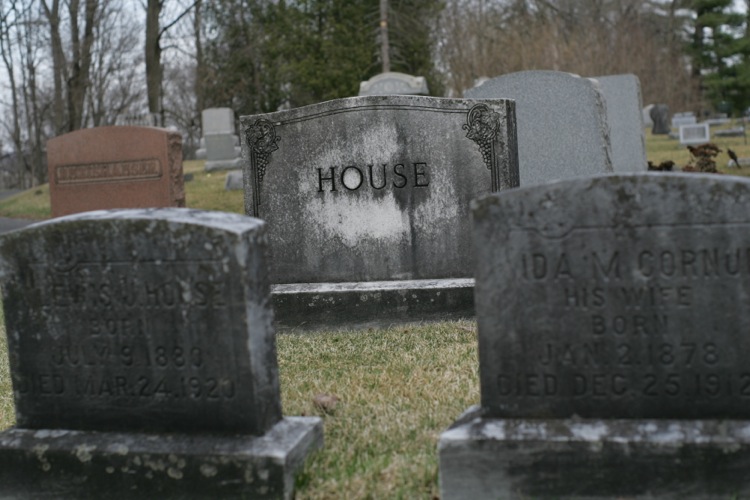
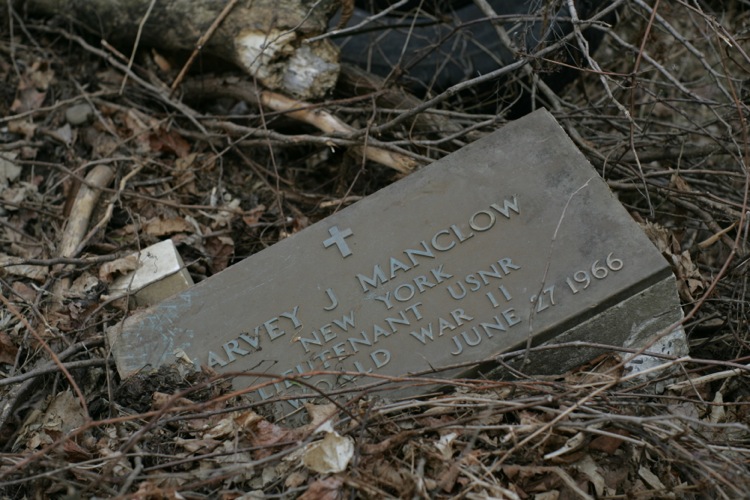
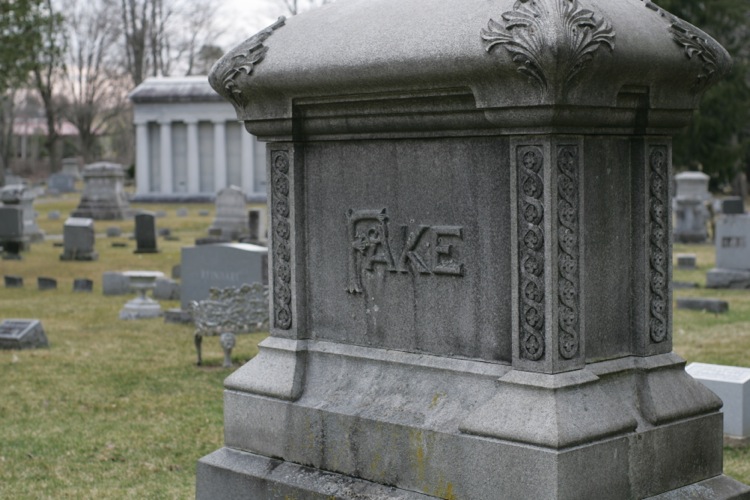
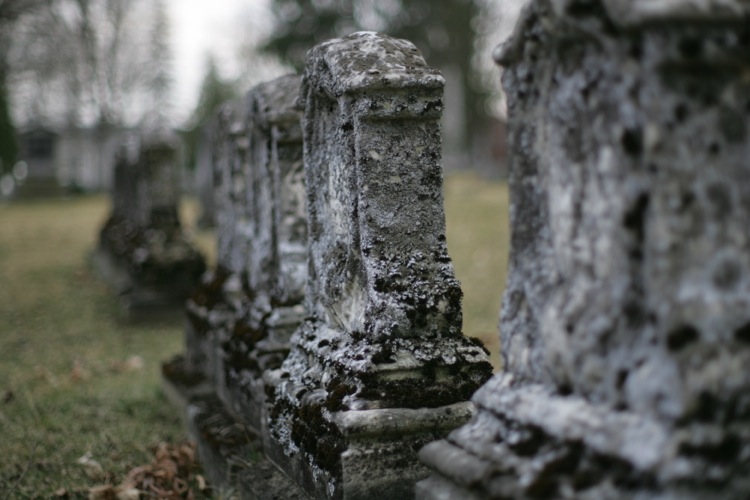
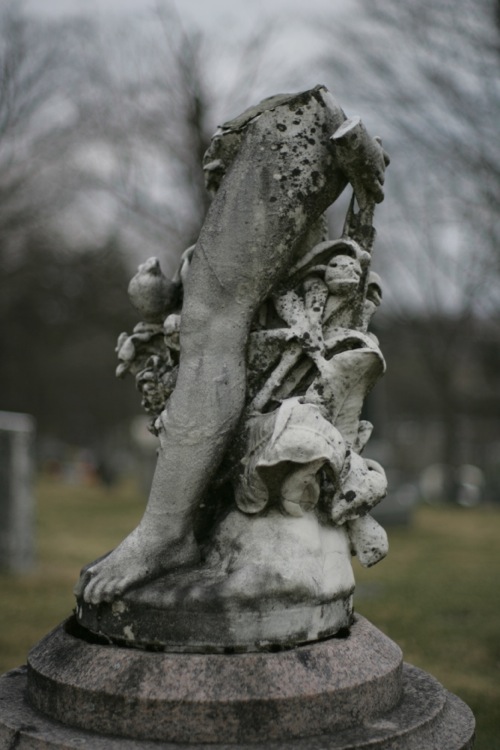
The damage to the statue is undeniably sad - especially if vandalism. It is, nevertheless, an arresting image.A nice walk through the cemetery today.
A couple of weeks ago I made a trek out to the Valley to revisit a couple of my favorite haunts around Winchester. I also swung through Front Royal seeking the Prospect Hill Cemetery which I had never been to before. After floundering around town for some time, searching in vain, I stopped in at the town's Visitor Center. The two elderly gentlemen there were evidently the right folks to ask. Between them I got quite a lesson in local history. They made sure I knew all the right families to look up while visiting Prospect Hill. I should have asked them to accompany me because I couldn't find half of the people they mentioned. Still, it was a nice cemetery with interesting history and a commanding view of the town and adjacent mountains.


On my way up to Winchester I stopped by the Shenandoah Memorial Park to visit Patsy Cline's grave. I'm not sure I understand the meaning of the pennies other than a way of saying you were there. They don't seem to have any significance beyond that. I took a photo instead.

My ultimate objective was Mount Hebron Cemetery. Winchester, Va. is a lovely town and has a cemetery to match. Like Prospect Hill Cemetery, Mount Hebron is sited on high ground and was the site of a battle during the Civil War. Mount Hebron has a long list of famous occupants and I chanced upon quite a few while strolling among the gravestones enjoying the beautiful spring weather.


If the name on that last one seems familiar it's probably because his grandson was named after him and achieved the rank of General, (along with some notoriety,) during WWII.
When I Googled the following individual to try to find out who he was and why he warranted such a grand memorial I was rewarded with a fascinating story. Amazingly, just this past weekend I heard his name mentioned on NPR by an author who wrote a book about America's libraries. Seems John Handley was a wealthy coal magnate from Pennsylvania who was so taken with the town of Winchester that he left most of his fortune to the town - including providing funds for an elegant library.
http://www.npr.org/2014/04/12/301781602/check-it-out-a-photographic-tour-of-americas-public-libraries

Last edited:


Seems John Handley was a wealthy coal magnate from Pennsylvania who was so taken with the town of Winchester that he left most of his fortune to the town - including providing funds for an elegant library.
Anyone else struck by the finials on top of the corners looking like faces?

Great shots!
Red1:
I was in Newcastle, England one time and happened upon a small, old graveyard overlooking the North Sea. Many of the headstones had the skull & crossbones on them.
You should check out Greenwood in Brooklyn. Amazing necropolis overlooking New York Harbor. Lots of crypts, some with elaborate designs such as pyramids. Walt Whitman is there.