• The move to the new server is done. There are some software and database maintenance updates in process. This has us passing the hat around to help out. We appreciate any donations. Seriously, even a dollar helps. The payment page may be found here - https://www.audiokarma.org/support.html

Gravestones

That's really cool, Bourbon. Did you know SRV in life?

Nah. I was driving around the Oak Cliff area of Dallas and got cut off by some jerk in a Chevy SUV. When I took an exit, I noticed a sign that advertised "Laurel Land" - so I decided to stop in. SRV is one of my favorites and I couldn't pass up the opportunity to pay my respects.
 
I understand that Audie Murphy's grave is the second most visited site after President Kennedy's. Is this true?
 
Excepting the Tomb of the Unknowns, that's probably true. The trams unload at the back of the Memorial Amphitheater almost opposite Murphy's grave. He is at the end of a row with a dedicated paved walkway and so stands out among all the other stones. My wife spotted it and waved me over.
 
A Return To Harper Cemetery


I recently revisited the Harper Cemetery at Harpers Ferry, WV. (See the very first photo in this thread shot back in the late '80s.) Surely one of the most romantically sited cemeteries in the east, it commands a dramatic view of the junction of the Shenandoah and Potomac rivers as they cleave the Blue Ridge. While reviewing my photos of the cemetery I wondered if any had been taken during the Civil War. A search of the Library of Congress' digital collections returned the following two extraordinary images. The first below is identified as a James Gardner photograph from 1865. The date must be when it was published and not when it was taken since the B&O railroad bridge in the photo was destroyed fairly early in the War.


From the Library of Congress

The second photo appears to have been taken during the same session and from the same general area. It shows nearly the same scene but is angled in a more northerly direction showing more of the Federal Armory buildings in Harpers Ferry. (The target of John Brown's 1859 raid.) This photograph is not identified as one of Gardner's though it must be. It is dated March 1862 which seems plausible given the state of the bridge and armory.


From the Library of Congress

I noticed the gravestone on the far left in the second photo seemed to have a legible inscription so I enlarged that part of the photograph and tried to enhance it as best I could. As soon as I could read it I realized I had just seen and photographed that very gravestone. (For some reason the name Ann Wilson stuck in my head.) Her marble slab is no longer standing upright but it is still quite legible after more than 150 years. When photographed by Gardner in 1862 the carving was only a few years old and still crisp and bright white. It was, however, already beginning to list to starboard. Note also her footstone with her initials.


From the Library of Congress


Now I am really anxious to return to the Harper Cemetery with copies of the 1862 photos to see if I can match up the shapes and sizes of the stones with enough accuracy to recreate Gardner's perspective. It will be a challenge, I am sure, especially given the overgrown character of the cemetery back then. There is also the likelihood that some of the stones in his photos are no longer extant. Even further complicating matters: I have observed that, when comparing his photos to mine, my 35mm equivalent lens seems significantly wider than whatever he was using. Perhaps using a zoom to try to match the apparent distance compression in his photos will help.
 
Last edited:
The cemetery in Harper's Ferry, and the village cemetery where we now live in New Hampshire are two of the most beautiful I've ever seen.

Gravestones are one of my son's favorite photography subjects - don't read too much into that! - I think he likes the texture and contrast of ancient gravestones.
Probably rude of me to post his photographs here; but here's a link to some of his relevant photos from his photoblog:
http://icouldbeahero.blogspot.com/search/label/graveyard


Here are a few of my own photos from 2012 - this is the Shaker cemetery in our old neighborhood in Harvard, MA. The "lollipop" grave markers are fairly well known.


The cemetery in Harper's Ferry, and the village cemetery where we now live in New Hampshire are two of the most beautiful I've ever seen.

Gravestones are one of my son's favorite photography subjects - don't read too much into that! - I think he likes the texture and contrast of ancient gravestones.
Probably rude of me to post his photographs here; but here's a link to some of his relevant photos from his photoblog:
http://icouldbeahero.blogspot.com/search/label/graveyard
Your son's work is impressive as usual. I don't think there's anything especially strange about gravestones as a photography subject - unless it becomes an obsession. (If you go to my Flickr page you can see what that looks like.)

Those Harvard "lollipop" markers remind me too much of plant tags. I would be interested in seeing some photos of your local village cemetery - especially if it rivals the Harper Cemetery. I'm envious of those of you in New England with so many beautiful cemeteries and rustic old churchyards.

Speaking of the Harper Cemetery . . . I was just up there earlier today. Despite (or perhaps because of) the weather, I thought it would make an interesting day trek and photo exercise. The snow was mostly shin deep with a few knee deep drifts. I was very careful not to trip over any of the shorter gravestones which were completely buried and difficult to detect. Prior to mine, there was but a single trail of human footprints and they only ventured in about 20 yards before retreating. Here is a sampling of today's efforts:


I've always been fascinated by gravestones. The cemetery on Monhegan Island, ME is one I always make a point of visiting whenever I return there. This is the oldest stone there:

attachment.php


Unfortunately, there are some stones that just don't photograph well. I've tried getting a readable shot of my great-grandfather's for years using film, digital, flash, no flash and all for naught. This is the best one I have and I still can't read all of it...at least, not all the Hebrew. I've never had it clear enough to have it translated:

attachment.php
 

Attachments

  • P7280220.jpg
    P7280220.jpg
    138.2 KB · Views: 80
  • 8-21-2008 001.jpg
    8-21-2008 001.jpg
    145.4 KB · Views: 80
...Unfortunately, there are some stones that just don't photograph well. I've tried getting a readable shot of my great-grandfather's for years using film, digital, flash, no flash and all for naught. This is the best one I have and I still can't read all of it...at least, not all the Hebrew. I've never had it clear enough to have it translated:...

Have you tried wetting it with water to reduce surface reflection? I think I would try wetting just the interior of the letters with a small sponge, like a sponge paintbrush.
 
Unfortunately, there are some stones that just don't photograph well. I've tried getting a readable shot of my great-grandfather's for years using film, digital, flash, no flash and all for naught. This is the best one I have and I still can't read all of it...at least, not all the Hebrew. I've never had it clear enough to have it translated:
Have you tried using a remote flash to create a raking light across the text? For difficult gravestones I have had some success using a tripod, the camera's timed shutter release and a manually triggered flash. You need to use your lowest ISO, stop the camera down and/or use a neutral density filter to give yourself a bit of a window to get the flash timing right. Low ambient light levels also help to achieve a reasonably long exposure time. Still, it can be a bit tricky watching the flashing light on the front of your camera signal the shutter release and firing the flash quickly enough to catch it while it's still open. (Obviously a remotely triggered flash would make this an easy proposition.) I really had to wonder what the early arrivals for morning service must have thought seeing the sporadic flashes coming from the churchyard with me silhouetted crouching down beside General Alexander's gravestone.


I'm still not entirely happy with the results but they are orders of magnitude superior to my ambient light and on-axis flash attempts. I think your results using this method would be even better than mine since your grandfather's granite stone still has its original smooth face more-or-less intact. Your problem would seem to stem more from the mottled light and dark grains of the granite itself which optically soften the outlines of the carving. (The carving also may have been somewhat shallow to begin with.)

General Alexander's gravestone above seems to be some sort of quartzite-sandstone or else a very granular marble whose surface has weathered (sugared) into an irregular, high-relief texture. Even with a raking light the edges of the carving are still indistinct and fuzzy.

I have read about many techniques which claim to make gravestone inscriptions more legible. Many would seem to have the potential of damaging the stone or, at the very least, making a mess in the graveyard. My inclination is to try less drastic techniques such a lighting, imaging and post-processing first. Old_tv_nut's suggestion of "painting" water into the carving to darken the inscription seems non-destructive enough but would take some time and require a good eye and a steady hand.

If there's a certain time of day where the sun would be hitting the face of the stone but not making it into the carving you might try lightly spritzing the entire face of the stone with water from a spray bottle. You would expect the water from the sun-lit portion of the stone to evaporate faster than that in the carving. There might be a window of time where only the carving is damp and therefore darker than the face.

I love your Phebe Starling photo. What a great name!

 
There is a small cemetery near me that is just beautiful in autumn...
Quite beautiful, indeed.

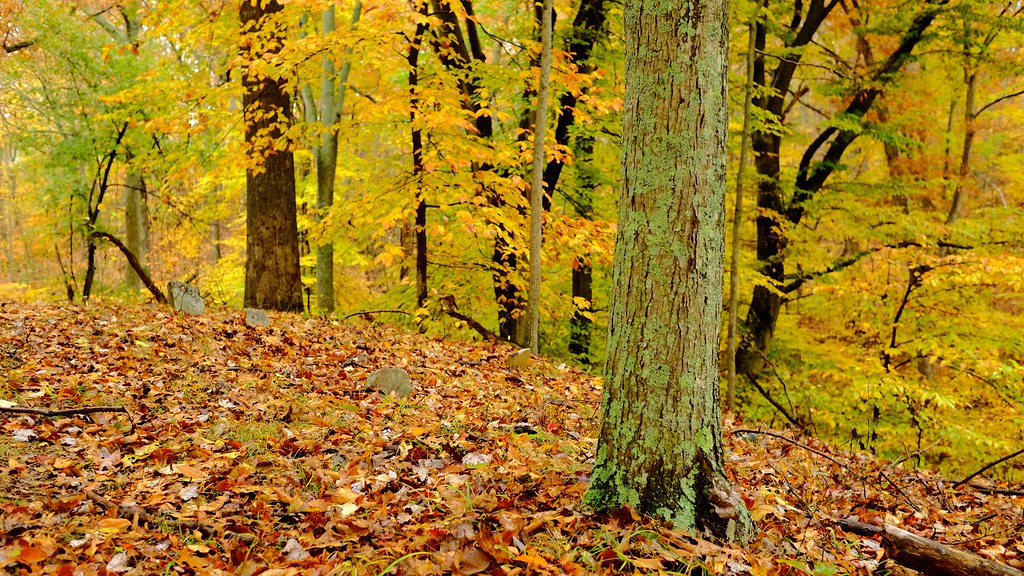
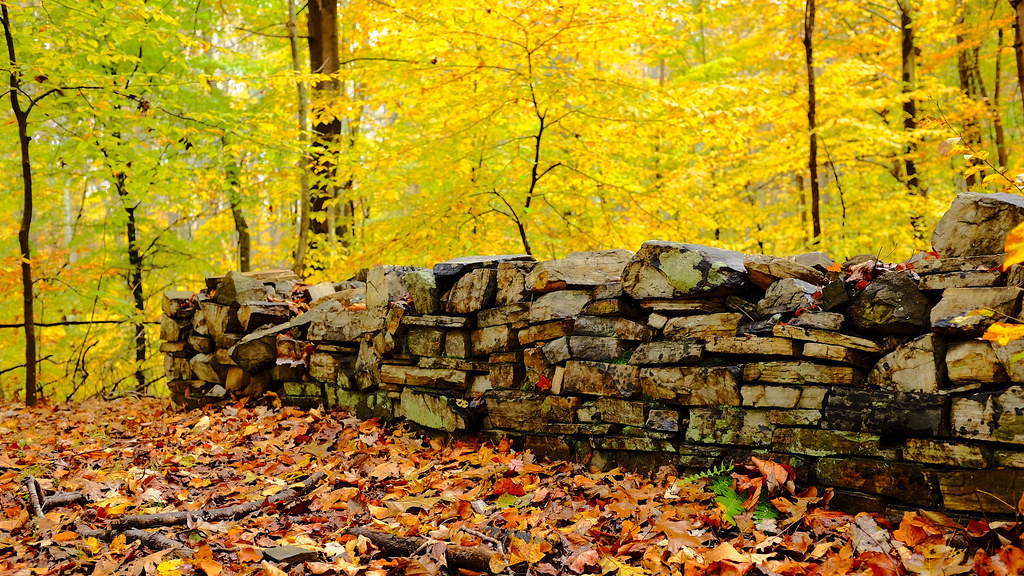
Autumn is, by far, my favorite season. Last year I made several pilgrimages to a couple of small, family plots located nearby on the flanks of Mother Leathercoat Mountain. I tried to time my visits to coincide with peak fall foliage. My first hike to the Dawson Family Cemetery was on an overcast morning after a heavy rain so colors were very saturated, (no pun intended.) Its location on the crest of a steep-sided spur allowed me to use the canopy of the trees in the valley below as a colorful backdrop. I think these are among the best cemetery photos I have taken recently.


Not far away, the Chapman Graveyard has much more elaborate gravestones reflecting their relative affluence. I love finding such picturesque little family plots hidden away back in the woods and thickets. These two are accessible because they are located on land owned by the Nature Conservancy. Unfortunately most are on private property.


A possibly interesting side note:

I was intrigued by your photo of Daniel O'Brien's gravestone thinking it might be somewhere across the Potomac since he served in a Maryland regiment during the Revolution. However, tracing him to NE Ohio, I was reminded of one of my own explorations of a branch of my family tree which took me to the nearby town of Ravenna, Ohio. Below is a photo I took many years ago of the imposing vault at the Maple Grove Cemetery which contains several generations of my ancestors. I have since learned that we were close kin to Lorenzo Carter, the first settler of what became Cleveland.

My branch - Erastus Carter - hacked their way through what was then a wilderness in 1804, a few years after Lorenzo. I found a great unpublished account of their adventures in the Portage County Historical Society's library. Just this evening I pulled out the old Carter family Bible which has been passed down to me along with my name. I had nearly forgotten it was in my possession and just how much family history it contains. Now I need to figure out how I'm going to copy all of the family record pages since they are way too big for my scanner.


Last edited:
An interesting discovery in one of Alexandria, Virginia's many beautiful cemeteries, Ivy Hill. I did not realize he spent the latter years of his life in this area.


Back
Top Bottom