I had the same problem with my 250k balance potentiometer for my 2285 (RS02540120) but as for replacing a balance control with a volume control, as suggested earlier in this thread, it simply won’t work. The reason is that the volume control has a log (Audio Taper) whereas the balance pot has a MN taper which is linear and resistive for only 50% of the carbon track while the other 50% is purely conductive (zero Ohm) with no resistance. The two channels are reversed so when one channel is in the resistive zone then the other channel is in zero Ohm zone and vice versa. Only at center both channels are at zero Ohm.
I tried DeOxit and FaderLube it but nothing worked. The carbon tracks were broken and worn. These pots were specially made by Alps for Marantz and are no longer available. There is no manufacturer today (Alps, Bournes, Alpha etc) who makes a dual pot replacement with the correct resistance, MN taper, distance between screw holes, length and form of the shaft etc. After almost half a year of looking for a replacement I couldn’t find anything from any donor on the used market. Also 250k Ohm is rare for Marantz 22xx series which doesn’t help.
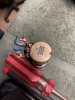
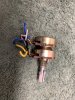
Finally I decided to rebuild my pot and after some research, I came up with the following idea: I bought LinqStat resistive plastic on eBay (they have sheets with different surface resistivity), cut a strip with length = half of total track length of the pot. Since surface resistance is proportional to the distance between two measuring points and inversely proportional to the width I had to find the proper width of the strip given the length. After some trial and error I cut the width of the strip resulting in total resistance between both short ends of the strip to equal 250k Ohm. It turns out that the width of the strip is very close to the original carbon track. After removing the carbon track, I glued this strip onto the previous location of the resistive part of the carbon track with epoxy. For the end of the strip I glued it onto the base of the lug with conductive glue. A better solution would probably be to use a new lug with a rivet through the plastic. For the non-resistive part of the track I used 1/8” wide and 1 mil thick 3M copper foil with conductive adhesive backing. The result is a pot with a smoother glide and probably less noisy (due to the conductive plastic) than the original and the taper is almost spot on. I don’t know how wear resistant the conductive plastic is nor the life length in cycles but for now it works extremely well. The good thing is that this is a linear balance pot which I rarely touch, it stays at center most of the time. One other benefit with this method is that any donor balance slide pot from the 22xx series can be rebuilt to any resistance since the form factor is the same for all models although the nominal resistance may differ. This procedure would have been quite more complicated for a volume control pot with an audio taper since that would mean merging pieces of plastic sheet with different conductivity and cut to curved shapes in order to match an audio taper.