• The move to the new server is done. There are some software and database maintenance updates in process. This has us passing the hat around to help out. We appreciate any donations. Seriously, even a dollar helps. The payment page may be found here - https://www.audiokarma.org/support.html

Harman Kardon Citation I - To Mod or Not To Mod?

To mod... or not to mod?


  • Total voters
    17

thr33p4c

AK Subscriber
Subscriber
Fate has blessed me with two Harmon Kardon Citation I tube preamps. One was beautifully built but also "well loved." The other was drastically modified over the years and is missing a lot of original parts.

The "well loved" unit had a pretty messed up face plate, broken balance pot, replacement Stereo and Phasing switches, 2 replacement tube sockets, etc, etc. I used the modded unit as a donor to bring the first one back to stock. I rebuilt the power supply and replaced all of the aging capacitors in the phono and line stages. Overall the restoration came out beautifully... but now I am stuck with a dilapidated donor unit and am struggling with deciding how to proceed.

Parts units are hard to come by and very expensive. I have the guts of a citation but am missing, knobs, pots, and tube sockets, and the face plate is trashed... I happen to have a handful of quality parts in my bins and am toying with the idea of a serious overhaul.

Here is my general idea:

Scope - Maintain the core phono and line stage circuits but eliminate unneeded controls to create the simplest signal path while using high quality modern parts to bring this unit into the 21st century.

1. Eliminate Turnover and Rolloff controls and simply hard wire the RIAA path for Phono 1 & 2
2. Eliminate RCA inputs for Tape HD, Cer Cartridge
3. Eliminate RCA tape output
4. Remove tape monitor switch and move tape input to selector switch
5. Remove contour circuitry and rewire the switch as a tone defeat
6. Replace all tube sockets
7. Replace volume control with a high quality stepped attenuator

Optional Ideas:
* Remove Center Channel and Phase Reversal circuitry - (Although I would like to keep the phase reversal feature for testing purposes)
* Add a relay circuit for power on delay and output cut at power off
* LED Indicators


Is what I am proposing complete blasphemy?

I will try to post some pictures of the donor unit tomorrow for reference.
 
Register to hide this ad
It is hard to determine the need to turn one of these into a project preamp with out some pictures.
I know that most would think they won a lottery if they obtained a Citation 1, so context is important.
Frankly, i firmly believe that many modern preamps exceed the performance of all vintage preamps.
So, even with your ambitious plans to do a comprehensive rebuild i don't think that rebuilding the original circuit minus some features will get you a preamp that would be competitive with a modern one. Of course, if you are looking at this as a project and challenge, then an overall impression of the final product is more important than just performance.
 
Jim McShane should have most of the parts you need to put your Citation 1 back to stock.

But if I had a second one (and I really like my rebuilt stock one), I’d be very tempted to try a hot Rodded version of the stock circuit, along the lines you suggest
 
Wow ! You do have some decisions to make. First and foremost, these units are yours and if you intend on keeping them, you have every right to rewire and customize as you wish. Of course, you also seem concerned with collectability. Surely, with Citation 1 prices always rising, even as we speak, you might want to stay on the "still considering" track for a while...

There is no blasphemy if you resto mod for your usage and enjoyment. If you also wonder about possibly selling your creation down the road, the value of the original Citation 1 functionality and versatility will be diminished. For a serious record collector, the variable Phono EQ choices and switchable controls have enormous value. If the original switches are still functioning, switching them out is a simple turn of the knob. Why would you want to remove the versatility if the sound quality can still sound fine ? Maybe, simply increasing the type and quality of the wiring to and from the switches will help you achieve better sonics.

Are the tube sockets flaky and causing noise problems ? Why automatic replacement ? Please do not expect newer Asian or Russian sockets to be any better. Older, USA made mil-spec sockets might be an upgrade, but, how about deciding that after you get this unit working ? Replacing the volume control might be an upgrade. That might also change sonic character. Again, can you get the unit working first with affordable parts ? If you only want RIAA phono EQ, how about upgrading only those EQ network parts first ? Simple hard-wiring now might not even sound better. Surely, down the road, you or the next owner will desire to audition some earlier than RIAA mono discs ? If you lose that cherished EQ switching now, it is forever lost. Forever is such a long time...

Rewiring some switches or sections of the switches for your particular needs is understandable. Bypassing them temporarily might divulge they were not so bad to begin with. Why would you remove the Tape Opts and Tape Head inputs ? The Tape opt is your easiest, direct path for an opt before the tone controls and line stages. Again, are the switches noisy or bad ? The Tape Hd. inputs could easily become a second Phono input or you can create another phono/low level EQ for your needs. Yes, I believe in restoring functionality first; then parts upgrading and resto modding later.

Do you have the original manuals, Sam's Photofacts and other lit ? Have you studied the actual EQ wiring while reading and rereading the schematic ? There is a lot of info to be gained concerning phono and tape playback curves, not to mention the knowledge gained while deciphering actual switch positions with schematic nomenclature. I would vote to get the second unit going first. You can change parts quality and parts types compared with the first restored example and then decide on your favorite sonic signatures. You can make a fascia later. It is almost already ready for the 21st century. It was designed by a legendary artisan with timeless record playing abilities....Whatever you decide, please enjoy your audio journeys....
 
Without a faceplate and knobs, and without a reasonable source of those parts I don't really see any problem with modding it. If you have the trashed faceplate around to use as a template, perhaps you can get something made up by Front Panel Express or someone to give you a finished look but without the deleted controls.
 
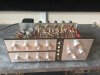
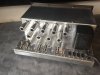
Guys, thank you so much for the thoughtful responses. Here are some pictures of the first restored unit using parts from the donor. This included:

From Donor Unit:
(2) AC Jacks
(2) Front Panel Switches
(2) Tube Sockets
Face Plate
Bottom cover feet
 

Attachments

  • IMG_4350.JPG
    IMG_4350.JPG
    81.4 KB · Views: 172
  • IMG_4351.JPG
    IMG_4351.JPG
    124.1 KB · Views: 173
  • IMG_4352.JPG
    IMG_4352.JPG
    77.9 KB · Views: 165
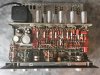
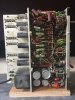
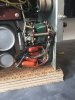
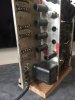
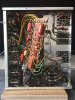
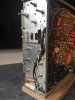
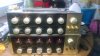
And here is the donor unit as it sits today:

Notice the following:
* Tube covers painted black
* Original volume pot replaced with home DIY stepped attenutator
* Original Turnover switch replaced and heavily modified
* Missing 2 AC jacks
* missing 2 tube sockets
* Original front panel switches have been re-purposed to swtich out some giant custom circuitry on a DIY peg board
* Mismatched caps throughout
* Balance pot replaced
* I forgot to mention above that I also needed the rotary power switch for the restored unit so that is missing too
* Face plate has very little writing left
* Missing knobs on all modified controls (Loudness, Balance, Turnover)

The way I see it I have 4 options:
1. Source original or equivalent parts and bring this back to stock with a nasty face plate
2. Resto-mod proposed above
3. Sell the unit as it sits
4. Disassemble and part out the remaining good parts.

As to my plans:

I live in a Manhattan apartment and unfortunately do not have the room to sustain a collection. I will be listening to the restored unit for a couple weeks then it will be posted for sale. If I really like how it performs, I would likely go the rest-mod route on the donor and keep that piece as my everyday preamp.
 

Attachments

  • IMG_4353.JPG
    IMG_4353.JPG
    70 KB · Views: 141
  • IMG_4354.JPG
    IMG_4354.JPG
    66.1 KB · Views: 133
  • IMG_4355.JPG
    IMG_4355.JPG
    63.8 KB · Views: 134
  • IMG_4356.JPG
    IMG_4356.JPG
    52 KB · Views: 131
  • IMG_4357.JPG
    IMG_4357.JPG
    79.3 KB · Views: 131
  • IMG_4358.JPG
    IMG_4358.JPG
    56.4 KB · Views: 129
  • IMG_4359.JPG
    IMG_4359.JPG
    82 KB · Views: 136
Wow... that first ones a real beaut. I'd be proud to own that one. The second. I'll echo what some else already pointed out. They belong to you and you should do what you want with it. I wouldn't hesitate if I had the skill and knowledge to mod it. Anxious to see where you take this.
 
Well, now that you posted pics and further described your dilemma, there is no doubt the vote casting will end up "pro-mod." Since the second unit is very unoriginal, returning it to original will become time consuming and could be very costly. Parts sourcing is not as easy as some would think, this decade. Twenty years ago, maybe the units were still easily sourced....

If you truly adore the sound of your lovely restored example, maybe returning the second unit to semi-stock could become an option. When "changed" or even old abandoned "as-is" units show up on my workbench, the first thought is "okay, this probably worked as it is wired, at some time in the past." Then, "bringing it back to life" begins. Looking at the changed second unit pics, someone took a whole lot of time and energy to modify it. The major effort in returning it to designer Hegeman's ideas probably seems almost overwhelming.

If it seems "complete" and is expected to work, perhaps it's worth a comparison listen with your original ? I always wondered why the designer used passive phono EQ, employed 12AT7s and was concerned why the Cit. 1 did not have high enough gain with my insensitive triode 2A3 theater amps. If I were in your situation, I might decide to investigate and resto-mod at will. Hegeman's predecessor unit, the all 12AX7 Lafayette KT-600, with active feedback phono EQ, was a major success. I did compare them, decades ago, including the simpler Cit. IV as a maybe, but only kept the KT-600 around. That Hegeman KT-600 design, is still somewhat of a reference IMHO...
 
I disagree. The faceplate and the chassis are in decent shape. The faceplate is one of the most important pieces in terms of appearance. And as long as you have the knobs, to me that is more than half of the battle. The chassis is also very much in play. While you may not be want to make the same circuit it is far easier to copy the original since you have already done that previous C1 rebuild. And since you have already rebuilt one, you may already have a good idea of where to implement some changes.
 
Last edited:
Hegeman's predecessor unit, the all 12AX7 Lafayette KT-600, with active feedback phono EQ, was a major success. I did compare them, decades ago, including the simpler Cit. IV as a maybe, but only kept the KT-600 around. That Hegeman KT-600 design, is still somewhat of a reference IMHO...

Is there any reference material that breaks down which designers worked on which pieces or is it just knowledge gained over the years? I would love to know more various designer's influences on the industry... Anyways, I wonder if Hegeman had any input on the Lafayette KT-630. I restored one of those a couple years back and was stunned by how good it sounded at the price point. It used 6BM8 Tubes with the pentode sections in push pull. The phono stage tubes were DC heated doubling as bias resistors. (to save money I guess). But talk about a double whammy.

Ill wait for a few more votes to come in but its looking neck in neck at the moment. I am leaning towards the following at the moment:

* Gut the unit completely, clean up all of the boards and rebuild it from scratch as if it were a kit fresh out of the box (I did this with my Heathkit W-5Ms and it was quite fun). That way I do not have to worry about reverse engineering the existing mods to figure out what the last tinkerer was trying to pull off. During the process, I would implement the mods discussed above.

If I go that route, I would likely replace all of the resistors. What is the go to resistor type for this type of undertaking? Also interested in recommendations for decent quality coaxial hookup wire in multiple colors. I used some nice silver plated teflon coated wire for my heathkits and liked working with it but this preamp has a lot of coax...
 
In response to some of the questions above. My reasoning for various modifications (Mostly influenced by the fact that I will likely be keeping this piece for personal use for many years)

1. Eliminate Turnover and Rolloff controls and simply hard wire the RIAA path for Phono 1 & 2
* I do not have a collection of older vinyl media and do not plan to start.

2. Eliminate RCA inputs for Tape HD, Cer Cartridge -
* I only have one turntable at the moment. I may get a second but could never see myself having a third. Thus, no need to maintain the Tape HD input.

3. Eliminate RCA tape output
* I am now reconsidering this one based on tubeactive's comments. I could see myself using the tape output if I ever use this piece as a dedicated tube phono stage.

4. Remove tape monitor switch
* Missing (2) original slider switches

5. Remove contour circuitry and rewire the switch as a tone defeat
* Fun experiment to simplify the signal path to see if there is a noticeable change in fidelity. I will need help determining the exact bypass point but its looking like going from the back side of coupling cap C23/75 to the grid of triode 1 of V4/V9

6. Replace all tube sockets
* Missing 2 original sockets. I suppose as an alternative I could consider sourcing NOS replacements and keep the existing sockets.

7. Replace volume control with a high quality stepped attenuator
* I have a very nice stepped attentuator sitting around that needs a home and the existing DIY attentuator is a mess (See images above).
 
I found this awesome post on a full citation rebuild following the kit instructions. This really has me motivated :)

Also cleared up some questions on sourcing shielded coax cable. One scary thing though. There is a huge warning about replacing tube sockets saying that because of the hole spacing and shield mounting they can only be sourced from old citation units. I scrounged two tube shields from my parts stash that matched the original citation shields exactly so I hope that the sockets are more common than this blogger is stating.

http://citationaudio.blogspot.com/2010/08/citation-i-refurb-final-assembly-part.html
 
I'd be surprised if those were anything other than common 9 pin shielded sockets. Unless there was a very specific reason for it, mfg rarely specified oddball parts like that just because it cost extra.
 
I would restore it to the original circuit with modern parts, maybe a motorized volume pot. and get the faceplate reconditioned.
I had a similar dilemma with one of my McIntosh C20's, in the end I can update it with modern parts, because it's collector value isn't there to worry about. Top is modded,bottom original. all of the faceplate and pointers are not stock.The end caps(not in photo)are copies made by a friend. The knobs came with the preamp
IMG_20160515_155224021.jpg
 
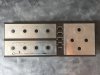
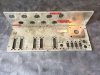
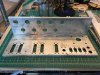
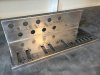
Well... I have decided to take this project to the next stage - Disassembly. I will likely be proceeding with a modified circuit but regardless of which path I take I am glad I decided to take this thing apart. The previous modifications were so intense and the parts/wire/chassis so dirty that the only way to do a decent restoration is a full rebuild. Here are some pics of the progress so far.

Nasty large bypass caps crowding power supply circuitry:
Power Supply.JPG

Back Plate Before:
Back Plate Before.JPG

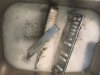
Soap & Water - At this stage, unfortunately I lost some of the "Citation I Made in USA Lettering" It looks like there was a stain there that must have been breaking down the lettering.
Soap & Water.JPG

Pre Polish.JPG

When polishing its always tough to balance the pressure to get the metal to look decent while saving the lettering. I am pretty happy overall but did lose some of the tube socket lettering during the polishing phase :(
After Polishing.JPG
 
Any updates? I would kill to have a face plate that looks that good. Lol mine was so bad I had to have it sandblasted to clean it up. I had to repaint the brown and the three face plates. None of which have lettering on them. Argh
 
Back
Top Bottom