• The move to the new server is done. There are some software and database maintenance updates in process. This has us passing the hat around to help out. We appreciate any donations. Seriously, even a dollar helps. The payment page may be found here - https://www.audiokarma.org/support.html

Harman Kardon HK770 Thread

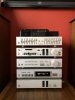
I had always wanted to own the 7 series but couldn't afford it back in the 80's.
I loved the look and the sound of my friends system.

A 770 popped up on Reverb for cheap and I bought it.
Spent some time in this site and others preparing for a refresh.
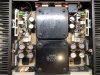
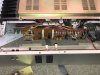
It appears people forget about the caps on the meter boards...

My 'have to have the entire line' sickness hit me hard.
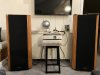
I did find a matching tape deck listed 'for parts' and purchased it as well.
It was a mess inside - the drawer transport cords were wrapped around the motors.

I recapped all of the units and cleaned up the glue and bad solder joints.

I also pulled my AR Remote Control out of storage (gave it a good refresh including the cap in the remote.)

One thing that bothers me about the tuner - if it is plugged in to the switched outlet of the pre - you lose your presets.
 

Attachments

  • IMG_1938.jpg
    IMG_1938.jpg
    144.2 KB · Views: 80
  • hk 770 meter board.jpg
    hk 770 meter board.jpg
    440.5 KB · Views: 82
  • hk Stack.jpeg
    hk Stack.jpeg
    86 KB · Views: 80
Last edited:
Just fired up my old HK 770 amp with my Infinity RS IIIb's today! I normally use a 250watt RMS Carver TFM-35 as these speakers are VERY power hungry. I'll be damned, but I almost think the HK 770 sounds BETTER than the Carver! From what I understand, the HK is a class AB amp that operates in class A mode for the first few watts. The Carver is either a Class H or Class G amp. The HK seems to have recessed highs while the Carver accentuates them more. Chris Bridge (Anatech) repaired the HK 770 for me and did a fantastic job, as always. Incidentally, he also repaired the TFM-35.
 

Attachments

  • 20220729_123225.jpg
    20220729_123225.jpg
    86.2 KB · Views: 47
  • 20220729_123247.jpg
    20220729_123247.jpg
    57.7 KB · Views: 46
  • 20220729_125801.jpg
    20220729_125801.jpg
    82.3 KB · Views: 48
Last edited:
Greetings Connor G et al.,

I recently acquired an HK770 whose power supplies have been completely recapped with what looks like the recommended Nichicon Gold 4700/50 and 2200/63. There's also a little recapping on the driver boards, and new one-turns for DC offset adjustment.

As yet, I've only hooked up the 770 to my (even older) HK-40 Stratophonics, and it satisfyingly kicks the hm out of them with a bit of Grace Jones. My whole lab rattles, so I'm not yet able to give the combination a real run for its money! I did, however, play some loud signal through it into a pair of 50W 8ohm resistors for several hours. This warmed up the 770 comfortably (~50C) while making the load's heat sink too hot to touch. A considerable bias mismatch (15mV R / 6mV L) explained a 10C difference in the heat sinks on either side. Note also how much lower this is than the manual's 24mV.

I'm finding that bias and offset settings are very touchy. Am I safe to replace the trim pots with multi-turn types (maybe 3 turns)?

I set the bias on both channels to ~18mV, and left the unit powered for a couple of days. When I looked again, both heat sinks are at an almost identical 40C (no load), *but* the bias has dropped to ~10mV on both sides! Is it likely that the bias trim pots could be to blame for this kind of drift?

Moreover, I'm noticing a fairly large difference in two transistors' bias on one side of the amp. I've measured TP6/TP4 at 17.5mV and TP6/TP5 at 22.8mV. More recently, TP6/TP4 = 13mV and TP6/TP5 = 19mV. I personally haven't had the unit (all) apart yet to examine the solder sides. I'm hoping the apparent transistor mismatch may be due to a dodgy/cold solder joint.

Does anyone have any ideas on the bias drift and the bias mismatch between two transistors on one side?

Regards,
Mike (The Plumber)
 
Last edited:
Greetings Connor G et al.,

I recently acquired an HK770 whose power supplies have been completely recapped with what looks like the recommended Nichicon Gold 4700/50 and 2200/63. There's also a little recapping on the driver boards, and new one-turns for DC offset adjustment.

As yet, I've only hooked up the 770 to my (even older) HK-40 Stratophonics, and it satisfyingly kicks the hm out of them with a bit of Grace Jones. My whole lab rattles, so I'm not yet able to give the combination a real run for its money! I did, however, play some loud signal through it into a pair of 50W 8ohm resistors for several hours. This warmed up the 770 comfortably (~50C) while making the load's heat sink too hot to touch. A considerable bias mismatch (15mV R / 6mV L) explained a 10C difference in the heat sinks on either side. Note also how much lower this is than the manual's 24mV.

I'm finding that bias and offset settings are very touchy. Am I safe to replace the trim pots with multi-turn types (maybe 3 turns)?

I set the bias on both channels to ~18mV, and left the unit powered for a couple of days. When I looked again, both heat sinks are at an almost identical 40C (no load), *but* the bias has dropped to ~10mV on both sides! Is it likely that the bias trim pots could be to blame for this kind of drift?

Moreover, I'm noticing a fairly large difference in two transistors' bias on one side of the amp. I've measured TP6/TP4 at 17.5mV and TP6/TP5 at 22.8mV. More recently, TP6/TP4 = 13mV and TP6/TP5 = 19mV. I personally haven't had the unit (all) apart yet to examine the solder sides. I'm hoping the apparent transistor mismatch may be due to a dodgy/cold solder joint.

Does anyone have any ideas on the bias drift and the bias mismatch between two transistors on one side?

Regards,
Mike (The Plumber)

Hi Mike,

First of all, congrats on the purchase! The 770 is certainly a special amplifier that flies way under the radar (or at least used to...)

Regarding the bias drifting: I've found this behavior only with units that had dodgy soldering and original single-turn bias trimmers. It could also be an issue with the pre drivers surprisingly. I've since started replacing all TO-92L predrivers in all of the 770's I work on (2SD666 & 2SB646 respectively).

A more common issue I see with the 770 is a wildly fluctuating DC offset, usually caused by the ultra temperature-sensitive dual fet packages on the inputs of each channel. The DC offset usually oscillates between +/- 10mV on a typical 770, but with a few units I've had through, fluctuated as much as +/- 25mV. Granted, 25mV offset on a DC amplifier is still very good in my book, there doesn't seem to be rhyme or reason as to why some examples fluctuate more than others.

You shouldn't have to replace the bias trimmers with multi-turn parts, as the bias adjustment is somewhat rough and doesn't need to be a fine adjustment. If there is substantial drifting taking place, and the original single-turn trimmers were replaced with new, I would look elsewhere for your issue.

Also, as for the differential in bias on the outputs, I wouldn't worry about it as it is pretty minor. HK biased this amp higher than need be from the factory, so a variation of ~5mV from one output to the other shouldn't be of issue. I've seen this behavior in many of the examples I've worked on, both before and after restoration. If the differential was greater, I would look into the issue further.

Start by inspecting all solder joints, especially on the hot-running driver cards. These cards easily slide out of place when removing two screws, the input connector, and the thermal tracking varistor. Another area that needs attention is the bottom sides of each main board. The biggest offenders here are the corrosive glue which can eat through traces and cause high resistance paths where they ought not to be, as well as bad soldering on the driver card connectors which are soldered to the main boards. You can see more on these issues here.

Good luck and enjoy! Let me know if I can help you any further :)
 
Last edited:
Just got these 2 from my audio tech

Very good preamp, the tech had problems with the muting relay so he bypassed, distortions numbers went down, better than the original specs
Is a really nice set up

View attachment 2618585 View attachment 2618586

I am going to test the HK725 against the best HK preamp the AP2500, all discrete circuit, the headphone too

View attachment 2618588
The muting relay in the hk725 is a common issue. I've chased my tail a few times trying to find issues and it almost always ended up being said relay. Nice AP2500.
 
I had always wanted to own the 7 series but couldn't afford it back in the 80's.
I loved the look and the sound of my friends system.

A 770 popped up on Reverb for cheap and I bought it.
Spent some time in this site and others preparing for a refresh.
It appears people forget about the caps on the meter boards...

My 'have to have the entire line' sickness hit me hard.
I did find a matching tape deck listed 'for parts' and purchased it as well.
It was a mess inside - the drawer transport cords were wrapped around the motors.

I recapped all of the units and cleaned up the glue and bad solder joints.

I also pulled my AR Remote Control out of storage (gave it a good refresh including the cap in the remote.)

One thing that bothers me about the tuner - if it is plugged in to the switched outlet of the pre - you lose your presets.
Nice work. The front VU and protection board is indeed an area that needs attention. There are a few very hot-running dropping resistors used on this board that almost always need replacement, or a reflow at minumum. I've found them hanging off of the board in some cases. Enjoy!
 
First of all, congrats on the purchase! The 770 is certainly a special amplifier that flies way under the radar (or at least used to...)
Thanks - You seem to be partly to blame for re-popularizing this interesting amplifier!
Regarding the bias drifting: I've found this behavior only with units that had dodgy soldering and original single-turn bias trimmers. It could also be an issue with the pre drivers surprisingly. I've since started replacing all TO-92L predrivers in all of the 770's I work on (2SD666 & 2SB646 respectively).
Do you mean Q419/Q421 and Q420/Q422? Coupled to the spindly driver board heat sink? That's a great tip, thanks.
A more common issue I see with the 770 is a wildly fluctuating DC offset, usually caused by the ultra temperature-sensitive dual fet packages on the inputs of each channel. The DC offset usually oscillates between +/- 10mV on a typical 770, but with a few units I've had through, fluctuated as much as +/- 25mV. Granted, 25mV offset on a DC amplifier is still very good in my book, there doesn't seem to be rhyme or reason as to why some examples fluctuate more than others..
Also interesting to read. I wonder whether it might be worth trying to clip small sinks to these? Do you know whether they run relatively hot? Have you tried to find a replacement for these paired devices?
You shouldn't have to replace the bias trimmers with multi-turn parts, as the bias adjustment is somewhat rough and doesn't need to be a fine adjustment. If there is substantial drifting taking place, and the original single-turn trimmers were replaced with new, I would look elsewhere for your issue.
Oddly, only the DC trim pots had been replaced. I'll definitely be replacing the bias ones.
Also, as for the differential in bias on the outputs, I wouldn't worry about it as it is pretty minor. HK biased this amp higher than need be from the factory, so a variation of ~5mV from one output to the other shouldn't be of issue. I've seen this behavior in many of the examples I've worked on, both before and after restoration. If the differential was greater, I would look into the issue further.
That's comforting. I don't think I'll be running it at 10mV, but I don't think I'll be running it as hot as the factory did. I see that the differential informs a kind of lower limit on bias setting. Although the effect might be difficult to measure, or hear.

I appreciate all the helpful info - and all your prior posts (and those of many others here). It's like having a 40-year multi-media addendum to the service manual.
 
Oh, and by the by... Has anyone tried their hand at simulating some or all of the HK770?
I've started collecting data sheets and looking for modern alternates of the transistor BOM that have SPICE models.
Some transistors in the original BOM already do have models, which is great.

I'm interested in the differences between the HK770 and the Silver SA5050.
On what are probably the same PCBs there are all kinds of subtle (looking) changes between the final schematics of both.
 
Regarding the bias drifting: I've found this behavior only with units that had dodgy soldering and original single-turn bias trimmers. It could also be an issue with the pre drivers surprisingly. I've since started replacing all TO-92L predrivers in all of the 770's I work on (2SD666 & 2SB646 respectively).
My mistake: I glossed over Q413/Q414 and Q415/Q416, the 2SD666 and 2SB646. From the manual, it looks like there's 44V from C to E, and ~28mA emitted. 1.2W seems a bit excessive, wot? Am I missing something? A huge base current?
 
My mistake: I glossed over Q413/Q414 and Q415/Q416, the 2SD666 and 2SB646. From the manual, it looks like there's 44V from C to E, and ~28mA emitted. 1.2W seems a bit excessive, wot? Am I missing something? A huge base current?
Hi, plumber. I just saw your replies now. Give me some time here to gather my thoughts and get back to you. But for now, your calculations do seem correct. The 770’s predriver / driver stage are biased into class A from memory. They run extremely hot. In many of the 770’s I’ve worked on, the board under the free standing TO-92L predrivers has been cooked well done. That’s why it’s a good idea to swap them for modern TO-92L equivalents.
 
I don’t have any of those tools, can you just turn a bit the adjust switch?

Hi Pablo, of course those adjustments are inside the case (and may be some work to get to - I haven't tried it myself) and of course you would be adjusting the innards of high voltage equipment, to which standard advice is, again of course... don't.
Having said that, you could in principle adjust the two meters to present equally without calibrating their absolute response. If it were me, I'd prefer to calibrate - otherwise, I'd just leave 'em off.
 
They run extremely hot. In many of the 770’s I’ve worked on, the board under the free standing TO-92L predrivers has been cooked well done. That’s why it’s a good idea to swap them for modern TO-92L equivalents.
That whole driver board runs hot. It's an interesting aspect of the design: 50V rails and very high bias for most of the driver board, 40V for the main output stage.
I have the beginnings of a working (ng)SPICE model for one channel of the amp, if anyone's interested. Replaced all the transistors for models from Bob Cordell, but the sim seems to work pretty well. Next I'm going to revert the modifications HK made for the 770 in order to simulate the SA5050, for comparison. The biggest difference is the addition of feedback from that same predriver stage, which is something I haven't seen before.
 
Hi Pablo, of course those adjustments are inside the case (and may be some work to get to - I haven't tried it myself) and of course you would be adjusting the innards of high voltage equipment, to which standard advice is, again of course... don't.
Having said that, you could in principle adjust the two meters to present equally without calibrating their absolute response. If it were me, I'd prefer to calibrate - otherwise, I'd just leave 'em off.

Can I adjust the switches with the amp off and see if there is any change is the display ? Thinking about just turning just one until they match
 
Can I adjust the switches with the amp off and see if there is any change is the display ? Thinking about just turning just one until they match
Sure, although you would still need to be careful: you still want to give the big filter caps time to discharge after turning the unit off (preferably, e.g. from a power bar's power switch, so that live AC isn't even reaching an open unit).
 
Connor was kind enough to rebuild my HK 770 & 725 a few months ago. While I was impressed with how they sounded when I received them back originally, they only continue to impress. I recently acquired a pair of immaculate Infinity Kappa 8’s, which I have wanted to have for 35 years! They have a reputation (supposedly) of being brutal on amps. I was a little reluctant to power them through the HK’s. I could not have been more wrong. The 770 drove them effortlessly, very punchy and with far less heat than the Adcom GFA5500 I was using initially! The 770 literally laughs at the load the Infinity’s present to them and sound great doing it . I am running these in a “nearfield” environment, not exactly what is the intended for the Kappa’s but they are setup for tight bass and good imaging at my listening position. I am only running @ <10 watt peaks but the 770 is never even approaches lukewarm status on the heatsinks. Just excellent performance and a rebuild worth every penny!

I work out of town a couple weeks a month and this is a very satisfying system to keep me entertained. While my listening space appears small, it is open to adjoining rooms that share the same irregular shape and angular ceilings. It is actually much more sonically appealing than presented. It definitely works with minimal tweaking. I am just amazed the HK’s can do what they do driving the Kappa’s.

I have also recently acquired a HK PA2400 which I think will perform even better after Connor’s rebuild 693B0C05-CCE8-4EBB-85F0-63EDA1376EA1.jpeg
 
Sorry if this is the wrong place to ask, but it seems like there are bunch of people quite knowledgeable about the 725/770 here.

The right channel on my 725 plays very low volume all the time regardless of input. It is unaffected by balance or volume control. Impossible to mute or raise the volume. It's the same on headphones connected to the 725 and speakers through the 770. The left channel plays fine and as you would expect.

Is there an obvious culprit/fix here?
 
Back
Top Bottom