

You are using an out of date browser. It may not display this or other websites correctly.
You should upgrade or use an alternative browser.
You should upgrade or use an alternative browser.
Heathkit Blues with AA-21 Amp
- Thread starter P90
- Start date

P90
Member
So I've heard, from 3 to around 7 for silicon. I just need someone with knowledge to look at the schematic and tell me which resistors and what values. I'm not confident that I could pull this off on my own. I would like nothing more than to replace all 8 output devices with silicon equivalents.It is possible to replace the germanium output transistors with silicon. Bias resistors must be changed to increase bias slightly.
All 8 are PNP - which strikes me as odd. And there are two different numbers. Four are 2N2147 and four are 34425.
If you care to look at the schematic and circuit description I posted them here:
https://we.tl/t-0P7GoVPSMx

If a genuine NTE121 matched pair is desired, you could go straight to NTE.
https://www.ntepartsdirect.com/ENG/PRODUCT/NTE121MP
https://www.ntepartsdirect.com/ENG/PRODUCT/NTE121MP
P90
Member
So on to my next discovery. The AA-21 has trim pots for every input. I never thought these would go south, but as I stared to do signal tracing, I found that 3 of the pots are bad. One is a 2K trim pot on one channel (won't drop below 375 ohms), and the other two are 50k trim pots for L&R magnetic phono (both completely open). Are these things prone to fail? Anyway, replacing these will tap into some of my creative skills because Heathkit manufactured them as modules that mount to the front panel with metal tabs. I think I'll call the factory and complain...oh, wait.
Anyway, I look at this as a great learning opportunity so I'm having fun overcoming the problems.
Anyway, I look at this as a great learning opportunity so I'm having fun overcoming the problems.

fred soop
Super Member
The earlier power transistors were germanium PNP. When silicon power transistors came along, they were NPN. Later, PNP silicon complements became available.
As for resistor values to change bias, this would probably need to be approximated then values adjusted for proper bias.
As for resistor values to change bias, this would probably need to be approximated then values adjusted for proper bias.
P90
Member
So progress has been made. Still in the germanium world...but
I was able to determine that the power amp sections of both channels are working.
Using a function generator connected to both channels with a 1k sine wave and the mode set to mono, an *extremely* weak signal reaches the output of one channel. So weak that it sounds like what one would associate with crosstalk. Setting to stereo makes no difference.
Any type of gentle tap on the chassis results in loud static pops.
I am guessing that some solder joint(s) or a wrong connection in the preamp and front panel controls may be the issue.
I was able to determine that the power amp sections of both channels are working.
Using a function generator connected to both channels with a 1k sine wave and the mode set to mono, an *extremely* weak signal reaches the output of one channel. So weak that it sounds like what one would associate with crosstalk. Setting to stereo makes no difference.
Any type of gentle tap on the chassis results in loud static pops.
I am guessing that some solder joint(s) or a wrong connection in the preamp and front panel controls may be the issue.
P90
Member
In the power supply rectifier, the ac voltage from ground to each of the power transformer's secondary coils measures correctly at 24v AC.
However, immediately after passing through the rectifier, the voltage should be 35v DC but it's only measuring 27. That's a significant difference. Are the diodes bad?
These are the (new) original 1N2860 silicon diodes that came with the kit.
However, immediately after passing through the rectifier, the voltage should be 35v DC but it's only measuring 27. That's a significant difference. Are the diodes bad?
These are the (new) original 1N2860 silicon diodes that came with the kit.
P90
Member
Well, it's working, and it sounds sweet. Got through all of the hurdles and learned quite a bit in the process. I still have to replace a noisy transistor on one of the preamp boards, and I will be experimenting with some output transistors to achieve a better match. Thanks to everyone who contributed to my journey.
I consider this my little lab/educational experiment, so I may convert it to silicon at some point. If I run into more issues I'll be sure to post here.
Next up will be either the matching tuner kit, or maybe the AA-100 or Dynaco Stereo 70, or PAS 3x, or Hafler 101. Then there's the Audio Research Dual 51, and Marantz 103. Or the beast - the Mesa Baron. Oh, maybe one of two 1960's Bassman amps. Or the Luxman R117. All require either restoration or repair. I'm having a tough time deciding. Any suggestions?
Cheers
Gene
I consider this my little lab/educational experiment, so I may convert it to silicon at some point. If I run into more issues I'll be sure to post here.
Next up will be either the matching tuner kit, or maybe the AA-100 or Dynaco Stereo 70, or PAS 3x, or Hafler 101. Then there's the Audio Research Dual 51, and Marantz 103. Or the beast - the Mesa Baron. Oh, maybe one of two 1960's Bassman amps. Or the Luxman R117. All require either restoration or repair. I'm having a tough time deciding. Any suggestions?
Cheers
Gene
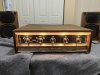

P90
Member
Beautiful! On my AA-21 there is a mix of both clear and frosted lamps above the pots. Which is original?
Nice wood cabinet too. Mine is a metal cabinet.
Thanks..
All the bulbs are frosted. I just put some Howard Feed-N-Wax on on the cabinet. It's really beautiful. It was a labor of love to get working. I'm so happy. It was worth all the effort.
I have the matching tuner that I will be assembling soon. I'll post a photo when it's done.

Doug G.
Lunatic Member
As a long-time Heathkit fan, this is a great thread and I',m glad you got the AA-21 working. I use AR-29s, AA-29s. AJ-29 and AA-2010s in my quadraphonic system and stereos in other rooms.
The AA-21 actually has a special place for me, too, because that and the matching tuner were in the music room system during my 7th grade class in 1965-66. There were wall-mounted speakers and our teacher let us bring our 45s and play them on that system. I was assigned to actually play the records because the teacher didn't want just anybody doing it and chancing damage to the Dual turntable.
I can still remember Joann Shatek singing along to "Get Off of My Cloud".
And, I just want to mention that an old multimeter and a VTVM are very different. The multimeter is OK for measuring things where the load doesn't really matter but you want a VTVM where the load does matter. A modern DMM is closer to a VTVM than it is to a regular multimeter.
Hmm, I tried to upload a picture from my 1971 class book of an instructor working on an AA-21 for the camera but I get an error. I'll try later.
Doug
The AA-21 actually has a special place for me, too, because that and the matching tuner were in the music room system during my 7th grade class in 1965-66. There were wall-mounted speakers and our teacher let us bring our 45s and play them on that system. I was assigned to actually play the records because the teacher didn't want just anybody doing it and chancing damage to the Dual turntable.
I can still remember Joann Shatek singing along to "Get Off of My Cloud".
And, I just want to mention that an old multimeter and a VTVM are very different. The multimeter is OK for measuring things where the load doesn't really matter but you want a VTVM where the load does matter. A modern DMM is closer to a VTVM than it is to a regular multimeter.
Hmm, I tried to upload a picture from my 1971 class book of an instructor working on an AA-21 for the camera but I get an error. I'll try later.
Doug
P90
Member
As a long-time Heathkit fan, this is a great thread and I',m glad you got the AA-21 working. I use AR-29s, AA-29s. AJ-29 and AA-2010s in my quadraphonic system and stereos in other rooms.
The AA-21 actually has a special place for me, too, because that and the matching tuner were in the music room system during my 7th grade class in 1965-66. There were wall-mounted speakers and our teacher let us bring our 45s and play them on that system. I was assigned to actually play the records because the teacher didn't want just anybody doing it and chancing damage to the Dual turntable.
I can still remember Joann Shatek singing along to "Get Off of My Cloud".
And, I just want to mention that an old multimeter and a VTVM are very different. The multimeter is OK for measuring things where the load doesn't really matter but you want a VTVM where the load does matter. A modern DMM is closer to a VTVM than it is to a regular multimeter.
Hmm, I tried to upload a picture from my 1971 class book of an instructor working on an AA-21 for the camera but I get an error. I'll try later.
Doug
Doug - thanks for sharing that. I had a similar experience. I heard what I believe was this amplifier in 1968 at the home of an engineer that worked for a radio station where my dad was the news director at the time. It was the first time I'd ever experienced listening to hi-fi and it completely fascinated me. I was astounded that such realistic sound was even possible.
Acquiring this kit was a dream come true. Building it was on my bucket list.
There's still some tweaking left to do. When I engage the loudness, one channel is quite noticeably louder than the other. And the original output transistors aren't as closely matched as they once were, so I may experiment with new ones as well.
- Gene

The lighting is really unique - looks great, love the font on the emblem too. That is beautiful.
(I have a few Heathkits here to try to fix up someday including an IG-18. One is an AA-14 which has silicon NPN and germanium PNP's and made the Heathkit of the Month list in the Orange County Amateur Radio Club: https://www.w6ze.org/Heathkit/Heathkit_Index.html#hotm) << I think that article is really cool. I don't see an AA-21 H.O.M. yet.
(I have a few Heathkits here to try to fix up someday including an IG-18. One is an AA-14 which has silicon NPN and germanium PNP's and made the Heathkit of the Month list in the Orange County Amateur Radio Club: https://www.w6ze.org/Heathkit/Heathkit_Index.html#hotm) << I think that article is really cool. I don't see an AA-21 H.O.M. yet.
P90
Member
Actually, the AA-14 was the first and only other Heathkit I've built, when I was just a kid. I ended up trading it for a Lafayette KT630 tube amp, that I wish I still had. I lived in Cleveland at the time and there was a Lafayette store nearby.The lighting is really unique - looks great, love the font on the emblem too. That is beautiful.
(I have a few Heathkits here to try to fix up someday including an IG-18. One is an AA-14 which has silicon NPN and germanium PNP's and made the Heathkit of the Month list in the Orange County Amateur Radio Club: https://www.w6ze.org/Heathkit/Heathkit_Index.html#hotm) << I think that article is really cool. I don't see an AA-21 H.O.M. yet.
Doug G.
Lunatic Member
If the AA-21 doesn't epitomize early sixties styling, nothing does.
There were a couple of earlier Heathkit amplifiers I yearned for, of the which the AA-14 was one but never got. Instead, I was "forced" to build a tube amplifier from scratch following a published schematic. I still wish I could have gotten one of the Heathkits.
I have written elsewhere that I seriously considered completely disassembling one of my AA-2010 quad amps, including removing all components from boards, so I could experience building a Heathkit again but ultimately decided against it because I didn't want to risk damaging circuit traces/lands on the boards. I settled for completely checking it out and replacing parts needing it.
Doug
There were a couple of earlier Heathkit amplifiers I yearned for, of the which the AA-14 was one but never got. Instead, I was "forced" to build a tube amplifier from scratch following a published schematic. I still wish I could have gotten one of the Heathkits.
I have written elsewhere that I seriously considered completely disassembling one of my AA-2010 quad amps, including removing all components from boards, so I could experience building a Heathkit again but ultimately decided against it because I didn't want to risk damaging circuit traces/lands on the boards. I settled for completely checking it out and replacing parts needing it.
Doug
P90
Member
When I acquired my unopened AA-21 kit back in 2014, I sought out the designer of the amplifier. Unfortunately, he passed away just one month before I purchased the kit. He was quite brilliant.
https://eng.umd.edu/ihof/c-frank-wheatley-jr
The thought just occurred to me...I wonder if it actually came from Wheatley's estate.
https://eng.umd.edu/ihof/c-frank-wheatley-jr
The thought just occurred to me...I wonder if it actually came from Wheatley's estate.
Last edited:
Very interesting.
You guys probably know but Heathkits had some influence on Steve Jobs' thinking as a young person. Who knows, maybe Heathkits changed the world.
http://rtoham.com/articles/steve-jobs-and-heathkit/
You guys probably know but Heathkits had some influence on Steve Jobs' thinking as a young person. Who knows, maybe Heathkits changed the world.
http://rtoham.com/articles/steve-jobs-and-heathkit/
P90
Member
Just now listening to Steely Dan's "Two Against Nature" and Tommy Emmanuel's "Mountains of Illinois" on this amp through a set of Phase Tech PC-40's.
OMG this this little amp sounds so AMAZING! Super tight bass. Instruments are clearly distinguished from one another, and pinpoint imaging. I can hear details in the recordings that I didn't notice before.
I want to add more heat sinking though as the outputs are getting hot. I hear that germanium's have a way of expressing their anger in the most inappropriate manner - by shorting and taking out everything behind them. Don't want that.
OMG this this little amp sounds so AMAZING! Super tight bass. Instruments are clearly distinguished from one another, and pinpoint imaging. I can hear details in the recordings that I didn't notice before.
I want to add more heat sinking though as the outputs are getting hot. I hear that germanium's have a way of expressing their anger in the most inappropriate manner - by shorting and taking out everything behind them. Don't want that.