• Please note that Audiokarma will be offline briefly for updates early on Monday morning, September 28th.

Heathkit Preamplifier Model WA-P2 Power Supply – What are you using?

... Might also consider changing the load from a resistor to a constant current type. Won't matter all that much really but its a bit more like what it will actually be dealing with.
I like the constant current source idea. Since each preamp will draw 10mA or slightly less, I would use 20mA load if you are building for two preamps.

I would also recommend adding a pair of zener diodes to the output to limit the DC voltage at startup before the tubes warm up. e.g. 1N5385 + 1N5385 in series.
 
Last edited:
I like the constant current source idea. Since each preamp will draw 10mA or slightly less, I would use 20mA load if you are building for two preamps.

I would also recommend adding a pair of zener diodes to the output to limit the DC voltage at startup before the tubes warm up. e.g. 1N5385 + 1N5385 in series.
Whoops, I totally missed that part of gadgets response. Thanks for highlighting it and thank you for the advice on the diodes for a warm up.
I really wish I could figure out a way to use the ez80 but I get error codes and a decent drop in voltage.

I'll need to play around in PSUD2 again. Once I ticked constant current my numbers were all over the place.

Thanks guys
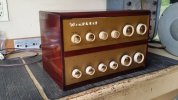
BTW these beauties showed up yesterday
ieg5j1U.jpeg
 
...Thanks guys
BTW these beauties showed up yesterday..
That looks like a nice set of WA-P2. The one on top is an early version. It may have a 300V maximum voltage rating on the quad capacitor instead of the 350V rating of the later versions. It also appears to be missing the top cover. In my experience the top cover is important for shielding / reducing hum.
 
That looks like a nice set of WA-P2. The one on top is an early version. It may have a 300V maximum voltage rating on the quad capacitor instead of the 350V rating of the later versions. It also appears to be missing the top cover. In my experience the top cover is important for shielding / reducing hum.
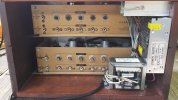
I just took the top cover off to see what I had to work with. I'm replacing the caps, might be a few days though. I think that the constant audio projects is starting to drive the wife crazy.

Tomorrow I'll try to fix my PSU design and I'll share it again.
Just out of curiosity, is there a rectifier tube that you guys would recommend. I'm not opposed to a SS rectifier but I appreciate the slow start up (and it's a built in dummy light!)
 
6X4 = EZ80

There are sometimes concerned mentioned about H-K shorts on these. I dont know how often it happens but you can always use something more overkill like a 6CA4 / EZ81. That one doesn't really have a reputation for internal failures.

If you just want the time delay, solid state diodes fed into a 6AX4 will do it. Thats a half wave damper diode. it would give the slow warmup of a tube rectifier but not actually be serving as a tube rectifier. Only special reason for using one over the other options is they are cheap and I happen to find octal sockets less annoying to wire than 7 or 9 pin.
 
I just used off the shelf parts (e-pay) for my stereo unit. The pre amps are basically rack-mounted and will slide out the front for adjustment/service.

It is quiet, but not my favorite pre. Don't forget the mods to the hum-balance. The filaments are now DC, so it is not needed.
 

Attachments

  • 20190525_142810.jpg
    20190525_142810.jpg
    92.5 KB · Views: 19
  • 20200718_161630.jpg
    20200718_161630.jpg
    86.9 KB · Views: 19
Last edited:
Phlogiston,

That sure is a good looking cabinet. I like it. :thumbsup:

Did you rewire the filaments for 12V operation?
 
Here's what I came up with. allows me to use some ez80's I have lying around. I also have small fuses I can add to the AC pins just for added protection.
Hopefully this will do, is it bad to have such a high resistor value right away? normally you don't see that, but normally you build with something better suited!
Not ideal, but it's what I have on hand.
4wfhxV7.png
 
If I was going to do that, I would stick a 5 - 10H choke where R2 is. Since you need so little current and you can afford relatively high resistance, that choke could be physically small. You could probably up the values of C2 and C3 (but you might get higher B+). It might be fine just as it is. Your gonna need 6.3V @ 600ma. for the filament. if that is easy to provide, the tube will work great.
 
If I was going to do that, I would stick a 5 - 10H choke where R2 is. Since you need so little current and you can afford relatively high resistance, that choke could be physically small. You could probably up the values of C2 and C3 (but you might get higher B+). It might be fine just as it is. Your gonna need 6.3V @ 600ma. for the filament. if that is easy to provide, the tube will work great.
The 6.3 is rated for either 3 or 4 amps and I believe each preamp only needs 1 amp. I should double check, but the dynaco fm3 that this came from has an insane amount of tubes. I want to say there are 10.

You mentioned 12v DC heaters which would be great, I'm just not sure I'll do it right away

*Edited
 
If my calculations are correct, I need a resistor that can handle at least 7.4 watts. Do I need to actually find the correct ohms to get me to 300, or can I use any value (let's say 1k) and see if the dummy load holds at the correct voltage that gets calculated in PSUD2.
 
Last edited:
If my calculations are correct, I need a resistor that can handle at least 7.4 watts. Do I need to actually find the correct ohms to get me to 300, or can I use any value (let's say 1k) and see if the dummy load holds at the correct voltage that gets calculated in PSUD2.
The final B+ voltage is not that critical. The Heathkit manual specifies 300V or 320V depending on where you look. I prefer 320V since that is what is shown in the voltage chart and it gives the phono stage a little more to work with. In my experience, the actual B+ current draw is a little less than 10mA.

The 6.3V supply should draw 0.9A per channel which is the expected sum of the three tubes specified current draw with 6.3V applied.
 
The final B+ voltage is not that critical. The Heathkit manual specifies 300V or 320V depending on where you look. I prefer 320V since that is what is shown in the voltage chart and it gives the phono stage a little more to work with. In my experience, the actual B+ current draw is a little less than 10mA.

The 6.3V supply should draw 0.9A per channel which is the expected sum of the three tubes specified current draw with 6.3V applied.
The only reason I ask is that without a load I was at 370v (please didn't crucify me, I shut it off as soon as it leveled off and I was on a dim bulb tester).
But this is without a load present. I'm half tempted to just run them both and cross my fingers. If I rises much over 320v I can just shut it down and go back to the drawing board.
However I think that I'm pretty close. If I put an insanely low load in the program, i end up with around 385.

I think I'll give it a go

Edit: I looked into the owners manual of the general radio 1201-b (has been recommended before for this very project) and it mentions 400vdc should be read at full load.
 
Last edited:
The only reason I ask is that without a load I was at 370v (please didn't crucify me, I shut it off as soon as it leveled off and I was on a dim bulb tester).
But this is without a load present. I'm half tempted to just run them both and cross my fingers. If I rises much over 320v I can just shut it down and go back to the drawing board.
However I think that I'm pretty close. If I put an insanely low load in the program, i end up with around 385.

I think I'll give it a go

...
When operating the WA-P2 there are two distinct power supply conditions:

1) When the preamp is first powered on there is essentially no load on the B+. With no B+ load the B+ voltage will rise to the 370VDC or higher. This higher voltage could cause problems if the capacitors cannot handle being over loaded.

2) Once the preamp has been on for 10 to 20 seconds the tubes will conduct and the B+ supply will settle to the safe value you simulated.

The issue is in the operating mode #1, the unloaded B+. One way to handle this is by using a pair of zener diodes in series as I suggested in post #21 above.
 
When operating the WA-P2 there are two distinct power supply conditions:

1) When the preamp is first powered on there is essentially no load on the B+. With no B+ load the B+ voltage will rise to the 370VDC or higher. This higher voltage could cause problems if the capacitors cannot handle being over loaded.

2) Once the preamp has been on for 10 to 20 seconds the tubes will conduct and the B+ supply will settle to the safe value you simulated.

The issue is in the operating mode #1, the unloaded B+. One way to handle this is by using a pair of zener diodes in series as I suggested in post #21 above.
Okay, that makes total sense. Sorry, I got too hung up on testing this. The caps will operate well above the 370.
Hoping I can test these out later tonight.
Thanks for the help, hopefully my dumb questions help somebody else down the road :biggrin:
 
If you want something a little more old school a string of neon bulbs will also get this done providing they dont see too much current.
 
Okay we are getting somewhere!
One preamp is holding steady at 327vdc. I imagine that will drop slightly once I get the other one hooked up.
They were both ready to go, but I let the magic smoke out of one. I had the input shorted, pretty sure it took out the first two caps in the filter. Won't know for sure until I take it apart.
Regardless, progress! I'm a little pissed about the mistake.

Edit: good news is that it wasn't anything I did, except for completely going over the whole build. Can't trust Heathkit builds if you didn't build them yourself!

2qGfdx5.jpeg


The red/white pair was underneath the hum pot and I believe it was shorting.
Good news is that I didn't have any tubes in on the first power up. Bad news is that the pot might be toast and I disassembled the power filter caps for no reason!

Oh well, I'll stop muddying up this thread. I'll post separately if I need anything. The other preamp is doing great. Thanks again everybody!
 
Last edited:
Back
Top Bottom