• Please note that Audiokarma will be offline briefly for updates early on Monday morning, September 28th.

Heathkit Preamplifier Model WA-P2 Power Supply – What are you using?

Okay we are getting somewhere!
One preamp is holding steady at 327vdc. I imagine that will drop slightly once I get the other one hooked up.
They were both ready to go, but I let the magic smoke out of one. I had the input shorted, pretty sure it took out the first two caps in the filter. Won't know for sure until I take it apart.
Regardless, progress! I'm a little pissed about the mistake.

Edit: good news is that it wasn't anything I did, except for completely going over the whole build. Can't trust Heathkit builds if you didn't build them yourself!

2qGfdx5.jpeg


The red/white pair was underneath the hum pot and I believe it was shorting.
Good news is that I didn't have any tubes in on the first power up. Bad news is that the pot might be toast and I disassembled the power filter caps for no reason!

Oh well, I'll stop muddying up this thread. I'll post separately if I need anything. The other preamp is doing great. Thanks again everybody!
I had a WA-P2 with a damaged hum pot. I was able to find a good, reasonable cost, replacement at Antique Electronic Supply. https://www.tubesandmore.com/products/potentiometer-100-linear-knurled-5w-wirewound-24mm

Also note: The 6.3V filament supply cannot be common to both preamps. i.e. each preamp must have its own separate winding. If not the two hum balance pots can fight each other and burn one or both. A common supply for the B+ is not a problem other than possible ground loops (unlikely).
 
I had a WA-P2 with a damaged hum pot. I was able to find a good, reasonable cost, replacement at Antique Electronic Supply. https://www.tubesandmore.com/products/potentiometer-100-linear-knurled-5w-wirewound-24mm

Also note: The 6.3V filament supply cannot be common to both preamps. i.e. each preamp must have its own separate winding. If not the two hum balance pots can fight each other and burn one or both. A common supply for the B+ is not a problem other than possible ground loops (unlikely).
Very interesting. So I can have the two preamps and the rectifier tube run to a shared terminal strip but I cannot daisy chain the octal sockets (at least for the heater)?

If that's the case, I totally fried it.
 
Very interesting. So I can have the two preamps and the rectifier tube run to a shared terminal strip but I cannot daisy chain the octal sockets (at least for the heater)?

If that's the case, I totally fried it.
Sorry, I did not clearly describe the problem. The problem only occurs if one is using the hum balance pots on both preamps. If you disconnect the ground (wiper) connection on one of the pots, you will be OK.

If one uses DC on the filaments and disconnects the ground connection on the hum balance pots you will be OK.
 
Sorry, I did not clearly describe the problem. The problem only occurs if one is using the hum balance pots on both preamps. If you disconnect the ground (wiper) connection on one of the pots, you will be OK.

If one uses DC on the filaments and disconnects the ground connection on the hum balance pots you will be OK.
If I already have to lift the ground, can the second pot (in my case the fried one) just be bypassed completely? Can I just directly wire 1 and 2 to the corresponding wires?
If not, I'll get another pot ordered.

I assume that's the case as you mentioned earlier
 
Last edited:
Yes, if you lift the ground on one of the hum pots, that will eliminate the shorting problem, assuming that there is no other shorting problem in the rest of the circuit. That being said, the hum pot remaining most likely will only provide the best hum null to one of the preamps. If you get lucky, the one hum pot will provide minimal hum to both preamps. If you are not so lucky, one preamp will be hum optimized and the other not. Try it and see what results you get.
 
Yes, if you lift the ground on one of the hum pots, that will eliminate the shorting problem, assuming that there is no other shorting problem in the rest of the circuit. That being said, the hum pot remaining most likely will only provide the best hum null to one of the preamps. If you get lucky, the one hum pot will provide minimal hum to both preamps. If you are not so lucky, one preamp will be hum optimized and the other not. Try it and see what results you get.
I ended up buying the schottkey diodes, caps and converter you listed in your last revision. I was tickled pink that the 300vdc worked out but I'm having numerous issues with the AC heater. Even if I can get the ground issue figured out, DC seems like a better end goal considering 2 preamps are sharing a single power supply.
I'll make sure to lift the other ground from the hum pot when I go to test
 
Yes, if you lift the ground on one of the hum pots, that will eliminate the shorting problem, assuming that there is no other shorting problem in the rest of the circuit. That being said, the hum pot remaining most likely will only provide the best hum null to one of the preamps. If you get lucky, the one hum pot will provide minimal hum to both preamps. If you are not so lucky, one preamp will be hum optimized and the other not. Try it and see what results you get.
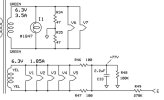
In your last revision, is the LED a necessity? Or did you just want a dummy light? And just to be clear, no actual ground to the chassis for the 6.3vac to DC section right?
 
In the last revision, post #9, R13 and the LED1 are not necessary. The LED illuminates to indicate when power is on.

The schematic does not show a ground connection for the DC filament supply, however; the pin 1 should either be grounded or tied to the junction of R10 / R11 (preferred). Important: disconnect the ground connection from the hum pots on the preamplifiers chassis.
 
Last edited:
In the last revision, post #9, R13 and the LED1 are not necessary. The LED illuminates to indicate when power is on.

The schematic does not show a ground connection for the DC filament supply, however; the pin 1 should either be grounded or tied to the junction of R10 / R11 (preferred). Important: disconnect the ground connection from the hum pots on the preamplifiers chassis.
Okay, thanks for clearing that up.
I've been busy with the family but I'm very close to finishing this but I am stuck when it comes to the 6.3DC conversion.
With the DC limiter having a limit of 3A, I can definitely make it work. But I'm stubborn and like the idea of a slow tube startup.
Before I change my mind and switch to diodes for rectification, I currently have two options. Parallel the AC feed for the rectifier tube (ez80 also takes 6.3vac) and the AC to DC supply.
I could also run the rectifier tube and the other preamps off the 6.3DC but my only hesitation is that it would need to be ran in parallel since the rectifier runs off 600ma and the other preamps can be ran in series because all the tubes are 300ma.

I guess I'm not sure how many amps may be lost when converting from AC to DC. My transformer is 4a at 6.3vac. if I'll still have 3a after converting to DC than I think I'm good to go.

If not, I'll either run the rectifier off AC and the preamps off DC. If that doesn't work, then I'm going to have to move to diodes for rectification
 
Okay, thanks for clearing that up.
I've been busy with the family but I'm very close to finishing this but I am stuck when it comes to the 6.3DC conversion.
With the DC limiter having a limit of 3A, I can definitely make it work. But I'm stubborn and like the idea of a slow tube startup.
Before I change my mind and switch to diodes for rectification, I currently have two options. Parallel the AC feed for the rectifier tube (ez80 also takes 6.3vac) and the AC to DC supply.
I could also run the rectifier tube and the other preamps off the 6.3DC but my only hesitation is that it would need to be ran in parallel since the rectifier runs off 600ma and the other preamps can be ran in series because all the tubes are 300ma.

I guess I'm not sure how many amps may be lost when converting from AC to DC. My transformer is 4a at 6.3vac. if I'll still have 3a after converting to DC than I think I'm good to go.

If not, I'll either run the rectifier off AC and the preamps off DC. If that doesn't work, then I'm going to have to move to diodes for rectification
I recommend running the rectifier off AC and the preamp tubes off DC. I would not try to run the rectifier off the output of the DC to DC converter that is also powering the audio tubes. The best case would be to run the rectifier tube off its own dedicated 6.3vac supply.
 
I recommend running the rectifier off AC and the preamp tubes off DC. I would not try to run the rectifier off the output of the DC to DC converter that is also powering the audio tubes. The best case would be to run the rectifier tube off its own dedicated 6.3vac supply.
I'm going to try to parallel the 6.3vac, to the rectifier and the AC to DC bridge. If that's problemsom for any reason, I'll probably move to diodes.

I really appreciate the time you've taken to answer my questions. At this point I'm just down to trial and error. I enjoy the idea of doing something different but it gets to the point that it isn't worth the time it or money saved!!

To be honest, I still don't know how these sound! But I absolutely love the idea of taking a common preamp and making it useful again. I think that we all hate seeing this stuff end up in the dump.
 
Yes, if you lift the ground on one of the hum pots, that will eliminate the shorting problem, assuming that there is no other shorting problem in the rest of the circuit. That being said, the hum pot remaining most likely will only provide the best hum null to one of the preamps.

None of my amps or preamps have a hum pot, but I elevate the filaments. They're all dead quiet. That's what I would do in a case like this also.

Jack
 
Honestly a pair of resistors is as effective as a hum pot in most cases and they are more reliable.
My 36W Marshall clone uses multiple cascaded 12AX7s in the front end. More gain even than a phono pre, and it's absolutely quiet with no hum pots. All the filaments ahead of the two output tubes are elevated to approximately +75V.
 
Last edited:
I recently built some amplifiers where I used a hum pot, but I tied the center tap, to the cathode connection of the cathode bias, push pull output stage.
The hum pot can be twisted fully either direction with no audible hum in any position.
I think they call that "wearing suspenders and a belt"
Once you learn all the little tricks to shut up a humming amplifier, you tend to implement them on every build, every time so that you don't have to go back in and change things once it's built.
"Suspenders and a belt"
 
...
To be honest, I still don't know how these sound! But I absolutely love the idea of taking a common preamp and making it useful again. I think that we all hate seeing this stuff end up in the dump.
These preamps can sound very very good when properly set up. There is a trick to obtaining the best performance from your WA-P2 preamps. The trick is explained in a very well written review in the June 1956 issue of Audiocraft magazine starting on page 26. It is well worth the read. You can find the magazine here: https://worldradiohistory.com/Archive-All-Audio/Archive-Audiocraft/Audiocraft-1956-06.pdf
 
Hobby took the backseat, we were beat down with nasty weather this week.
nePOGzc.jpeg


Pretty happy camper here.
I need to double check my b+, but this is holding steady. Rectifier is ran off AC. I just need to give her a skirt and I can finally listen to these preamps that I recapped a month ago
 
Back
Top Bottom