• The move to the new server is done. There are some software and database maintenance updates in process. This has us passing the hat around to help out. We appreciate any donations. Seriously, even a dollar helps. The payment page may be found here - https://www.audiokarma.org/support.html

Help ID'ing Capacitors in Beomaster 3000-2 (2402)?

Johnny_Law

o.O
Subscriber
I am pretty sure these are tantalum capacitors ... but this is my first rodeo with caps in this packaging with this coloring so I wanted to make sure.

They are not marked with either values or polarity. (I can find both via the schematic, but that's not my question here.)

(I replaced little green tantalums in here already, but those were marked with value and polarity.)

So - are these tantalum? Or something else?

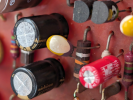
Purple bottom / yellow top with white dot:
1714958585029.png

Black bottom, orange top, black dot:

1714958647660.png

Pink bottom, red top, white dot:

1714958678901.png

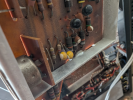
Black bottom, yellow top, white dot, and in the background pink bottom, then black in the middle, with brown top & white dot:
1714958708066.png

Thanks!
 
Register to hide this ad
Try this: http://www.csgnetwork.com/capcctantcalc.html

I think the yellow/purple/white dot would be 47x0.1 = 4.7uF. If the bottom color is grey, it should be 25V.
Orange/Black dot/black bottom with no extra band 30uF/10V???
The red/pink/white dot....can you see if the coating looks like the red is in two parts...i.e. 2/2/pink/white dot? If so, I'd decode it as 2.2uF/35V

Guess the same question could apply for the orange, thus making it 33uF/10V.

None of these help with polarity, but if the small value ones are correct (can you pull and measure?) just replace with film and not worry about it, or leave them in place. Alternatively, follow the traces to a known polarity component.

Edited for bad math in public. :rflmao:
 
Last edited:
They look to be. Do you have a cap checker to see if they measure in spec and as a capacitor? There are some little cylinders that could be mistaken for electrolytic caps that are actually inductors, but I don't know of any tear-drop shaped components other than tantalum caps.
 
Should be able to test them to confirm value. Tantalums usually don't go bad unless they get too much voltage. At that point they blow up but I'd be surprised if they have drifted by enough to not be able to figure out what they are.

What is this? The parts look like old US stuff. Honestly I'd be slightly more concerned about all those carbon resistors than the tantalum caps.
 
Should be able to test them to confirm value. Tantalums usually don't go bad unless they get too much voltage. At that point they blow up but I'd be surprised if they have drifted by enough to not be able to figure out what they are.

What is this? The parts look like old US stuff. Honestly I'd be slightly more concerned about all those carbon resistors than the tantalum caps.

It's a B&O Beomaster 3000-2. Made in Denmark.

The 3000-2 is a really pretty piece, which made it into a MoMa exhibit in 2014: https://www.moma.org/collection/works/1842
 
Back
Top Bottom