• Please note that Audiokarma will be offline briefly for updates early on Monday morning, September 28th.

Here It Is: The All Singing All Dancing HTMCPS

If you have the old PCB and earlier BOM use 200k resistors instead of the 75k, 2.2uf caps instead of the 1.5ufs this gives improved bass extension and 470ohm resistors instead of the 390ohms which gives a "little" less gain in the second stage.

Hi Hypnotoad,

I took your advice from the SSP thread and replaced 100uF caps with 47uF and I am getting less opamp noise. At least this is true for LME49990 used in HTMCPS.

I've also replaced the 10uF from CNC to 47uF caps as well, with not much benefit. The CNC was already quiet equipped with 10uF and the 47uF caps are as quiet.

Anyway, I will try out the 470 ohm resistors replacing the 390's once I receive them.
 
Anyone try this with a DL-110 HOMC yet? Deciding between this and the CNC build. See what I mean here: http://www.audiokarma.org/forums/showthread.php?t=256704 (specifically http://www.audiokarma.org/forums/showpost.php?p=3101877&postcount=7). Originally only wanted to build one but maybe I need to build both to see for myself?!

The HTMCPS is optimized for the gain of the cart and uses the carts internal resistance to accomplish this, therefore the need to instal the correct resistors.

You can check out when someone on HiFi Vision tested his DL-110 on the CNC and HTMCPS:

http://www.hifivision.com/phono-turntables/24051-diy-moving-coil-phonostage-12.html#post347623
 
Here's a spec for DL-110:

Type: Moving coil (MC)
Output: 1.6mV Compatible with MM inputs
Channel Balance: 1dB Max. (1kHz)
Channel Separation: 25 dB Min. (1 kHz)
Output Impedance: 160 ohms
Suggested Loading: 47K ohms
Stylus: 0.1 x 0.2 mm special elliptical solid diamond
Cantilever: Aluminum
Frequency Range: 20 Hz to 45 kHz
Tracking Force: 1.8g ± 0.3g (1.5~2.1g)
Compliance 8 x 10⁻⁶ cm/dyne
Weight: 4.8g

Based on the calculator, you need 160 Ohm for R1/R2 & 750 Ohm for R2/R10.
 
I tested DL-110 with CNC and HTMCPS. Apart from slight difference in gain (CNC at 10'0 position and HTMCPS at 9'0 position) sound same. BTW I did not get chance to replace 49990 from CNC into HTMCPS. While same cartridge was used (i.e. Denon DL-110), CNC (w/ 49990) sounded cleaner than HTMCPS (w/ 2134). Next time I set both of them with 49990 and test again. May be I like 49990 more than 2134 and its not problem with HTMCPS. This point need more attention.
 
Last edited:
Other than the 49990 is anyone rolling other ICs? May be interested in getting a few extras with my order. I think I'm going to have to end up trying both projects anyway.
 
Other than the 49990 is anyone rolling other ICs? May be interested in getting a few extras with my order. I think I'm going to have to end up trying both projects anyway.

I have tries Ad-823,Opa-2134 and LME 49990 all with good results.My preference would be
1. LME 49990(great details,good bass,better imaging,no harshness)
2. OPA2134(great bass,but too laid back)
3. AD823(Forward sounding,low bass compared with both the above Opamps,high frequencies sometimes sound little shrill)

One Lenco heaven member having good results with LM833 in CNC,and since its cheap I ordered 2 pairs for CNC.Here is the LH review http://www.lencoheaven.net/forum/index.php?topic=9021.15

Regards,
Sachin
 
Did you work out why the battery was getting hot?

No idea why the battery was getting hot, but I am pretty sure that it was user error, ie me connecting the batteries incorrectly. Anyway, I fired her up this morning and was greeted with stereo sound finally!

Unfortunately I'm getting a lot of noise, but I don't blame the pre. I'm in Chula Vista, CA, which is within close vicinity of a broadcast tower in Tijuana, Mexico. The tower serves all of San Diego county. My HTMCPS is currently in skeleton form -- caseless, sitting in my Panavise stand and all wires are unshielded, so I'm pretty certain the noise I'm hearing is due to me being so close to the tower. Once I get everything properly shielded and cased up, I'm sure the noise will go away.

Despite the noise, the sound I heard was VERY good, and can only expect it to improve as things break in and the noise is addressed. :thmbsp:

Also, I did some switching among my opamps and found a combo that minimized the amount of DC I saw at input, now at .2mv.

Straight edge micro screw driver works well to pry the chip and lift up. When I am rolling opamps for testing, I use another bracket on top of the soldered bracket and this allows better grip and lift the whole bracket with ease. It takes less than 5 sec to replace both opamps. :)

Thanks for the tip on stacking the brackets! Those bracket legs are much sturdier than the opamp ones.
 
Unfortunately I'm getting a lot of noise, but I don't blame the pre. I'm in Chula Vista, CA, which is within close vicinity of a broadcast tower in Tijuana, Mexico. The tower serves all of San Diego county. My HTMCPS is currently in skeleton form -- caseless, sitting in my Panavise stand and all wires are unshielded, so I'm pretty certain the noise I'm hearing is due to me being so close to the tower. Once I get everything properly shielded and cased up, I'm sure the noise will go away.

Despite the noise, the sound I heard was VERY good, and can only expect it to improve as things break in and the noise is addressed. :thmbsp:


If RF pickup is still there after it's in a grounded case then you can try putting some capacitors across the inputs, 47pf - 200pf polypropylene's should be fine as it may be from the turntable leads acting as antennae. They won't affect the sound as MC carts are pretty much immune to the effects of capacitance.
 
I have built this phono. Thanks to Sachin for the printed circuit board. I have a problem with it. I have very low gain when used with my cartridge which is a hybrid ie: a cross between a moving coil and a moving magnet. It is a Pickering XLZ7500. It has a resistance of 3R and an output of 0.33mV. The value of R1/R9 is 3R and that of R2/R10 68R. I am at a loss to understand why this phono and cartridge combination does not output appropriate gain. The volume of my amp must be fully up and then the sound is noisy sshhh and low. I do not understand why it will not work satisfactorily. The cartridge presents a voltage output, just as a moving coil cartridge does. The cartridge also has an impedance, just as a moving coil cartridge has. To my mind it should work.
Has anybody else tried this combination and what were their results?
Any help in resolving my problem here would be gratefully appreciated.
Incidentally I have played around with the gain of the first stage by trying various different values of resistance in the feedback loop, but to no avail.
Regards Paul.
 
I have built this phono. Thanks to Sachin for the printed circuit board. I have a problem with it. I have very low gain when used with my cartridge which is a hybrid ie: a cross between a moving coil and a moving magnet. It is a Pickering XLZ7500. It has a resistance of 3R and an output of 0.33mV. The value of R1/R9 is 3R and that of R2/R10 68R. I am at a loss to understand why this phono and cartridge combination does not output appropriate gain. The volume of my amp must be fully up and then the sound is noisy sshhh and low. I do not understand why it will not work satisfactorily. The cartridge presents a voltage output, just as a moving coil cartridge does. The cartridge also has an impedance, just as a moving coil cartridge has. To my mind it should work.
Has anybody else tried this combination and what were their results?
Any help in resolving my problem here would be gratefully appreciated.
Incidentally I have played around with the gain of the first stage by trying various different values of resistance in the feedback loop, but to no avail.
Regards Paul.

This cart will not work with the HTMCPS as it's a low output MM design not MC.

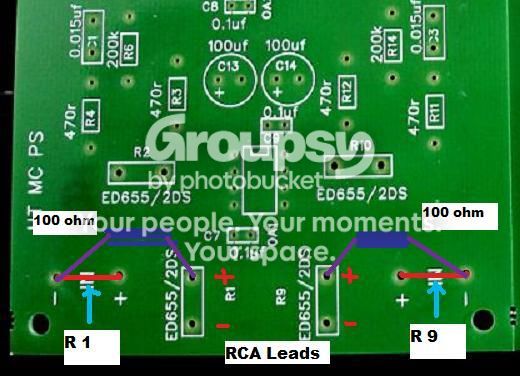
Thinking out loud about this though, if you are using the terminal blocks for R1/R9, it might work if you were to remove resistors R1/R9 and remove the leads from the input RCA's. Connect the RCA input leads with the positive on the connection closest to the opamp positive input and the negative lead on the furthest connection.

Then place resistors R1/R9 between where the positive and negative RCA inputs used to be. You will need some resistors for impedance loading say 100ohms placed as shown, you can solder them to the underneath of the PCB.

HTMCPSConversion-1.jpg


You would be in effect converting into a regular preamp input instead of the transimpedance design. It should work fine but I can't guarantee how much noise you will get.

It should work fine in theory, but no guarantees. You will of course have an inverting design so it will be out of phase but there are a lot of preamps out there that do this, and people don't even notice it.
 
Last edited:
I have tries Ad-823,Opa-2134 and LME 49990 all with good results.My preference would be
1. LME 49990(great details,good bass,better imaging,no harshness)
2. OPA2134(great bass,but too laid back)
3. AD823(Forward sounding,low bass compared with both the above Opamps,high frequencies sometimes sound little shrill)

One Lenco heaven member having good results with LM833 in CNC,and since its cheap I ordered 2 pairs for CNC.Here is the LH review http://www.lencoheaven.net/forum/index.php?topic=9021.15

Regards,
Sachin

I just ordered 8 of those adapters for the LME 49990 of Ebay and will get some of the Op Amps to try out when they arrive thanks for the tip.

I will also pick up some LM833's to try out.
 
Does this phono stage work with MI carts also? I'm thinking of trying a Soundsmith at some point when my SAE 1000e needs re-tipping.
 
For those using batteries to drive HTMCPS, LME49990 may be a struggle for some. I have 10 SOIC socket adapters with LME49990 and two will refuse to run at at the input socket of HTMCPS. When this happens you can hear it. It either makes lots of crackle static while playing music or just will not produce sound at one of the channel. Adding more voltage helps but placing them in the output side socket is the best work around. This is with +/-10V with the load. Those using set of 9V batteries ,with about ~8V or less at the actual output may potentially experience more issues. When they don't sound right at the first try, just swap the adapters between input and output socket.
 
two will refuse to run at at the input socket of HTMCPS. When this happens you can hear it. It either makes lots of crackle static while playing music or just will not produce sound at one of the channel
This behaviour is also noticed by me but for 2134 while only for input side. That time battery was low. After swapping it with output side of same type, it worked till battery died. While it worked it was well balanced stereo. With new batteries it was never issue.
 
This cart will not work with the HTMCPS as it's a low output MM design not MC.

Thinking out loud about this though, if you are using the terminal blocks for R1/R9, it might work if you were to remove resistors R1/R9 and remove the leads from the input RCA's. Connect the RCA input leads with the positive on the connection closest to the opamp positive input and the negative lead on the furthest connection.

Then place resistors R1/R9 between where the positive and negative RCA inputs used to be. You will need some resistors for impedance loading say 100ohms placed as shown, you can solder them to the underneath of the PCB.

HTMCPSConversion-1.jpg


You would be in effect converting into a regular preamp input instead of the transimpedance design. It should work fine but I can't guarantee how much noise you will get.

It should work fine in theory, but no guarantees. You will of course have an inverting design so it will be out of phase but there are a lot of preamps out there that do this, and people don't even notice it.

Thank you for this. I tried it this afternoon. Gain was good, sound was good, but unfortunately the background shhhhh, as expected was too much. Anyway back to the drawing board. As it is a regular preamp now, could I reduce the gain of the first stage and then use this phono for a moving magnet cartridge? The input impedance would need to be changed too.
Most of the opamp phono circuits I have seen are not of an inverting design, so it could be quiet interesting, if feasible to see how this would compare to the more common non inverting designs.

Regards Paul.
 
Thank you for this. I tried it this afternoon. Gain was good, sound was good, but unfortunately the background shhhhh, as expected was too much. Anyway back to the drawing board. As it is a regular preamp now, could I reduce the gain of the first stage and then use this phono for a moving magnet cartridge? The input impedance would need to be changed too.
Most of the opamp phono circuits I have seen are not of an inverting design, so it could be quiet interesting, if feasible to see how this would compare to the more common non inverting designs.

Regards Paul.

That's what I figured, you would probably be better off building a CNC and keeping the HTMCPS in case you get a moving coil cart.

But if you want to use it as a regular MM stage increase the value of the 100ohm impedance resistors you put in, try the standard 47k for a start.

And as you figured you will have to decrease the gain a lot though.

You should try R2/R10 at 2k ohms, R1/R9 at 100ohms this would decrease the gain and noise of the first stage to around the correct MM levels.

This is for a regular MM cart and not the one you have.
 
Last edited:
That's what I figured, you would probably be better off building a CNC and keeping the HTMCPS in case you get a moving coil cart.

But if you want to use it as a regular MM stage increase the value of the 100ohm impedance resistors you put in, try the standard 47k for a start.

And as you figured you will have to decrease the gain a lot though.

You should try R2/R10 at 2k ohms, R1/R9 at 100ohms this would decrease the gain and noise of the first stage to around the correct MM levels.

This is for a regular MM cart and not the one you have.

Thank you again, yes I have built the CNC, but I am just curious to see how the HTMCPS would sound with a regular MM cartridge. It would be no problem to reverse it back to a MC cartridge phono, if I ever get a moving coil.
I will let you know the sonic results when I have changed the components you mentioned.

Regards Paul.
 
Back
Top Bottom