• The move to the new server is done. There are some software and database maintenance updates in process. This has us passing the hat around to help out. We appreciate any donations. Seriously, even a dollar helps. The payment page may be found here - https://www.audiokarma.org/support.html

HH Scott 222 (a) selector switch problem

pantoramasan

AK Subscriber
Subscriber
HH Scott 222 (a) selector switch problem? or maybe something else?

Unit fires up normally. However, when in stereo mode only one channel works: When in mono balance “A” mode, sound ok out of speaker: When in balance mono “B” mode, sound ok out of speaker: Monophonic Records mode, both speakers function: In Stereo mode only channel “B” speaker works. When in reverse stereo mode, both speakers function: Channel “A” mode, no speaker function: Channel “B” mode, channel B speaker ok, functions. So anyone have an idea what is causing this?? Once again I reach out to the AK community.

I have googled and researched and could not find anything on this malfunction or where to look on the unit.

Thanks in advance for any assistance you may provide.
 
Register to hide this ad
Assuming your unit is built correctly, your excellent details of the symptoms provide a strong clue:

1. The circuits FROM (and therefore after) the MODE switch (not selector switch) are good, since it will ultimately send a signal (of some kind) to the line, tone, and power amp sections of both channels to be heard in both speakers. All of these circuits appear AFTER the mode switch, and since each speaker CAN produce sound independently, it means that these circuits must be good .

2. The other huge clue is that the signal from both channels is making it from the selector switch TO the MODE switch, since both channels play in REVERSE stereo mode. However, it needs to be verified that both channels in fact operate INDEPENDENTLY (as they should) in this mode, but are simply reversed as the setting implies. Check by supplying a source signal to only one channel at a time in this mode, to make sure that only the (reversed) speaker plays when the appropriate input is connected. If this is true, then it means that the signal for both channels is in fact making it TO the mode switch from the selector switch.

3. If everything above is true as stated, then the problem must be localized at the Mode Switch -- either the switch itself, or its wiring.

I hope this helps!

Dave
 
Have you cleaned the mode switch? Every Scott that I've owned has benefitted enormously from DeOxiting it switches (including resolving some of the symptoms you describe).
 
Assuming your unit is built correctly, your excellent details of the symptoms provide a strong clue:

1. The circuits FROM (and therefore after) the MODE switch (not selector switch) are good, since it will ultimately send a signal (of some kind) to the line, tone, and power amp sections of both channels to be heard in both speakers. All of these circuits appear AFTER the mode switch, and since each speaker CAN produce sound independently, it means that these circuits must be good .

2. The other huge clue is that the signal from both channels is making it from the selector switch TO the MODE switch, since both channels play in REVERSE stereo mode. However, it needs to be verified that both channels in fact operate INDEPENDENTLY (as they should) in this mode, but are simply reversed as the setting implies. Check by supplying a source signal to only one channel at a time in this mode, to make sure that only the (reversed) speaker plays when the appropriate input is connected. If this is true, then it means that the signal for both channels is in fact making it TO the mode switch from the selector switch.

3. If everything above is true as stated, then the problem must be localized at the Mode Switch -- either the switch itself, or its wiring.

I hope this helps!

Dave

Thanks for breaking that down for me. Now I have a way to test. Much appreciated.
 
Have you cleaned the mode switch? Every Scott that I've owned has benefitted enormously from DeOxiting it switches (including resolving some of the symptoms you describe).

I actually had to blow out the switches with air due to the previous owner drenching the the switches with deoxit. Initially I thought that to be the problem.
 
Hmmm . . are you sure here drenched them with "DeOxit"? DeOxit usually dries out very quickly no matter how drenched it is. After 24 hours a switch should be dry as a bone. Maybe he used something else?
 
I'm not really sure if it was DeOxit he used. I will ask though. I do have DeOxit, Green and Red. I have not used any. I did however spray them with "Electrosolve" Contact cleaner to try and clean them off. Even still, the masonite wafer, or whatever it is called, around the switch is still showing saturation. Whatever he put on it was not the right stuff I guess. Good think I don't have too much $$ in this unit. Otherwise though it is in near perfect original condition with the unique cover.
 
Assuming your unit is built correctly, your excellent details of the symptoms provide a strong clue:

1. The circuits FROM (and therefore after) the MODE switch (not selector switch) are good, since it will ultimately send a signal (of some kind) to the line, tone, and power amp sections of both channels to be heard in both speakers. All of these circuits appear AFTER the mode switch, and since each speaker CAN produce sound independently, it means that these circuits must be good .

2. The other huge clue is that the signal from both channels is making it from the selector switch TO the MODE switch, since both channels play in REVERSE stereo mode. However, it needs to be verified that both channels in fact operate INDEPENDENTLY (as they should) in this mode, but are simply reversed as the setting implies. Check by supplying a source signal to only one channel at a time in this mode, to make sure that only the (reversed) speaker plays when the appropriate input is connected. If this is true, then it means that the signal for both channels is in fact making it TO the mode switch from the selector switch.

3. If everything above is true as stated, then the problem must be localized at the Mode Switch -- either the switch itself, or its wiring.

I hope this helps!

Dave

Evidently I was mistaken in my previous test: Hope you can decipher my test results.

Independently checked "each" channel with only one speaker connected to the amp at a time, And again with both speakers connected A & B

Channel "A" test

Bal. A=ok
Bal. B=no
Monophonic=ok
Stereo=ok
Reverse=ok
Channel A=no
Channel B=ok

Channel "B" test

Bal. A=no
Bal. B=ok
Monophonic=ok
Stereo=ok
Reverse=no
Channel A=no
Channel B=ok

Combined Channel A & B test

Bal. A=both ok
Bal. B=both ok
Monophonic=both ok
Stereo= B speaker only
Reverse= A speaker only
Channel A=none, no sound
Channel B=Both Ok
 
Last edited:
Pan -- If you will, please try it again, but always leave the speakers in both channels connected. It's the source that you should connect only one channel at a time while you run the mode switch through its different settings. So you'll be running the mode switch through its various settings three times: Once with just a left input connected, once with just a right input connected, and once with both inputs connected. With each test, let us know which speaker(s) play in each setting of the switch.

Dave
 
Thanks Dave,
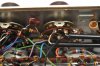
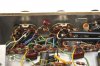
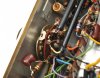
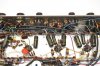
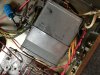
Some photos of the switch and area. I can remove the top aluminum plate if necessary for more pics.
 

Attachments

  • DSC_0261.JPG
    DSC_0261.JPG
    79.1 KB · Views: 21
  • DSC_0262.JPG
    DSC_0262.JPG
    86.1 KB · Views: 20
  • DSC_0266.JPG
    DSC_0266.JPG
    74.7 KB · Views: 18
  • DSC_0267.JPG
    DSC_0267.JPG
    121.5 KB · Views: 19
  • DSC_0263.JPG
    DSC_0263.JPG
    113 KB · Views: 19
Ok, The results of the test is as follows:

Channel "A" connected only: No sound in any position.

Channel "B Connected only: Bal.A=ok, Bal.B=ok, Monophonic=Both Spkrs work, Stereo=B only, Reverse= A only, Channel A=None, Channel B=Both spkrs work.

A & B connected: Bal.A=A only, Bal.B=B only, Monophonic=Both spkrs work, Stereo= B only, Reverse= A only, Channel A=none, Channel B= Both Spkrs. work
 
Great job! So now we know that the input into Channel A is not making it out of the Mode switch. To help isolate things further, make sure that when using other inputs, the same thing occurs: Inputs into channel A are not playing when selected to.

Look at your mode switch. The 100K resistor (brown-black-yellow-silver) shunted by a 180 pF cap is the path that the signal takes to get FROM the input selector switch, TO the mode switch. There are two of these networks (one for each channel), the one plainly visible, and one below it (in your pic) which is well hidden (it is actually high up under the rear cover for the front panel).

I don't know which is which channel wise, but I would start your hunt in the area of these networks. Look for either a loose connection, short, or something that appears not to be normal. In any event, your problem will most likely be found in this area.

Good luck with it!

Dave
 
No, Not yet. But I did check all the solder joints, wiring etc. And all looks good. Did not find any cracks etc. But now I gave up for a short time as one of my Dynaco Mk III's developed a loud hum. I will need to figure that one out ASAP. It is one of my four that I am running. Temporarily replaced it with my spare Fisher 80 AZ. Too many project, too little time.
Hope you enjoyed your Holiday!
 
Sure did, thanks. I understand the too many projects problem. It might be worth reflowing the solder in the areas Dave identifies, and measuring the resistors for any significant differences.

Has your Dynaco Mk III had all the high voltage electrolytic filter caps replaced? It looks the 20 + 20 + 30 + 20 are all in one can. If not, they would be prime suspects. Also, are your two KT88s a matched pair in this amp?
 
Sure did, thanks. I understand the too many projects problem. It might be worth reflowing the solder in the areas Dave identifies, and measuring the resistors for any significant differences.

Has your Dynaco Mk III had all the high voltage electrolytic filter caps replaced? It looks the 20 + 20 + 30 + 20 are all in one can. If not, they would be prime suspects. Also, are your two KT88s a matched pair in this amp?
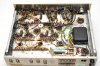
The Dynaco has had only a couple of caps replaced. But otherwise 100% original. I assumed it may be caps. So that will be the next step. Here are a couple of images of the guts. I believe the large oil cap would need to be replaced. Correct?
 

Attachments

  • IMG_1482.jpg
    IMG_1482.jpg
    113.6 KB · Views: 12
  • IMG_1483.jpg
    IMG_1483.jpg
    116.8 KB · Views: 11
No, those big oil filled caps are usually reliable in my experience. I think you should suspect the multisection can cap mounted above.

And probably replace the tubular caps on the top of the PCB, if they are still original.
 
Thanks. I will locate a new can cap and yes, the tubular caps on the PCB are original. I will look for those as well. Would it be wise to change out the entire board? There are new replacements sold on eBay for $55.00. Plug and play.
 
Probably. I don't know this amp personally. Your board looks pretty crispy, so that might be worth doing, but you could just replace the caps. Dynakit parts (e.g.) have a bias kit and a 30,20,20,20 can (550V looks better than 525V), plus the metalized polyprop parts for the board. I don't know what that 4uf oil filled can is doing (in the bias circuit?)! I'd remove it, unless this is a well-known mod.

If you think you might replace the whole board, I suggest asking for recommendations in a new thread.
 
Back
Top Bottom