• The move to the new server is done. There are some software and database maintenance updates in process. This has us passing the hat around to help out. We appreciate any donations. Seriously, even a dollar helps. The payment page may be found here - https://www.audiokarma.org/support.html

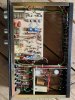
Hi Guys! Want To See A Mess?

I never understood bypass caps. the math on parallel caps is easy; C1+C2+C3=Ctotal. You are changing the value of the equivalent capacitor. What do they think they are improving?

The classic argument for bypass caps.....that I am aware of.....says that electrolytics have too much impedance at very high frequencies and adding film bypass caps lowers overall impedance at those frequencies.

The argument against bypass caps.....that I am aware of.....says that (by introducing a tiny amount of inductance) the leads of bypass caps can create resonances at very high frequencies that more than negate any potential benefits. It might not happen in every case, but would require sophisticated testing abilities to know for certain yes or no. It is beyond the scope of my knowledge to defend this argument. But have read some very convincing posts over at DIYaudio.com (by Eva et. al.).

Also, Rod Elliot said not to use caps with long leads extending off the board, as was the case in subject piece of this thread.
 
Last edited:
So I replaced a few caps and tried it out, it does work in tuner and aux but there's
no left channel when I turn the bass control there a pop then it works, maybe more
cleaning needs to be done or other??
 
Likely a dirty bass pot, perhaps a cracked solder connection to it.

And no, capacitor networks are NOT simply adding the capacitance together, the math is somewhat more complicated than that. Simple addition of the values is close, but how far off depends on the actual circuit and values of the capacitors. I know, I flunked that part of electronics in my physics class.

And as noted, there are resonance and resistance effects that are very difficult to predict when adding "bypass capacitors". Any effects, positive or negative, should be clear on an oscilloscope. Ears are not a good measuring device for this sort of stuff, as most of what's of interest is beyond human hearing range.
 
I have a DH-101 sitting on the shelf here. Give me a few minutes and I’ll take some pics.

I think you did good with what you paid. The earlier Hafler preamps (DH-100, 101, 110) are going for more and more money these days.

I have a couple DH-100 that I really like. I haven’t touched my DH-101 yet.
 
Thank you elitopus so much, this is what I need, and early this morning I
found a hopefully like new DH-101 on ebay and went for it.
 
Last edited:
Glad I could help. So what are your plans for the modified DH-101 then?

So far when I get the other one, I'll see what else it will need. I have to say I also have a DH-100 and it doesn't
really match my amp it just play's to loud I can't even turn the volume up to 8 or 9 o'clock and it blast's the 101
I go up past 10 and it plays a nice volume so it these work out I'll most likely sell the DH-100.
 
I have a couple DH-100. One that I recapped and removed the muting circuit, and the other is stock. I use the first one in my main system driving some Ashly Mosfet amps. I usually setup the gain so I can turn the preamp up all the way and the amps will just barely flash the clip lights.

I want to recap my DH-101 and give a try. Also I’d like to get a DH-110 if I could find one for a decent price.
 
I was looking at the DH-110 but if anything like the output of the DH-100 it's not good for me, I played
it a bit this morning and once I set the bass control to 9:00 o'clock it plays really nice I just have to replace
the caps the modder took out and it should work good I hope.
 
The classic argument for bypass caps.....that I am aware of.....says that electrolytics have too much impedance at very high frequencies and adding film bypass caps lowers overall impedance at those frequencies.

The argument against bypass caps.....that I am aware of.....says that (by introducing a tiny amount of inductance) the leads of bypass caps can create resonances at very high frequencies that more than negate any potential benefits. It might not happen in every case, but would require sophisticated testing abilities to know for certain yes or no. It is beyond the scope of my knowledge to defend this argument. But have read some very convincing posts over at DIYaudio.com (by Eva et. al.).

Also, Rod Elliot said not to use caps with long leads extending off the board, as was the case in subject piece of this thread.


yup, this. The extra fraction of a microfarad isn't the goal at all, its the Z at high frequencies. Not a terrible idea if done cleanly, but using long leads and sloppy placement may do more harm than good. Also it looks bad and adds risk for parts falling off or shorting, none of which is good.
 
Hey, @tube-a-lou , there is an ever-growing collection of good info and pointers in this thread you've created about the DH-101... but the title doesn't contain that. For those of us who may search, by title, for help with our DH-101s, would you edit the thread title to include "DH-101" in there somewhere?
 
Last edited:
^That first thread is what I was going to use as a reference to work on mine. And AKer Bob helped me out on my DH-100 also. Really knowledgeable guy about Haflers.
 
Hey, @tube-a-lou , there is an ever-growing collection of good info and pointers in this thread you've created about the DH-101... but the title doesn't contain that. For those of us who may search, by title, for help with our DH-101s, would you edit the thread title to include "DH-101" in there somewhere?

Can't seem to do it, there's no way to change it sorry.


I think it is a good idea. Subscribers can edit thread titles, perhaps non-subscribers do not have that ability, I don't know.

But where there's a will...you could request that a mod do it. If you click the "Report" link at the bottom of your opening post a request could be made in the box that pops-up. If you want to that is.
 
Back
Top Bottom