• The move to the new server is done. There are some software and database maintenance updates in process. This has us passing the hat around to help out. We appreciate any donations. Seriously, even a dollar helps. The payment page may be found here - https://www.audiokarma.org/support.html

High compliance cartridge recommendations for jelco ts-350s arm? (Under 500 usd)

TrevorBarten

Well-Known Member
I just recently put together a turntable and though I initially had a shure m97x cartridge mounted I went back to a Stanton 681 eee due to some minor sonic issues with the m97x (had some trouble getting it adjusted so probably caused by that.) I really like the stanton 681 eee but I would like to have some other cartridges to play around with. I also wouldn't mind trying some modern cartridge but my main focus is bang for my buck so if vintage is a better deal I would much prefer vintage, even a new cartridge I would try to find secondhand. I really like cartridges with a brush, I know it has some supposedly audible downsides but the convenience is just something I'd rather not loose. The arm has an effective mass of 9.2 grams so I assume that would mean I need a high compliance cartridge though maybe medium compliance would still be ok? MM and MC would both be fine, though I am not aware of many high compliance mc cartridges.
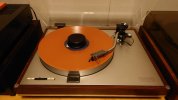
Current set up:DSC_2410.JPG
 
Register to hide this ad
The arm has an effective mass of 9.2 grams
I doubt that.
I estimate that that headshell alone is that weight. Have you weighed that headshell?
Your picture is very small but that headshell looks like a Jelco HS-25; 12,5 grams I believe. Sometimes I have the feeling Jelco specifies their arms without headshell

The purpose of those brushes is to dampen the resonance frequency if it falls outside the ideal bandwith.

Maybe it gives a good insight if you record some music (any type of music) with audacity (freeware, multiplatform) and do a spectral analysis to see what your current resonance frequency is.
 
I doubt that.
I estimate that that headshell alone is that weight. Have you weighed that headshell?
Your picture is very small but that headshell looks like a Jelco HS-25; 12,5 grams I believe. Sometimes I have the feeling Jelco specifies their arms without headshell

The purpose of those brushes is to dampen the resonance frequency if it falls outside the ideal bandwith.

Maybe it gives a good insight if you record some music (any type of music) with audacity (freeware, multiplatform) and do a spectral analysis to see what your current resonance frequency is.
I did not know this and honestly didn't really think about it as this is the headshell that was included when I purchased this tonearm. I just weighed the cartridge and headshell together and that came out to 21.15 grams so it seems you might be right as even best case scenario the effective mass of the arm would be more than 9 grams, worst case scenario If the total effective mass is around 24.20 grams (21.15-6.15 (googled specs for stanton 681 5.8 grams plus estimate of headshell wires) + 9.2) that would mean I would need something around medium to low compliance? I kinda bought this arm because of the low effective mass so that would be fairly annoying but ok I'll live. I guess I could get a lighter headshell, but I do not know how light you can go I would assume that around the 5-7 gram mark would be the minimum? I will do what you suggest tomorrow with the audacity recording. Could you perhaps specify exactly how that would work? I have never done it before. I have used audacity to record audio before but that's about it. I also do not have a dac, closest I can get is a laptop with a microphone input or a headphone amp, but that's the other way around.
 
Could you perhaps specify exactly how that would work? I have never done it before. I have used audacity to record audio before but that's about it. I also do not have a dac, closest I can get is a laptop with a microphone input or a headphone amp, but that's the other way around.
So you have to make a recording with a line in. A microphone won't work. Some modern higher end laptops have a 3,5mm jack that can sense what kind of 3,5mm plug is inserted and when it's a stereo plug it asks if it's a headphone or line in. Most other laptops have a combo jack but that is purely suited for a headset. So a microphone plus headphones, no line in.

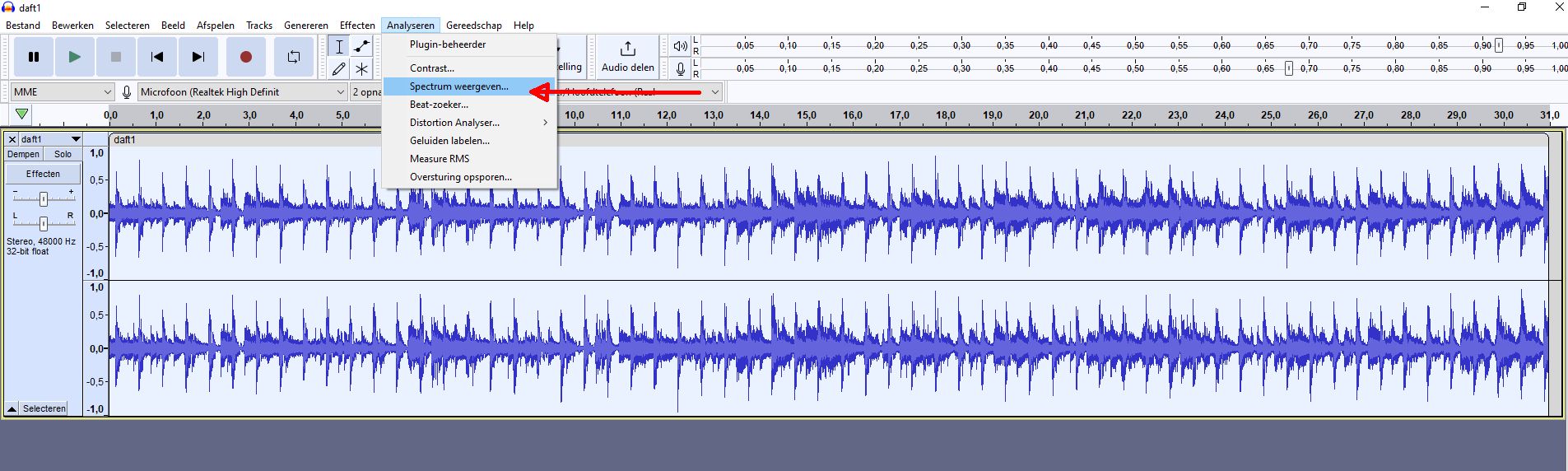
But if you manage to get a recording by line in, this is what you have to do:
audacity1.jpg

So this is a screenshot in my mothers tongue, but I guess you'll understand. You make the recording (the wave pattern you see). make it at least 1 minute, and select the track (ctrl+a). Some versions have a select limit of little over 2min, so any recording under 2min is ideal.
Then go to analyze->display spectrum.
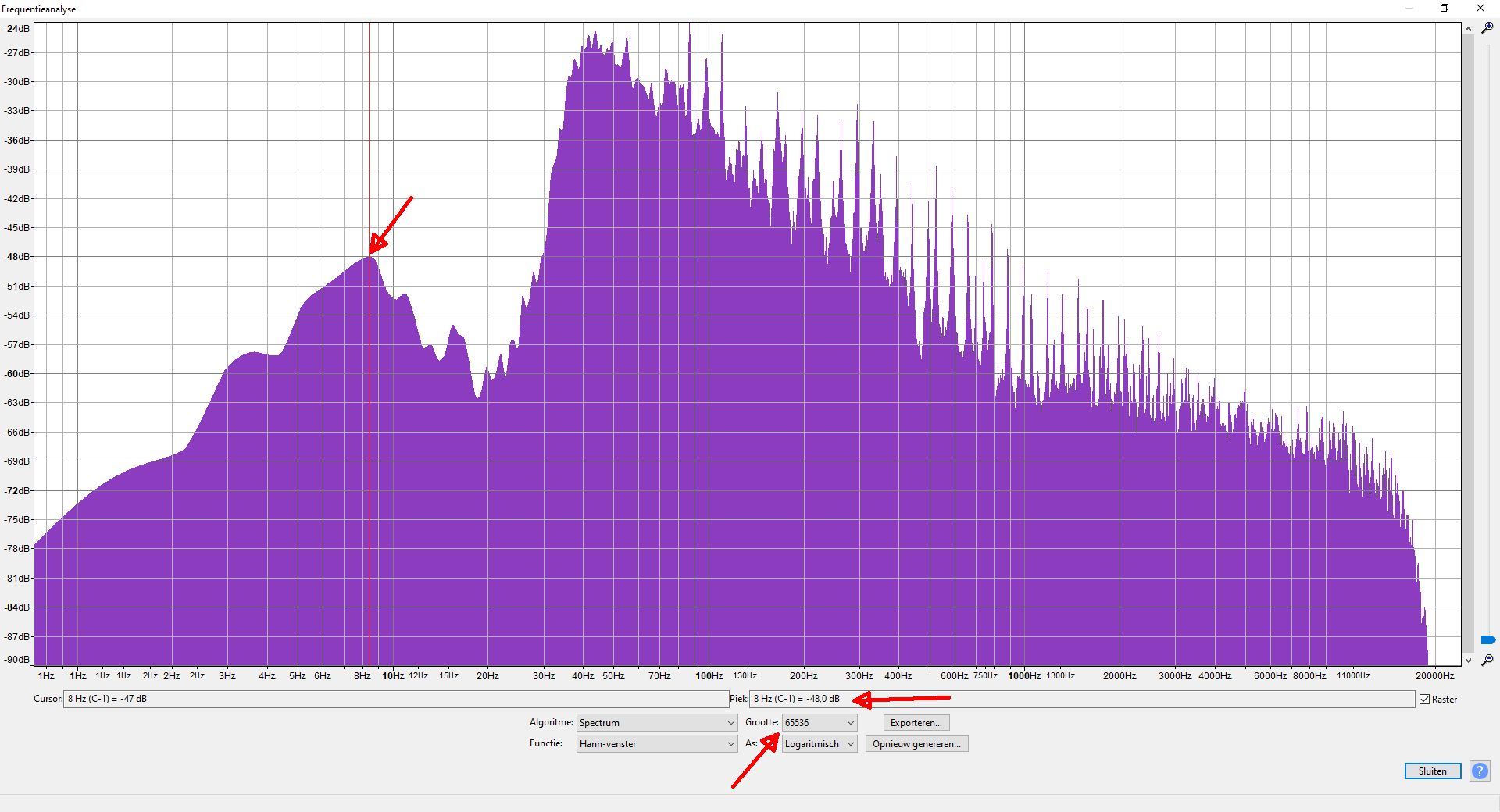
Then you get this:
audacity2.jpg


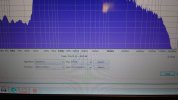
Set the sample size to 65536 (bottom arrow; higher numbers gives too much information)
put your cursor on the highest peak in the low frequencies (red arrow), so there will be a distinct peak, around 4-12Hz.
The peak will give the frequency in the bottom (other red arrow). This is a rounded value, in the graph you can see that the actual peak is somewhere between 8 and 9Hz (the red line), but who's counting.

Regarding your effective mass, I estimate that the effective mass of that arm including that headshell will be between 16 and 24gram.
If your headshell is already 21.15-5.8=15,35gram (that's including wires and mounting hardware (0,5gr), then chances are the complete arm is 20gr or more.
Not all the headshell weight is directly transferrable to the same effective mass, as half of it sits a little bit closer to the fulcrum point, but you might loose 1 or 2 grams because of that.
If you can weigh your counterweigth and measure it's distance to the fulcrum point (ideally: the distance between fulcrum point and 2/3 of the depth of the counterweigth), then I can make a fairly exact calculation of the effective mass.
Because the counterweight is moved forewards or more to the back depending on if you mount a heavier or lighter cartridge, the effective mass also changes slightly with that. But I expect your future cartridge will be in the ballpark of that 5,8 grams.

But for a arm like that I would recommend a medium to low compliance cartridge. Or a cartridge with a damping brush

 
So you have to make a recording with a line in. A microphone won't work. Some modern higher end laptops have a 3,5mm jack that can sense what kind of 3,5mm plug is inserted and when it's a stereo plug it asks if it's a headphone or line in. Most other laptops have a combo jack but that is purely suited for a headset. So a microphone plus headphones, no line in.

But if you manage to get a recording by line in, this is what you have to do:
audacity1.jpg

So this is a screenshot in my mothers tongue, but I guess you'll understand. You make the recording (the wave pattern you see). make it at least 1 minute, and select the track (ctrl+a). Some versions have a select limit of little over 2min, so any recording under 2min is ideal.
Then go to analyze->display spectrum.
Then you get this:
audacity2.jpg


Set the sample size to 65536 (bottom arrow; higher numbers gives too much information)
put your cursor on the highest peak in the low frequencies (red arrow), so there will be a distinct peak, around 4-12Hz.
The peak will give the frequency in the bottom (other red arrow). This is a rounded value, in the graph you can see that the actual peak is somewhere between 8 and 9Hz (the red line), but who's counting.

Regarding your effective mass, I estimate that the effective mass of that arm including that headshell will be between 16 and 24gram.
If your headshell is already 21.15-5.8=15,35gram (that's including wires and mounting hardware (0,5gr), then chances are the complete arm is 20gr or more.
Not all the headshell weight is directly transferrable to the same effective mass, as half of it sits a little bit closer to the fulcrum point, but you might loose 1 or 2 grams because of that.
If you can weigh your counterweigth and measure it's distance to the fulcrum point (ideally: the distance between fulcrum point and 2/3 of the depth of the counterweigth), then I can make a fairly exact calculation of the effective mass.
Because the counterweight is moved forewards or more to the back depending on if you mount a heavier or lighter cartridge, the effective mass also changes slightly with that. But I expect your future cartridge will be in the ballpark of that 5,8 grams.

But for a arm like that I would recommend a medium to low compliance cartridge. Or a cartridge with a damping brush
Thank you for the detailed guide. I am also dutch so no issue there :). I already did some measuring but I accidentally damaged my stanton stylus during this so I have to remount the shure cartridge again in order to do some more testing. Once I am done I'll share the results for both the stanton 681 eee and the shure m97xe with and without the brush.
 
Not all the headshell weight is directly transferrable to the same effective mass...
I'm sure you just missed to mention it - the same goes for the cartridge and anything else one mounts to the headshell.

If you can weigh your counterweigth and measure it's distance to the fulcrum point (ideally: the distance between fulcrum point and 2/3 of the depth of the counterweigth), then I can make a fairly exact calculation of the effective mass.
For my understanding (I'm down with physics, I believe; the reference point remains a mystery though):

1) I guess the 2/3rds is a thereabout location of the center of gravity for this specific counterweight, due to its shape/distribution of mass, right?

2) Is there a rule/standard, that manufacturers of arms go by, for the position of the counterweight at stated effective mass of the arm? When-arm-is-balanced would be my first choice, but it seems unlikely that the counterweight with "classical" arms can be moved close enough to the pivot (I can't test this - Revox B790) without a shell and? cartridge installed.

3) For compliance stated at 100 Hz - what ratio do you use to feed the equation?
 
So you have to make a recording with a line in. A microphone won't work. Some modern higher end laptops have a 3,5mm jack that can sense what kind of 3,5mm plug is inserted and when it's a stereo plug it asks if it's a headphone or line in. Most other laptops have a combo jack but that is purely suited for a headset. So a microphone plus headphones, no line in.

But if you manage to get a recording by line in, this is what you have to do:
audacity1.jpg

So this is a screenshot in my mothers tongue, but I guess you'll understand. You make the recording (the wave pattern you see). make it at least 1 minute, and select the track (ctrl+a). Some versions have a select limit of little over 2min, so any recording under 2min is ideal.
Then go to analyze->display spectrum.
Then you get this:
audacity2.jpg


Set the sample size to 65536 (bottom arrow; higher numbers gives too much information)
put your cursor on the highest peak in the low frequencies (red arrow), so there will be a distinct peak, around 4-12Hz.
The peak will give the frequency in the bottom (other red arrow). This is a rounded value, in the graph you can see that the actual peak is somewhere between 8 and 9Hz (the red line), but who's counting.

Regarding your effective mass, I estimate that the effective mass of that arm including that headshell will be between 16 and 24gram.
If your headshell is already 21.15-5.8=15,35gram (that's including wires and mounting hardware (0,5gr), then chances are the complete arm is 20gr or more.
Not all the headshell weight is directly transferrable to the same effective mass, as half of it sits a little bit closer to the fulcrum point, but you might loose 1 or 2 grams because of that.
If you can weigh your counterweigth and measure it's distance to the fulcrum point (ideally: the distance between fulcrum point and 2/3 of the depth of the counterweigth), then I can make a fairly exact calculation of the effective mass.
Because the counterweight is moved forewards or more to the back depending on if you mount a heavier or lighter cartridge, the effective mass also changes slightly with that. But I expect your future cartridge will be in the ballpark of that 5,8 grams.

But for a arm like that I would recommend a medium to low compliance cartridge. Or a cartridge with a damping brush
Ok so I have run the test a few times now and I have some measurements. I would like to mention that even though I did do some measurements with the stanton and will include these because of my later shure results indicating that tracking force doesn't affect the resonant frequency much (in this very unscientific test that is) they will be fairly unreliable because 1 the stanton had a pretty large channel imbalance which I tried to fix by twisting thee cantilever but sadly the tip fell off. And 2 the tracking force during the brush test was set up 0.7-1 gram too low. Anyhow the results:
Stanton 681 eee with brush (wrong tracking force)
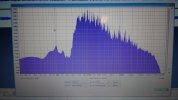
DSC_2411.JPG
Resonant frequency at around 9 Hz.

Stanton 681 eee without brush (tracking force at 1.2 grams)
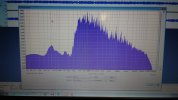
DSC_2413.JPG
I ran this test 3 times and each time I got a cluster between 5 and 12 Hz. With a dip between 10 and 8 it seems. Not too sure what to make of this since it doesn't entirely fall in line with the shure results.

Shure m97xe results:
Shure m97xe with brush (tracking force at 1.75 grams)
1:DSC_2420.JPG
2:DSC_2421.JPG
3:DSC_2422.JPG

So the results here are 8 Hz, 9 Hz and 10 Hz.
Shure m97xe with brush (1.25 grams tracking force)
1:DSC_2425.JPG
2:DSC_2426.JPG
Both are at 9 Hz

Shure m97xe without brush (1.25 grams tracking force)
1:DSC_2419.JPG
5Hz.

Shure m97xe without brush (1.75 grams tracking force)
1:DSC_2423.JPG
2:DSC_2424.JPG
Both are at 5 Hz

So seeing all these results the conclusions I would draw are that 1 tracking force in this instance doesn't really affect the resonant frequency much and 2 the brush does infact get the resonant frequency within an acceptable range. However without the brush the 5 Hz doesn't seem to be that far off from what is acceptable. If anyone could help me make sense of what I could do with this information and also why the brushless stanton results are kinda messy (unless that's just due to cartridge issues) that would be fantastic. All these measurements where done using the same headshell as discussed earlier.
 
Also I weighed thee counter weight and that came out to 148.45 grams.
DSC_2427.JPG
The length of the counter weight is 3.9 cm (including the black ring for setting the tracking force). The distance to the fulcrum point with tracking force set at 1.75 grams for the shure cartridge that weighs 21.51 grams including the headshell is +- 5.3 cm as the distance from the end of the counter weight to the fulcrum point is 2.7 cm. (I went from the depth front to back so if you meant it the other way around it would be +- 4 cm) . I don't think the distance measurement are that accurate but the weights definitely are.
 
Last edited:
1.25 grams for the M97xE with brush is too light. Should be 1.5-1.75 grams with brush. That’s 1 gram tip force + 0.5 grams brush force, or 1.25 grams tip force + 0.5 grams brush force.
 
I'm sure you just missed to mention it - the same goes for the cartridge and anything else one mounts to the headshell.
Of course

For my understanding (I'm down with physics, I believe; the reference point remains a mystery though):

1) I guess the 2/3rds is a thereabout location of the center of gravity for this specific counterweight, due to its shape/distribution of mass, right?
yes, a guesstimation. There's a set ring (usually plastic) and usually a more narrow profile. So it's inertiacenter is not exactly in the center of the counterweight.
But you can take the exact center too, it won't make a large difference.
2) Is there a rule/standard, that manufacturers of arms go by, for the position of the counterweight at stated effective mass of the arm? When-arm-is-balanced would be my first choice, but it seems unlikely that the counterweight with "classical" arms can be moved close enough to the pivot (I can't test this - Revox B790) without a shell and? cartridge installed.
No there is no rule. the mass of the cartridge determines the position of the counterweigth (and thus has some influence on the effective mass), and also the amount of VTF determines the position of the counterweight (and thus has some additional influence on the effective mass, for a statically balanced arm that is)

3) For compliance stated at 100 Hz - what ratio do you use to feed the equation?
There is no ratio to convert 100hz to 10hz compliance. Except that that ratio is somewhere between 1 and 2.
An at-95e and a denon DL-160 have almost exactly the same 10hz compliance, yet the AT-95e is specced at 6,5N/mm@100hz and the DL-160 at 10N/mm@100Hz.
So for some cartridges, there will be a ratio that happens to be the same but for others, there isn't. So no definitive relationship
 
1.25 grams for the M97xE with brush is too light. Should be 1.5-1.75 grams with brush. That’s 1 gram tip force + 0.5 grams brush force, or 1.25 grams tip force + 0.5 grams brush force.
I am aware, I did that to see what would happen to the resonant frequency since I also had the stanton set up incorrectly and wanted to know if those measurements could be used at all. If you read the post you'd find that I also did a measurement with brush at 1.75, without brush at 1.25 and without at 1.75.
 
I read all of it. But I didn’t/don’t understand your use of the too light VTF on the xE. You need to know that the cantilever and it’s suspension is the spring in the resonant system of the tonearm assembly. That spring constant won’t change between 1.25-1.75 grams. Not until you press the spring with enough VTF to mash it down enough to lose its spring constant. So you should always record/measure your resonant frequency at the proper VTF for competent tracking.
 
I read all of it. But I didn’t/don’t understand your use of the too light VTF on the xE. You need to know that the cantilever and it’s suspension is the spring in the resonant system of the tonearm assembly. That spring constant won’t change between 1.25-1.75 grams. Not until you press the spring with enough VTF to mash it down enough to lose its spring constant. So you should always record/measure your resonant frequency at the proper VTF for competent tracking.
No clue what you want to hear. I already explained my reasoning.
 
I read all of it. But I didn’t/don’t understand your use of the too light VTF on the xE. You need to know that the cantilever and it’s suspension is the spring in the resonant system of the tonearm assembly. That spring constant won’t change between 1.25-1.75 grams. Not until you press the spring with enough VTF to mash it down enough to lose its spring constant. So you should always record/measure your resonant frequency at the proper VTF for competent tracking.
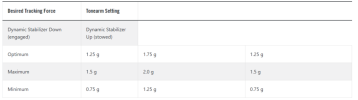
Also If you want to get into things you are not even correct as the user guide for the m97xe says to use anywhere from 1.25 to 2.0 grams with the stylus guard engaged.
user guide.PNG
 
2.0 is too heavy. 1.25 is too light. Manufacturer give a range, and we know how ridiculous “ranges” can be for styli. Don’t we? Ridiculous ranges date back decades; just read the 3rd party testing results in the major audio magazines. I just don’t see the utility of testing for resonance at VTFs outside of the competent tracking range of a stylus. You may get a 10 Hz resonance, but what good is that if the stylus is mistracking? SMH

I’m no M97xE novice. Been playing them since 2001.

IMG_3114.jpeg

IMG_4394.jpeg

IMG_5504.jpeg
 
Last edited:
Thanks for the detailled answer, @mr_petit. :thumbsup: I understand all of the said, I just wanted confirmation.

Now for the Shure results with brush lifted...

If the equation f = 1000 : (2 x π x √(M x C)) , which everyone seems to use, is correct, and applies exclusively for compliance at 10 Hz, then:
- increasing resonant frequency, let's say, by 100% (from 5 to 10 Hz) demands decreasing √(M x C) by 50%
- with given catridge + stylus + VTF-in-spec + headshell + arm + counterweight combo, and brush lifted, it can't be done.

The most obvious way to go is with lighter headshell and screws...actually, using the brush would be the most obvious - DOH!
 
Last edited:
2.0 is too heavy. 1.25 is too light. Manufacturer give a range, and we know how ridiculous “ranges” can be for styli. Don’t we? Ridiculous ranges date back decades; just read the 3rd party testing results in the major audio magazines. I just don’t see the utility of testing for resonance at VTFs outside of the competent tracking range of a stylus. You may get a 10 Hz resonance, but what good is that if the stylus is mistracking? SMH

I’m no M97xE novice. Been playing them since 2001.

View attachment 2963458

View attachment 2963461

View attachment 2963462
It's impressive how actively you are ignoring the point. All I can tell you is to read my replies again. Besides that this discussion is pointless.
 
Thanks for the detailled answer, @mr_petit. :thumbsup: I understand all of the said, I just wanted confirmation.

Now for the Shure results with brush lifted...

If the equation f = 1000 : (2 x π x √(M x C)) , which everyone seems to use, is correct, and applies exclusively for compliance at 10 Hz, then:
- increasing resonant frequency, let's say, by 100% (from 5 to 10 Hz) demands decreasing √(M x C) by 50%
- with given catridge + stylus + VTF-in-spec + headshell + arm + counterweight combo, and brush lifted, it can't be done.

The most obvious way to go is with lighter headshell and screws...actually, using the brush would be the most obvious - DOH!
Ok, makes sense. What I don't entirely understand is what exactly is the downside of using a cartridge with a brush that's high compliance on a relatively high effective mass tonearm if the resonant frequency is still at 9 Hz. Is the brush just a magic tool that solve all compliance issues or are there other factors and is the measured 9 Hz not telling the whole story?
 
I can't think of any downside(-s). This is way above my paygrade - though the one grey cell loves a bit of an exercise once in a while.

Shure claims that the brush is a dynamic stabilizer to better deal with warps, cleaning the groove and eliminating static electricity. And not only that...engaging the brush, the cartridge can be used with heavier arms. According to the formula, the brush then must affect compliance or effective mass or both.

I fead the formula with data available:

- arm effective mass of 9,2 g, as specified by Jelco
- cartridge-shell mass of 21,5 g, as specified by you
- compliance of 25 µm/mN , as specified by Shure,

and got a frequency of ~5,7 Hz, which should be close enought to what you measured.

Although it sounds reasonable, I still got a problem, beacuse I can't pinpoint the ~0,7 Hz difference compared with your measurments of ~5 Hz. What bothers me the most, ist that the compliance stated is static, which to my "knowledge", is at 0 Hz. Of course, nobody knows a conversion ratio to 10 Hz either. The difference could as well be accounted to aging suspension or to production tolerances...or all of them reasons.

Your sytem effective mass is high (30,7 g), so you're in for a very low compliance cartridge - 8 µm/mN for 10 Hz, which may be difficult.

On the other hand...take a peak.
 
I can't think of any downside(-s). This is way above my paygrade - though the one grey cell loves a bit of an exercise once in a while.

Shure claims that the brush is a dynamic stabilizer to better deal with warps, cleaning the groove and eliminating static electricity. And not only that...engaging the brush, the cartridge can be used with heavier arms. According to the formula, the brush then must affect compliance or effective mass or both.

I fead the formula with data available:

- arm effective mass of 9,2 g, as specified by Jelco
- cartridge-shell mass of 21,5 g, as specified by you
- compliance of 25 µm/mN , as specified by Shure,

and got a frequency of ~5,7 Hz, which should be close enought to what you measured.

Although it sounds reasonable, I still got a problem, beacuse I can't pinpoint the ~0,7 Hz difference compared with your measurments of ~5 Hz. What bothers me the most, ist that the compliance stated is static, which to my "knowledge", is at 0 Hz. Of course, nobody knows a conversion ratio to 10 Hz either. The difference could as well be accounted to aging suspension or to production tolerances...or all of them reasons.

Your sytem effective mass is high (30,7 g), so you're in for a very low compliance cartridge - 8 µm/mN for 10 Hz, which may be difficult.

On the other hand...take a peak.
So conclusion, get a lighter headshell and find something medium to low compliance or if it's high compliance it needs to have a brush ? Any recommendations for low compliance carts in the 500 usd range in that case?
 
Back
Top Bottom