• The move to the new server is done. There are some software and database maintenance updates in process. This has us passing the hat around to help out. We appreciate any donations. Seriously, even a dollar helps. The payment page may be found here - https://www.audiokarma.org/support.html

High compliance cartridge recommendations for jelco ts-350s arm? (Under 500 usd)

The brush, IF working properly, will not change the resonant frequency. It will DAMP the resonant peak. Flatten it, drop it down a few dBs. Just like a car’s suspension: Springs will make the car bounce on bumps, but adding proper shock absorbers will tame the bounce, make it manageable.

So what does the brush, working properly look like?

Not working properly:


Working properly:

 
So seeing all these results the conclusions I would draw are that 1 tracking force in this instance doesn't really affect the resonant frequency much and 2 the brush does infact get the resonant frequency within an acceptable range. However without the brush the 5 Hz doesn't seem to be that far off from what is acceptable. If anyone could help me make sense of what I could do with this information and also why the brushless stanton results are kinda messy (unless that's just due to cartridge issues) that would be fantastic. All these measurements where done using the same headshell as discussed earlier.
All those recordings/graphs look really strange,....
It's also not really clear what I'm looking at, with so many plots. You get 3 different resonance frequencies with the same cartridge and brush down?
Have you recorded with line in, or with that microphone you were talking about.
In the background I can see that your recorded signal was really really weak. Can you upload one of your recordings?
Your conclusion that the resonant frequency (or compliance) doesn't change with VTF is correct (or at least, it doesn't change measureably).
5hz without brush on the m97 is something I'd expect on an arm like that. That's frequency is pretty low, not ideal.
If with the brush it raises the resonance frequency to 8-9Hz, it clearly has an impact on compliance.
 
Last edited:
One thing to consider is the suspension of the cantilever. Shure and Stanton suspensions are not identical. Both stylus assemblies use a tension or tie wire. That wire is used to provide spring force to return the cantilever to its neutral position on wide or deep excursions from bass modulations in the groove. The elastomer block acts as a spring for higher frequencies, like the tie wire. But the elastomer blocks are also the *damper* for all cantilever movements, at all frequencies. It’s the cantilever shock absorber. Prevents cantilever bouncing.

IMO, the differences you see in the resonance plots are due to the differences in design of the styli suspensions between Shure and Stanton.

M97xE:

IMG_0565.jpeg


Stanton: (I think the 1.5 dB dip between the twin peaks is due to less damping of the suspension.)

IMG_0564.jpeg
 
Can you make a measurement with with your tonearm and your stylus scale, where you've removed both the headshell and the counterweigth from the arm and that the tip of the arm (the sme connector) is resting on the scale?
Then we have more or less (half) the weight of your armwand.
And can you measure the length from the tip of the armwand (so at the sme connector) to the fulcrum?
I can make a guesstimation for both, but measuring is more accurate.

BTW, what I found for the stanton 681eee as weight is 6,3gr. on most sources, so I'll use that number (and 0,5g for the screws, these are usually not included in arm eff mass, but headshell leads are)

I'm now at 24g eff. mass for your arm with that headshell, so quite heavy:
effmassjelcots350s.jpg


You'll ideally need a cartridge with a compliance between 6 and 13 N/mm

Even if we take the exact center of the counterweight as gravitational center, the arm mass is still 22,3gr, so that's not gonna make a huge difference.
And my guesstimation for the arm wand...that's maybe gonna make 1 gram difference (to go down, I took quite a light armwand)
So it's gonna be a 20gr+ arm.
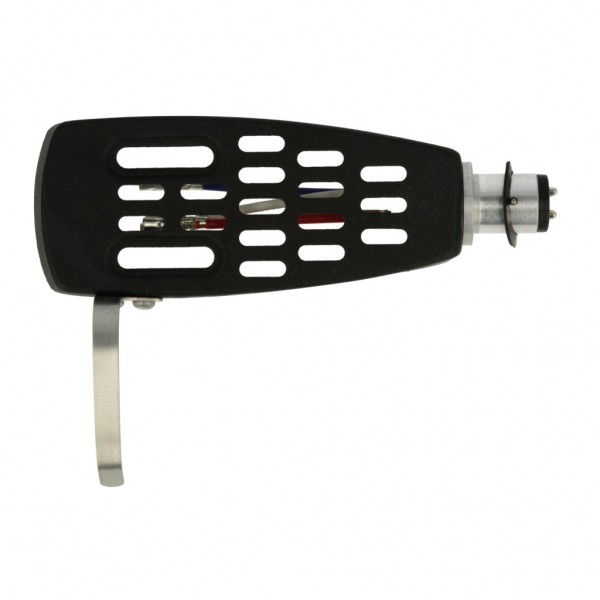
Mounting a lighter headshell is the way to go if you want to have more choice in new cartridges.
Problem with lighter headshells is that you'll probably loose the azimuth adjust you now have. Sadly most headshells with azimuth adjust are fairly heavy....

But what I don't understand is that as far as I could find, that headshell what you're using is a Tonar 5386, and that is listed as 12,5gr, just like I wrote in my first post.
I found these sources:
So are they wrong or do you have something like extra weight spacers fitted between headshell and cartridge?
Somewhere there's almost a 2gr difference, which is a lot imho.
 
Last edited:
On the other hand...take a peak.
That korf calculator has a lot of mathematical errors. For instance, it calculates with the assumtion that every cartridge suspension has the same damping factor/characteristics...
And regarding it's outcome: every combination that is calculated the normal way (Hooke's law) with a resonance frequency higher than ~10,25Hz has too much excursion.
What's that all about?!? (you can easily check that by calculating different compliances/eff masses)

Also, if you assume that the peak of the excursion is the resonance frequency (which pretty much makes sense....), that frequency from the korf calculator can be off by 2Hz or so.
And that is not some mathematical fluke, that is something you can observe in reality.
 
So conclusion, get a lighter headshell and find something medium to low compliance or if it's high compliance it needs to have a brush ? Any recommendations for low compliance carts in the 500 usd range in that case?
Here's an elliptical that tracks at 2 grams and a nice NOS conical that does as well. Under your budget for both.


ADC K8
 
Last edited:
If looking for a mid compliance cartridge this is currently my favorite budget LOMC, outstanding bass output, really gets your toes tapping. Paid $313 about 6months ago and felt I got a great deal, I see they're now $259, WOW.

Here's a link to a thread where it goes up against the Denon DL-301MKII head to head.

IMG_20221202_235017069.jpg

Screenshot_20230820-220826.png
 
Last edited:
All those recordings/graphs look really strange,....
It's also not really clear what I'm looking at, with so many plots. You get 3 different resonance frequencies with the same cartridge and brush down?
Have you recorded with line in, or with that microphone you were talking about.
In the background I can see that your recorded signal was really really weak. Can you upload one of your recordings?
Your conclusion that the resonant frequency (or compliance) doesn't change with VTF is correct (or at least, it doesn't change measureably).
5hz without brush on the m97 is something I'd expect on an arm like that. That's frequency is pretty low, not ideal.
If with the brush it raises the resonance frequency to 8-9Hz, it clearly has an impact on compliance.
I used the mic input. The signal was around -3db on average iirc. I do not have a way currently to get a line in recorded as the only way I could do this would be my desktop soundcard. I understand it's not optimal but as far as current results go I feel this is pretty much in line with what could be expected no? I am unable to provide any recordings right now as I am on vacation sorry for that.
 
Can you make a measurement with with your tonearm and your stylus scale, where you've removed both the headshell and the counterweigth from the arm and that the tip of the arm (the sme connector) is resting on the scale?
Then we have more or less (half) the weight of your armwand.
And can you measure the length from the tip of the armwand (so at the sme connector) to the fulcrum?
I can make a guesstimation for both, but measuring is more accurate.

BTW, what I found for the stanton 681eee as weight is 6,3gr. on most sources, so I'll use that number (and 0,5g for the screws, these are usually not included in arm eff mass, but headshell leads are)

I'm now at 24g eff. mass for your arm with that headshell, so quite heavy:
effmassjelcots350s.jpg


You'll ideally need a cartridge with a compliance between 6 and 13 N/mm

Even if we take the exact center of the counterweight as gravitational center, the arm mass is still 22,3gr, so that's not gonna make a huge difference.
And my guesstimation for the arm wand...that's maybe gonna make 1 gram difference (to go down, I took quite a light armwand)
So it's gonna be a 20gr+ arm.
Mounting a lighter headshell is the way to go if you want to have more choice in new cartridges.
Problem with lighter headshells is that you'll probably loose the azimuth adjust you now have. Sadly most headshells with azimuth adjust are fairly heavy....

But what I don't understand is that as far as I could find, that headshell what you're using is a Tonar 5386, and that is listed as 12,5gr, just like I wrote in my first post.
I found these sources:
So are they wrong or do you have something like extra weight spacers fitted between headshell and cartridge?
Somewhere there's almost a 2gr difference, which is a lot imho.
I do not know. I won't be home for around 10 days but when I get home I'll weigh the headshell on its own. All I know is that the wires are audio technica ones, I don't know which ones.
 
I used the mic input. The signal was around -3db on average iirc. I do not have a way currently to get a line in recorded as the only way I could do this would be my desktop soundcard. I understand it's not optimal but as far as current results go I feel this is pretty much in line with what could be expected no? I am unable to provide any recordings right now as I am on vacation sorry for that.

Most mic inputs use filters to maximize vocal frequencies. Not usually flat FR.
 
Best MM cart of medium compliance is the Denon 109D, You can buy a S/H body & new Jilco Elliptical stylus for under $500.

Cheers
 
Tried all of these on my Jelco TS-550 MKII tonearm with excellent results! Shure & Empire with lighter headshells.

AT-VM540ML
Nagaoka MP-200
Denon DL-301 MKII (MC)
Shure M97xE
Empire 2000Z
Grado Opus3
Grado Gold3

Currently mounted is an AT33 PTGII MC cartridge. :music:

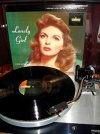
lnly grl.JPG
 
Can you make a measurement with with your tonearm and your stylus scale, where you've removed both the headshell and the counterweigth from the arm and that the tip of the arm (the sme connector) is resting on the scale?
Then we have more or less (half) the weight of your armwand.
And can you measure the length from the tip of the armwand (so at the sme connector) to the fulcrum?
I can make a guesstimation for both, but measuring is more accurate.

BTW, what I found for the stanton 681eee as weight is 6,3gr. on most sources, so I'll use that number (and 0,5g for the screws, these are usually not included in arm eff mass, but headshell leads are)

I'm now at 24g eff. mass for your arm with that headshell, so quite heavy:
effmassjelcots350s.jpg


You'll ideally need a cartridge with a compliance between 6 and 13 N/mm

Even if we take the exact center of the counterweight as gravitational center, the arm mass is still 22,3gr, so that's not gonna make a huge difference.
And my guesstimation for the arm wand...that's maybe gonna make 1 gram difference (to go down, I took quite a light armwand)
So it's gonna be a 20gr+ arm.
Mounting a lighter headshell is the way to go if you want to have more choice in new cartridges.
Problem with lighter headshells is that you'll probably loose the azimuth adjust you now have. Sadly most headshells with azimuth adjust are fairly heavy....

But what I don't understand is that as far as I could find, that headshell what you're using is a Tonar 5386, and that is listed as 12,5gr, just like I wrote in my first post.
I found these sources:
So are they wrong or do you have something like extra weight spacers fitted between headshell and cartridge?
Somewhere there's almost a 2gr difference, which is a lot imho.
Ok so here are the results:

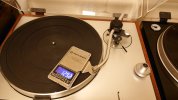
Arm wand weight = 12.92 grams :
DSC_2656.JPG
Arm wand to fulcrum +-=18.7 cm
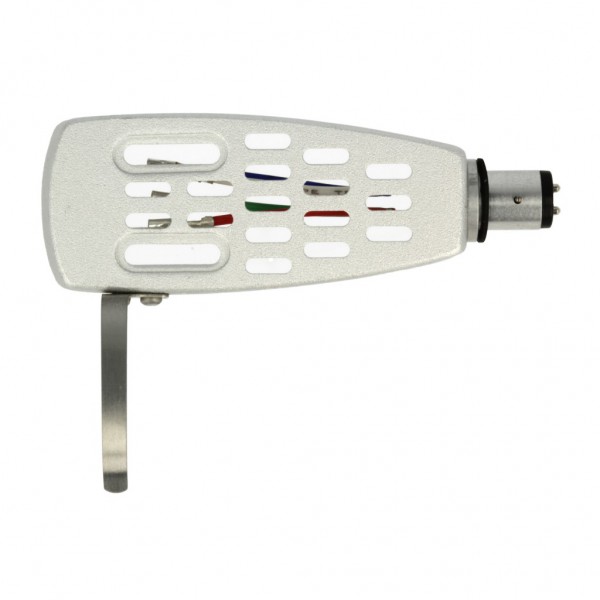
Headshell weight = 11.92 grams :

DSC_2658.JPG
Wire weight = 0.98 grams:

DSC_2661.JPG
Screw weight = 1.53 grams:

DSC_2660.JPG
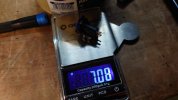
Shure cartridge weight = 7.08 grams:

DSC_2659.JPG

The screws, bolts, washers and the wires being right around 2.5 grams would make up the missing 2 grams though the headshell weighing +- 0.58 grams less than advertised seems fairly weird, maybe the weight advertised is with the wires?
 
Last edited:
The screws, bolts, washers and the wires being right around 2.5 grams would make up the missing 2 grams though the headshell weighing +- 0.58 grams less than advertised seems fairly weird, maybe the weight advertised is with the wires?
Headshell weight is always with wires, but without screws.
Your screws are probably stainless steel as they weigh 1,5gr. Aluminium screws typically weigh 0,5gr. So you can save 1 gram with that.
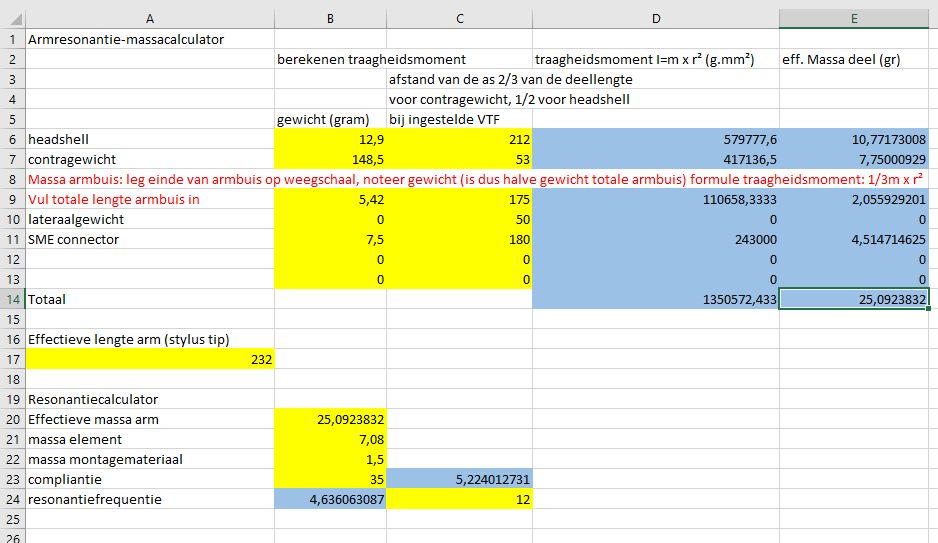
My effective mass calculation of your arm is 25 grams.
effmassdefjelcots350s.jpg


There are some assumptions, like how much the sme connector in your arm weighs. They can be anywere between 6 and 11 grams, but in the end that difference might effect the calculation by only 2 grams or so. It's not gonna turn this arm in a medium or light arm. It's a heavy arm.
(I took 7,5 grams for that connector, so the armwand itself is therefore about 11gr).
For this arm, a low compliance cartridge is optimal.
 
Headshell weight is always with wires, but without screws.
Your screws are probably stainless steel as they weigh 1,5gr. Aluminium screws typically weigh 0,5gr. So you can save 1 gram with that.
My effective mass calculation of your arm is 25 grams.
effmassdefjelcots350s.jpg


There are some assumptions, like how much the sme connector in your arm weighs. They can be anywere between 6 and 11 grams, but in the end that difference might effect the calculation by only 2 grams or so. It's not gonna turn this arm in a medium or light arm. It's a heavy arm.
(I took 7,5 grams for that connector, so the armwand itself is therefore about 11gr).
For this arm, a low compliance cartridge is optimal.
Ok, thank you so much for the help, I will look for a low compliance cartridge in that case. If I do go with a low compliance cartridge is there still any reason to decrease the weight with different screws for example? Also In the future when looking at a tonearm, is there a way to know if the tonearm's rated effective mass is including a headshell or not?
 
Last edited:
Ok, thank you so much for the help, I will look for a low compliance cartridge in that case. If I do go with a low compliance cartridge is there still any reason to decrease the weight with different screws for example? Also In the future when looking at a tonearm, is there a way to know if the tonearm's rated effective mass is including a headshell or not?
Changing out the screws won't make the arm considerably lighter. Getting a lighter headshell will give the most weight reduction. Not only the headshell itself gives the weight saving, but the couterweight will also be nearer to the fulcrum point.
However, good headshells are expensive. You can get a cheap light headshell from thakker.eu for ~€15 that weighs about 7 grams:

That way you can knock 6-8 grams off the effective mass (with lighter screws), which is quite a lot.
However, quality is....hit&miss. I've read stories that a headshell sometimes isn't straight (so azimuth alignment problem).
And of course, you'll loose azimuth adjustability; that's the nice thing about the jelco headshells.
The only light headshell (in SME style) that you can buy new, that is light and has azimuth control, is I think the headshell from the technics sl-1200G/GAE.
But that one is €110, and I don't know if that screw is actually ment to change azimuth. And sitting on the underside instead of the left side, it makes it far more difficult to use, if it works at all (no experience)
Maybe someone here has another suggestion for an SME headshell with azimuth adjustability and weight around 7-8 grams?

Normally, the tonearm's effective mass is including headshell. How can you tell? if it's below 13g, it's virtually impossible to come to that eff. mass with an SME style headshell.
Best way is to actually weigh as much parts as possible and do the calculation yourself. Lots of tonearms have quoted eff. mass, or eff. mass written all over the internet from which I'm sure that that isn't correct.

Looking for low compliance cartridges is pretty difficult, most of them are MC and if you want one with a more advanced stylus and cantilever, they usually start at around €500
And a lot of them are still fairly high compliant.
The most difficult aspect is that with most japanese cartridges, the compliance is given at 100Hz. That is a measure for how well it tracks, and has nothing to do with the 10Hz resonance. There is also no real conversion factor, despite what most people on the internet will tell you.
As for the required resonance frequency, most sources will tell you that the target value is between 8Hz and 12Hz.
That said I'd rather have 8Hz than 12Hz, and I think you can go little below 8Hz.
The higher value is a value so that the resonance can't be excited by the lowest notes in music (typically ~16-20Hz).
The low resonance value (8Hz) is chosen so that warps in the record can't excite the low resonance.
However, if you have less warped records, the problem is also less.
Typically, warps have a frequency between 1 and 4Hz I guess.
So if you're close to that, say 5Hz, chances are the stylus will loose contact more easily when going over a warp (or becoming less stable on the warp, resulting in a big shift in balance from left to right in the music) than cartridges that have a higher resonance in your arm.

But it's not only the resonance frequency that determines that. Damping is another factor. This is a parameter that is not specified by cartridge manufacturers.

 
Headshell weight is always with wires, but without screws.
Your screws are probably stainless steel as they weigh 1,5gr. Aluminium screws typically weigh 0,5gr. So you can save 1 gram with that.
My effective mass calculation of your arm is 25 grams.
effmassdefjelcots350s.jpg


There are some assumptions, like how much the sme connector in your arm weighs. They can be anywere between 6 and 11 grams, but in the end that difference might effect the calculation by only 2 grams or so. It's not gonna turn this arm in a medium or light arm. It's a heavy arm.
(I took 7,5 grams for that connector, so the armwand itself is therefore about 11gr).
For this arm, a low compliance cartridge is optimal.
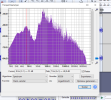
Hello, it's been a while. I would like to thank you once again for all the help you have given me. I currently have an accuphase ac-2 cartridge and while I do think it sounds great, I feel like it's a bit too heavy on the low end. I bought a proper field recorder with a line input so that I can actually get good recording for testing and using that same spectrum analysis on a few different recording I get to a resonant frequency of 6 Hz
test 1:

test 1.png

test 2:

test 2.PNG

I also did a rough calculation and got to a resonant frequency of -+ 6.6Hz so excluding calculation errors it seems to line up. Now, I wanted to ask a few things if you do not mind.
1: Do these spectrums look natural? My previous attempted measurements had some weird things in the lower frequencies, is that still present here?
2: Is a resonant frequency of 6 Hz a possible cause of an emphasized low end? Or would the only real result be worse tracking performance?

Thank you.
 
I also did a rough calculation and got to a resonant frequency of -+ 6.6Hz so excluding calculation errors it seems to line up. Now, I wanted to ask a few things if you do not mind.
1: Do these spectrums look natural? My previous attempted measurements had some weird things in the lower frequencies, is that still present here?
2: Is a resonant frequency of 6 Hz a possible cause of an emphasized low end? Or would the only real result be worse tracking performance?

Thank you.
1. Both spectrums look normal. There's a clear peak. It's normal that you sometimes see some smaller sub peaks. A number of these lower peaks are also the result of the calculationmethod used and there will undoubtedly be some smaller resonances on different frequencies. But the main peak here is ~10dB louder so it's clear where the main resonance is.

2. No, the resonance frequency has nothing to do with a low end. What we call low end is ~25Hz to 50Hz or somewhat in that frequency. The 6Hz is totally inaudible.
If you have a resonance frequency that is too low, you could get effects like if you have a warp, you hear a shift in the pitch in mid tones (500-2500Hz, where the ear is very sensitive). That kind of things. And if you have wooden floors and walk etc you could hear it too. But it'll always be something like a tremor in the mid tones.
 
Last edited:
1. Both spectrums look normal. There's a clear peak. It's normal that you sometimes see some smaller sub peaks. A number of these lower peaks are also the result of the calculationmethod used and there will undoubtedly be some smaller resonances on different frequencies. But the main peak here is ~10dB louder so it's clear where the main resonance is.

2. No, the resonance frequency has nothing to do with a low end. What we call low end is ~25Hz to 50Hz or somewhat in that frequency. The 6Hz is totally inaudible.
If you have a resonance frequency that is too low, you could get effects like if you have a warp, you hear a shift in the pitch in mid tones (500-2500Hz, where the ear is very sensitive). That kind of things. And if you have wooden floors and walk etc you could hear it too. But it'll always be something like a tremor in the mid tones.
So would a 6Hz resonant frequency be acceptable? I just did some experimenting with a lighter headshell (really cheap but weighs around 7 grams with wires, screws weigh 0.5 grams) and I barely got to 7 Hz. The spectrum looks like this:

spectrum without extra weight.PNG

The peak is at 7Hz but for some reason there is also a peak at 6 Hz. No clue why that happens.

I tried it with an extra weight on the headshell of around 0.9 grams (and adjusted the counter weight) and it was at 6 Hz again:

secptrum with extra weight.PNG


Seeing this, is there even a point in using a lighter headshell when the resonant frequency with this particular cartridge stays at 6 Hz from 8-12 grams atleast? I understand that that is probably going from like 6.4 to 5.6 but as mentioned earlier in this thread the jelco hs-25 is a much nicer headshell. I ordered a jelco hs-50 mk2 which is supposed to be around 2-3 grams lighter than the hs-25 (and as far as I am aware the hs-50 is the original headshell for the ts-350 regardless) so I will likely be using that when it arrives. I just want to figure out whether using this cartridge even makes sense. I did pay quite a bit of money for it and while I can probably resell it for the same amount, I'd prefer not to deal with the hassle of doing that and finding a different cartridge to use. Ofcourse if it is truly just not a great match I'd do it, but from what I could find online 6Hz seems to be right on the edge of what is 'reasonable'. I understand that 6Hz is not low end, my speakers don't even go below 40Hz. I will also be picking up an oem version of a sa-250 arm later today which supposedly came shipped with an ortofon 2m black from the company it was sold by. From what I learned in this thread and the specs I found online this should result in a resonant frequency of around 6 Hz as well (13.39 effective mass without headshell, shipped with what looks like a rebranded hs-25 which would be +- 12 grams, cartridge weight of 7.2 grams and 22 um compliance) which results in +- 5.94 Hz. Is this just negligence by the transrotor (the company that sold the arm and cartridge combo) or does this have to do with the characteristics of the cartridge? Or Am I doing something wrong, I do want to note that using this same calculation the resonant frequency of my current setup should be 6.8 so chances are the resonant frequency of the ortofon black setup will be more in the 5Hz range.
 
So seeing all these results the conclusions I would draw are that 1 tracking force in this instance doesn't really affect the resonant frequency much and 2 the brush does infact get the resonant frequency within an acceptable range. However without the brush the 5 Hz doesn't seem to be that far off from what is acceptable. If anyone could help me make sense of what I could do with this information and also why the brushless stanton results are kinda messy (unless that's just due to cartridge issues) that would be fantastic. All these measurements where done using the same headshell as discussed earlier.

It all makes sense to me.

You have a heavy headshell, with the cartridge and headshell alone the combination is a high mass one (21gr). The M97xE is a rather high compliance cartridge, 5Hz sans-brush is not surprising. The Shure brush acts a hydraulic damper -because it does have silicon fluid on the bushings- and thus changes the results. The Stanton brush has no silicone fluid, it is there just for cleaning the record.

Although it sounds reasonable, I still got a problem, beacuse I can't pinpoint the ~0,7 Hz difference compared with your measurments of ~5 Hz. What bothers me the most, ist that the compliance stated is static, which to my "knowledge", is at 0 Hz. Of course, nobody knows a conversion ratio to 10 Hz either. The difference could as well be accounted to aging suspension or to production tolerances...or all of them reasons.

All of these formulas for compliance are questionable and shouldn't be relied upon, because of many reasons, one reason is that cartridge suspensions are different and some have narrower (high) Q-factors other have low Q-factors.

There are other reasons and the best explanation and tests are here in the Korf Blog. Required reading!!
 
Last edited:
Back
Top Bottom