• The move to the new server is done. There are some software and database maintenance updates in process. This has us passing the hat around to help out. We appreciate any donations. Seriously, even a dollar helps. The payment page may be found here - https://www.audiokarma.org/support.html

HK Citation II AC grounding

Hi Fi and I

Active Member
Hi folks,
I would like to install a 3 prong AC power cord on my Citation II.
Could someone help me with the ground wire, where do I connect it?
Thank you!
 
Register to hide this ad
Here's what I did in a converted Organ amp:

https://audiokarma.org/forums/index...vintage-tube-gear.871000/page-2#post-12779804

In short (pun definitely not intended), the ground is just connected to the chassis.

A few cautions:

1. Make *very* sure it is not hot chassis. (I don't know of any HK of that stye/vintage that was).
2. You may want to check that there isn't anything else funny about the PS design. There should never be any current on the ground.
3. Beware of possible ground loop issues. The input connector grounds are probably connected to the chassis, too. Thus, the case of the amp is already grounded through the other equipment connected to it (assuming that any of the equipment has a 3 wire plug.) So now the chassis is connected to ground via two different paths -- In other words, begging for a ground loop and the results there of -- rapid mashing of your hands on your ears, speaker componets flying out of windows, etc.

In my case, the organ amp and the sound source are normally plugged into the same power strip, and I have not had any indications of ground loop issues.

 
Here's what I did in a converted Organ amp:

https://audiokarma.org/forums/index...vintage-tube-gear.871000/page-2#post-12779804

In short (pun definitely not intended), the ground is just connected to the chassis.

A few cautions:

1. Make *very* sure it is not hot chassis. (I don't know of any HK of that stye/vintage that was).
2. You may want to check that there isn't anything else funny about the PS design. There should never be any current on the ground.
3. Beware of possible ground loop issues. The input connector grounds are probably connected to the chassis, too. Thus, the case of the amp is already grounded through the other equipment connected to it (assuming that any of the equipment has a 3 wire plug.) So now the chassis is connected to ground via two different paths -- In other words, begging for a ground loop and the results there of -- rapid mashing of your hands on your ears, speaker componets flying out of windows, etc.

In my case, the organ amp and the sound source are normally plugged into the same power strip, and I have not had any indications of ground loop issues.
thanks!
 
Instead of making fun and wasting everyone's time, tell us how to resolve the riddle!

Sorry ma'am, I'll waste as much time as I want! I even used smiley's and you still took offense so here's what I have to say:

I'm a repair tech so there's no riddle and I was trying to be light humored about it because I see people adding grounds to things that were not engineered for it and it sometimes causes all sorts of problems. Ground loops, hum, stray RF etc.

No offense intended that since you didn't know where a ground would go, your reply told me that you are just a tinkerer and don't really know why you would or wouldn't add a ground.

The original design with the two prong plug is not a safety issue or the company would have gone out of business years ago. Also, they are UL listed so when you add something that's not supposed to be a part of the original design, then you throw that right out the window.

I was being humorous and you took it the wrong way!
 
Last edited:
It may have been UL listed in 1960 but probably wouldn't pass now. Now I must admit that I'm not super familiar with consumer standards, but you wouldn't pass in the industrial world without a metal chassis being safety grounded.
John
 
I don't think it's a dumb question.
If not a three prong plug, I'd at least install a polarized plug to make sure the hot leg was fused and switched.
 
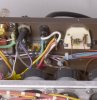
It's pretty straightforward, and as I recall, the stock inputs are not chassis grounded so there is likely little risk in a ground loop situation. Just run the ground wire to a star eyelet and bolt it to one of the transformer mounting bolts. It is what I did in mine and the amp is dead silent. I know Jim McShane recommends this conversion as he sells the heavy duty 3 wire cords for them.

The pic below is of my amp. You can see the green ground wire going to the bolt.

Ground.jpg
 
If the amp in question uses the chassis as the circuit ground, meaning ground points from various spots on the audio and/or power supply circuit are attached to the chassis at numerous locations, then connecting a mains ground to the chassis has a pretty good chance of introducing a ground loop. Therefore if the amp design uses the chassis as the circuit ground I would advise against adding a mains ground.

If the amp has a circuit ground that is separate from the chassis, then it's relatively straight forward to add a mains chassis ground without worry of creating a ground loop. Find where the amp connects circuit ground to chassis. It should be at one point only on the chassis if the amp was designed/wired correctly. Connect the mains ground from the three prong plug to that same point. Done.

If I'm wiring up an amp from scratch, I will make the connection from circuit ground to chassis from the negative terminal of the power supply reservoir cap (i.e., from the first cap right after the rectifier in the power supply filtering section) to a location on the chassis that is near the IEC power inlet.
 
If I'm wiring up an amp from scratch, I will make the connection from circuit ground to chassis from the negative terminal of the power supply reservoir cap (i.e., from the first cap right after the rectifier in the power supply filtering section) to a location on the chassis that is near the IEC power inlet.

So then what do you do with the center of the IEC? If it is a metal IEC Connector (i.e. with filter), then the shell of the connector is ground anyway. Do you isolate it from the chassis?

If it is a plastic connector, do you leave the center terminal un-connected? If so, then it is not really IEC at all, but it appears to be grounded equipment, which from a safey point of view is worse than just having a 2 wire power cord.

I don't think any electrical safety person/organization would approve of leaving the ground disconnected inside equipment.

If you ground the IEC to the same point on the chassis (which is correct from a safey point of view), then how are you avoiding a ground loop?
 
A ground loop forms when you have different voltage potentials at different points on the ground system. A voltage potential difference allows current to flow in the ground wiring, which creates the ability for hum to form. You avoid it by connecting the circuit ground to the chassis at one single point, and connecting the mains ground to the chassis at the same point. If connecting in the manner described, there is no opportunity for a loop to form within the amp chassis itself. That was just a restatement of above with a little more detail.

In the case where you have no other choice but to use a mains connection socket that implicitly connects the third prong to the chassis via its mounting method, then you can still to a very large degree avoid the potential for a ground loop by connecting the circuit ground to a point on the chassis very near to where the IEC socket is mounted.

This does not mean, if following the methods described, that you will not have ground loops between components. Let's say for example you have a preamp with an IEC socket connection and a power amp with an IEC socket connection, and they are plugged into separate wall sockets at different locations in your home. In this case you could still have a ground loop form between components. The loop would exist from say the amp to the preamp through the Romex house wiring, and the loop is closed by connecting the audio interconnect cable between those components. This is why some people prefer not to mess with adding 3 prong grounds, if those components did not originally have them. But there are at least two ways to solve that type of ground loop problem if it shows up: a) plug in all components into the same wall socket, b) use a ground lift adapter plug (which defeats the purpose of the three prong plug in the first place). Those solutions either avoid the ground loop or "break" the ground circuit so that current doesn't flow through the ground wiring.
 
Back
Top Bottom