• The move to the new server is done. There are some software and database maintenance updates in process. This has us passing the hat around to help out. We appreciate any donations. Seriously, even a dollar helps. The payment page may be found here - https://www.audiokarma.org/support.html

Home Audio amp vs. Pro Audio amp

+1 on the QSC's. I've never heard a "bad sounding" QSC. The older MX series are excellent sounding amps with bass control much like the Crown Macrotechs. Heavy, but very good amps. I've not used their newer "lighter" amps, but many many many concert sound providers use nothing but QSC, and their rigs always sound very good.
 
Yikes! what's happening here?
An appreciation for quality and durable electronics.. in leu of the usual Yama/ Sansui /Pioneer Kenwood etc..retail /comsumer grade Japanese mid fi dross from the 70/80"s

Hand in your Thrift store passes :thmbsp:
 
Yikes! what's happening here?
An appreciation for quality and durable electronics.. in leu of the usual Yama/ Sansui /Pioneer Kenwood etc..retail /comsumer grade Japanese mid fi dross from the 70/80"s

Hand in your Thrift store passes :thmbsp:

Refreshing isn't it!:D
 
Behringer is on the low end of the chain. Pretty much a PA amp, not so good for music. (IMHO) My 2 centavos.


Many people would agree with you...

However :) The A500 I have (not stock) will go toe to toe with a Parasound A21 at low to moderate listening levels. A21 takes command tho when you really crank. My 2c
 
anyone ever used a Peavey CS-800 as a sub amp? I have one gathering dust.
would love a couple of old Crown DC-300!
 
About Pre-Amps into Pro Amps...

From what I've read: some pro amps need a higher voltage from pre than what many home pre-amps deliver to maximize SQ from pro amp :scratch2:

I have something on the order of 12 to 15 different power amps mixed between pro and consumer styles. On a bet I averaged the input sensitivity of the pro amps vs. the consumer amps and the pro amps very slightly edged out the consumer amps. IOW, the average of the pro amps had slightly higher input sensitivity (lower number); I won the bet.

The bigger factor can be the input impedance. Pro amps often have lower input impedance than consumer amps. Generally not a problem for most preamps, but those with unusually high output impedance may not be good pairing. Or, perhaps in similar vein, trying to drive them direct from a source may (or may not) be a consideration re. source output impedance.

General rule of thumb: Maintain at least 1:10 ratio of preamp/source output impedance:amplifier input impedance.
 
I have something on the order of 12 to 15 different power amps mixed between pro and consumer styles. On a bet I averaged the input sensitivity of the pro amps vs. the consumer amps and the pro amps very slightly edged out the consumer amps. IOW, the average of the pro amps had slightly higher input sensitivity (lower number); I won the bet.

The bigger factor can be the input impedance. Pro amps often have lower input impedance than consumer amps. Generally not a problem for most preamps, but those with unusually high output impedance may not be good pairing. Or, perhaps in similar vein, trying to drive them direct from a source may (or may not) be a consideration re. source output impedance.

General rule of thumb: Maintain at least 1:10 ratio of preamp/source output impedance:amplifier input impedance.

Many pro type amps have variable input sensitivity settings such as the Macrotech I have, which has three, .75V, 1.4V, and 26db.
QSC tend to be fixed, but in the service manual they give you the values of the resistors to change to obtain different gain settings....but most common is around the 1.5-2V range.....

Input impedance is usually up around 10K for most pro amps I work on, they usually are fairly high impedance because the designers assume that in a PA System you will be linking many amplifiers inputs together.....fairly standard for large systems......

Even the older McIntosh amps have to gain settings .75 and 2.5V.......
 
anyone ever used a Peavey CS-800 as a sub amp? I have one gathering dust.
would love a couple of old Crown DC-300!

Those old CS-800 amps are pretty good.....I remember repairing one of those once and being fairly impressed at the performance....
 
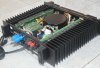
Anyone hear Accuphase pro amps?
Looks great inside, i hope they sound good too.
 

Attachments

  • ACCUPHASE PRO 3.jpg
    ACCUPHASE PRO 3.jpg
    174.9 KB · Views: 30
Anyone hear Accuphase pro amps?
Looks great inside, i hope they sound good too.

Good for domestic use as it is convection cooled, but probably wouldn't last long in my PA system running at full power for hours on end.....

There aren't a lot of pro amps which are convection cooled, but the ones that are make good HiFi amps.....No fan noise...:thmbsp:
 
similost - 'how in the f*#k can a 350w amp costing $700.00 sound as good as a 120w amp costing $5000.00?'

:banana:

Simple. It's all about expectations. You expect a high end amp to be expensive, so they overcharge you. There is nothing magical in the $5000 amp that is not in the best of the pro amps.
 
Many pro type amps have variable input sensitivity settings such as the Macrotech I have, which has three, .75V, 1.4V, and 26db.
QSC tend to be fixed, but in the service manual they give you the values of the resistors to change to obtain different gain settings....but most common is around the 1.5-2V range.....

Input impedance is usually up around 10K for most pro amps I work on, they usually are fairly high impedance because the designers assume that in a PA System you will be linking many amplifiers inputs together.....fairly standard for large systems......

Even the older McIntosh amps have to gain settings .75 and 2.5V.......


Yup, my Crown amps have the three settings too. I used the middle one for the averaging. Most don't though...albeit more newer amps with all the DSP stuff may have more options here than traditional. Even a fixed setting usually not a problem anyway unless you're trying to match up some big differences in sensitivity of speakers or something.

As far as the input impedance, yeah, 10k give or take is about what I've seen. Some a bit higher, some a bit lower, depends on too if running balanced or unbalanced. With many consumer amps running 30-50k input impedance, some 100k or more, it's relatively low in context of the comparison.
 
Last edited:
Yes they are. They are ugly but sound fantastic and are well built.

Yep one of the most ugly amps ever I think....:yes:

Yup, my Crown amps have the three settings too. I used the middle one for the averaging. Most don't though...albeit more newer amps with all the DSP stuff may have more options here than traditional. Even a fixed setting usually not a problem anyway unless you're trying to match up some big differences in sensitivity of speakers or something.

As far as the input impedance, yeah, 10k give or take is about what I've seen. Some a bit higher, some a bit lower, depends on too if running balanced or unbalanced. With many consumer amps running 30-50k input impedance, some 100k or more, it's relatively low in context of the comparison.

My Crown is modified to 32db (2.5V) which is what it needs to be for our PA system processors for the limiters.
I left it like that in my system because it actually matches up fairly well with the MC452 with what it needs to do with the subs.

Yeah some high end amps are pretty high impedance......I realized this after I made my post......
 
FWIW, I just bought a pair of Micro Tech 1200s this morning to use in parallel mono mode with my Thiel CS3.6.

I always thought the parallel mono mode would be interesting to run on some of those amp-killer speakers. The CS3.6 aren't known to be amp killers but they are, according to reviews, essentially 2.7 ohm resistors.

Micro Tech 1200 rated power in parallel mono mode:

620W @ 4 ohms
965W @ 2 ohms
1300W @ 1 ohm

Should have plenty to git'er done. ;)
 
Back
Top Bottom