• The move to the new server is done. There are some software and database maintenance updates in process. This has us passing the hat around to help out. We appreciate any donations. Seriously, even a dollar helps. The payment page may be found here - https://www.audiokarma.org/support.html

horns vs. speakers

CLS500

Well-Known Member
Can anyone provide a quick overview regarding the pros and cons of horns vs. speakers in mid-range, and tweeter applications???? I see them both used and am just curious about when and why the types are selected. Thanks....
 
Register to hide this ad
Horns are quite efficient number 1- more so than standard cone speakers. Horns can be overwhelming for some people however, sharp definition and perhaps not as delicate as some mediums. I think a good happy medium to full blown horns are "wave guides" like those used in some noted projects here in AK. When crossed over properly and a good driver the sonic transition is smooth and defined. I thought the Altec 811 horn to be quite exceptional, as used in the ALtec 19 design, until I went to a proper wave guide.

Where horns really sound exceptional is in folded bass horn designs like Klipsch Horns and some of Bill Fitzmaurice designs.

As for cones, domes, ribbons, etc there are still good places for those even yet- but if ou really want to fill a room then a large 14" x 10" wave guide is my personal choice.
DC
 
With horns you also have a huge assortment of compression drivers you can experiment with, with the others you are just stuck with how they sound/perform. Horns can be intimidating, and at the same time they can be fantastic when the right combination of horn, driver, woofer, is found.
 
There's really no way of describing the difference between any horn and any cone/dome speaker as they are all different. However, there are some things you can count on. A horn is more efficient, so it needs less power. Horns can also be a lot bigger, and they tend to need a large room to really shine.

If you have room for horns, try some! I feel like the horn tweeters I'm using now are a lot more detailed and smooth than any domes I've had in my setup before.
 
One other thing about horns is that they usually require a considerably more sophisticated crossover design, or at least a L-Pad to pad them down since they almost always have a lot higher sensitivity than the woofer they're being used with. That's not a negative, it just means a horn requires more planning when building a speaker with one.

My JBL's have a wave guide tweeter, and they sound great. Horns can too, or they can sound horrible, but then again, so can conventional drivers.
 
Sophisticated crossover? I guess it would be if you consider anything more than a cap on the tweeter as defining a sophisticated design. Introducing an L-pad just provides variable HF attenuation (in a 2-way for example) if your unsure what level of attenuation is needed. It can be easily replaced with fixed attenuation once it has been determined and measured. Many times, 1st order crossovers are desirable when it's a all horn loaded design and low power amplification is going to be used. I'd hardly view that as sophisticated.

A "waveguide" is still a horn is it not?


RC
 
All waveguides are horns, not all horns are waveguides. Waveguides tend to need more sophisticated crossovers because you have to have CD compensation.
 
Sophisticated crossover? I guess it would be if you consider anything more than a cap on the tweeter as defining a sophisticated design. Introducing an L-pad just provides variable HF attenuation (in a 2-way for example) if your unsure what level of attenuation is needed. It can be easily replaced with fixed attenuation once it has been determined and measured. Many times, 1st order crossovers are desirable when it's a all horn loaded design and low power amplification is going to be used. I'd hardly view that as sophisticated.

A "waveguide" is still a horn is it not?


RC

My point was that the crossover would need to be more sophisticated if one did not use an L-pad. It would take trial an error to get the level right otherwise.

Also, I was talking about the difference between a wave guide (conventional tweeter loaded in a wave guide) vs a straight horn (compression driver) which to me aren't the same thing.
 
Last edited:
All waveguides are horns, not all horns are waveguides. Waveguides tend to need more sophisticated crossovers because you have to have CD compensation.

That's a good observation/ comment. I tend to put waveguides outside the norm of tradional horn speakers as they need more "work" like proper drivers, xovers tweaks, compensations, etc, to best complete their integration into typical speaker uses.
DC
 
I guess I never have viewed that the addition of compensation or a L-pad would be considered sophisticated.


RC
 
More parts = more sophisticated, no? Compensation is rarely ever generic, with any compression driver you choose, the compensation network will be different if using CD horns.
 
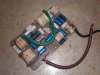
Here is a pic of the x-over from my old KEF Reference One-Two's high order 3-way. Not horn, but thats what I would consider to be in the sophisticated neighborhood ;)

I suppose that the addition of calculated compensation could be considered sophisticated when compared to a design not requiring it.


RC
 

Attachments

  • kef reference 1 x-over (816 x 612).jpg
    kef reference 1 x-over (816 x 612).jpg
    128.8 KB · Views: 65
Back
Top Bottom