
Splatter Pak
High-End Scrounger
Up to now, for me, it's just been dumb luck finding the synergy of amp and speaker.



Interesting, does this "ratio" have a name? And why is this ratio important? Does it mean the amplifier will deliver better dynamics or generally just pairs well with most speakers?

Past owner of both the 9000 and 11000 Sansui speakers, and they are very sensitive; properly restored it only takes a few watts to make them ring. Problem is that as much as I wanted them to sound good, they just don't. Sat them side by side with a pair of Altec 15 and they got utterly destroyed in the comparison, and I don't even like the Altec 15s that much.Every amp sounds different than every other amp ..
You are most likely listening to amp differences, and differing speaker sensitivities, not synergy ..
It's fairly difficult to get an idea of an amp's sonic character without a lot of comparison between differing components and differing speakers in your system.
What you're describing is exactly what I was remembering about the TEAC amps ..
Completely forgettable products .. unlike their Tape Decks, which was their main product, some of which were truly fine machines.
Those amps weren't on many short lists ...
Speaker sensitivity specs were mostly a product of the manufacturers imagination in those days also .. especially the Japanese manufactures at that time ..
They kept re-upping each other until their spec became meaningless.
Look around and see if you can find an independent non-manuf. sensitivity spec on the Sansui speakers.
Depending on the topology of the amp there often isn't much difference between 30wpc and 50 wpc ratiings. A lot depends on the amp's power supply, and the load that the speaker is presenting..

Past owner of both the 9000 and 11000 Sansui speakers, and they are very sensitive; properly restored it only takes a few watts to make them ring. Problem is that as much as I wanted them to sound good, they just don't. Sat them side by side with a pair of Altec 15 and they got utterly destroyed in the comparison, and I don't even like the Altec 15s that much.

Interesting, does this "ratio" have a name? And why is this ratio important? Does it mean the amplifier will deliver better dynamics or generally just pairs well with most speakers?
Agreed, there was lots of truth stretching and downright lying about specs, probably still is; measurement can be pretty subjective. The Sansuis did go very loud on little power, but didn't sound good doing it. Those massive woofers have no extension and don't reach far down or have any authority at all really.Then you know ... and it's a ported box which always helps ..
I just read every audio mag published back then, and the magazines were finding very different sensitivity specs than the Japanese speaker manufacturers were publishing... and a lot of those boxes were sealed and couldn't by design, have remotely what the manufac.'s were claiming.

Agreed, there was lots of truth stretching and downright lying about specs, probably still is; measurement can be pretty subjective. The Sansuis did go very loud on little power, but didn't sound good doing it. Those massive woofers have no extension and don't reach far down or have any authority at all really.
Too many drivers, and of not good enough quality, common problem with japanese speakers of the time. They do look very good next to a good Sansui rack though, which is where their only real value would be to me -- as collectible period objects. There aren't very many of the 11000 speakers out there; their value can only creep upwards regardless of the sound produced.
Interesting, does this "ratio" have a name? And why is this ratio important? Does it mean the amplifier will deliver better dynamics or generally just pairs well with most speakers?
Oh for sure, audio is really subjective and everyone likes what they like; my likes aren't going to be everyone else's, and vice versa. Keep enjoying the music.When I got the x11000 I was at first disappointed with the sound. After changing amplifiers around and recapping the speakers with poly capacitors, I ended up selling my la scalas because I vastly preferred the x11000. I've heard lots of high end speakers and the non high end x11000 just does it for me - what makes me like them is the huge impact the bass drivers produce, the lack of any boom, clear mids, and the slight sharpness of the horn tweeters. I really enjoy them on movies too, the clarity and impact is fantastic. They sure aren't for everyone though, and I can totally see why someone else might not like them as much as I do.

I suspect a lot of people who don't like Sansui speakers had the same issue you have. BTW, welcome to AK!
I have liked just about every Sansui speaker I've had. But I like low impedance speakers, so I tend to have better and more powerful amplification. However I also have had many speakers, amplifiers, and receivers go through this house. If it doesn't sound good with one piece, I try again until I get that Synergy.
As for the ratio between 4 ohms and 8 ohms, it can be challenging. Many manufacturers don't provide specifications for 4 ohms. Basically, only the better units will supply it, because it won't look good on a cheap amp or receiver. I agree with @Grenadeslio that the Kenwood KA-4006 would sound good with them. I've had great experiences with Kenwood receivers and amps, and I really don't understand why they don't get the respect they deserve. I had a Kenwood KA-4008 for well over a year, and I would have kept it, if I could have separated the amp from the preamp. It could drive every speaker I tried with it, and sound great in the process. Instead, I use a Sansui AU-9900 for testing equipment with. It works for the majority of gear I've tried.
I would suggest going to quality separates, but that's me. I think they are way better. I don't think I have any receivers in the house at the moment.


According to Ohms Law an amplifier that produces 100WPC @ 8 Ohms should be 200WPC @ 4 Ohms and 400WPC @ 2 Ohms. This is the theoretical ideal. Very few if any amplifiers match that theoretical ideal. However, the closer an amplifier comes to that ideal the better it almost always is.
Here's a link to a good explanation:
Ohms Law Tutorial and Power in Electrical Circuits (electronics-tutorials.ws)
Most of this is directly related to the power supply section. A better, stiffer, more capable power supply will take you closer to the "double down" power ratings.
One reason this is important is because there are plenty of 4 Ohm rated speakers. Many receivers and regular (not high end) amplifiers have a switch to set the amplifier for 4 Ohm operation. They do this by current limiting the power supply. This is an indicator of a marginal power supply.
The Ohm rating of a speaker is usually only a nominal figure. With an 8 Ohm rated speaker the actual impedance may dip below 4 Ohms at certain frequencies. Some 4 Ohm rated speakers may dip below 2 Ohms at certain frequencies.
Some speakers are easy to drive and work fine with just about any amplifier receiver. Other speakers present a load that many receivers and integrated amplifiers aren't comfortable with. Personally, I choose my speakers first and then acquire the amplifier necessary to drive them to their best. My main choices of speakers (planar magnetics, ESL's) are generally considered to not be receiver/amplifier friendly.
My Acoustats drop as low as 2 Ohms. The Magnepans are an almost true 4 Ohm load but like lots of current.

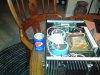


many pro amps will do this but that doesn't make them the best choice sonically, forced air cooling really helps
Just helps to make them lighter and better able to withstand being abused for many hours.

not always lighter
Thank you everyone for taking the time to answer my questions and sharing your stories. This has been very helpful. There is no doubt I'll be experimenting with different equipment, but now I'm equipped with some knowledge. I will also be relooking at some of the Kenwood amplifiers I had previously considered (KA-5700 and a KA-9100).
I also own a Technics SE-A900S which seems to fall in the "somewhat" decent amps category based on the comments in this thread. I bought the amp knowing it was faulty (distortion issue in the right channel) and so have not been able to try it with my speakers yet. I have already spent some time trying to find the fault but haven't had any luck - will be posting a seprate thread in the DIY forums with all the details later today. (P.S. I'm one of those electronics engineers that never got a chance to get any hands on experince with electronics in the real world. And so I'm trying to use my love for music as a way to learn/get some hands on experience while enjoying this hobby.)
Thanks again!
You're welcome ...
But during your experiments do try the Ohm's with a true separate power amp, with a damping factor above 70 ..
Properly powered they are truly unusual and excellent speakers ..
Most of the older Japanese amps and receivers have damping factors below 70 .. which is okay with a ported box system like the ESS,
but doesn't optimally control a sealed box like the Walsh.
 (1 review)


