• The move to the new server is done. There are some software and database maintenance updates in process. This has us passing the hat around to help out. We appreciate any donations. Seriously, even a dollar helps. The payment page may be found here - https://www.audiokarma.org/support.html

How Loud in db is LOUD?

What frequency of measurement/averaging would you suggest as most useful or accurate?

For the purposes here in the forum, most guys will be using a Rat Shack type db Meter, so these generally have two setting for averaging, they sometimes call it "response", which is simply "fast" and "slow".
I suggest using slow because it samples more data so its going to give a more realistic average reading....
 
my question to you folks in terms of db - is 100 db loud??

Funny thing abouy loudness, it is sometimes hard to judge the expanse of the forest while in the midst of the trees. In other words, if you want to know when something is loud, it is when the guy in the wife-beater shirt and buzz-cut white hair is standing at the top of stairs yelling at you to 'turn that **** down!' Whatever its measured loudness at that time, it is too loud.

But, more to your question, yeah 100dB is kinda loud, but as numerous others have chimed in, stating the weighting curve is important. But all is not lost. In my experience, the difference between A-weighting and C-weighting for classic rock type of music is right around 8dB to 10dB. With more modern types of music I have measured 12 to 15dB of difference between the two weights. Then again, just the other night (due to this thread surfacing), I measured a Klaus Schulze song (from the Body Love album) that measured the same for A-weighing and C-weighting - it was predominated by midrange synth sounds. So, if we assume you measured your SPL with a C-weight, then it would reasonably safe to assume you were experiencing around 90dBA of SPL.

The fun thing about perceived loudness is that for every 10dB of measured change, there is a doubling of halving of perceived volume. Therefore, if you think that 100dBC is purdy durn loud, then raising it to 110dBC would be TWICE as loud as what was already determined to be loud. Twice as loud as loud is really loud. But, it is something that you can get aclimated to easily. Play music at 100dBA for a while to adjust to this loud level, then crank it up another 10dB for a real loudness treat and wallow in this sonic bubblebath for a while. THEN, turn it back down to 100dBA and you'll think that 100dBA just ain't loud at all. Reminds me of when I was driving on the Autobahn, I decided to floor the rental to see how fast it would go. Turns out there was a limiter at 200KPH (~125MPH). After a while, that speed became the norm, and when I slowed back down to 100KPH it felt like I was crawling, even though just 30 minutes earlier 100KPH felt like I was zipping along after driving in town. In other words, whatever volume you listen at, it soon becomes the norm by which the next volume change will be judged.

Back in my college days a friend I worked with drove me from school to work and back from work to home. He'd ususally come in for some music listening before he went home for the night. We did this nearly every night. One night I saw that he picked up my SPL meter during a bass guitar solo on a Hawkwind album we were listening to. During the side change, when we could talk, he stated that the bass guitar was tickling the back of his throat and he was curious as to how loud it was. He measured 121dB at our listening position on the couch. To be fair, this was most likely a C-weighted measurement. Based on my previously stated experiences, it was most likely just a bit below 110dBA for a more useful way of experssing the measurement. We weren't trying to play it loud, or set any records, or see how loud it goes. Rather, this is just how we liked to listen to music.

The important thing, as a listener, is to pay attention to how your body is responding to the SPLs. If you're hearing extranious noises in your ears, or if they are feeling hot, or if you're becoming distracted or aggitated, then by all means turn it down. No band, no stereo, no feeling of machismo is worth losing your hearing over.
 
Yeah, but you yourself said they don't go over 100dB. JP is obviously a head banger. No slur intended. He needs something that reads excessive (IMO) levels.
The Studio Six app I use with an iPhone has ranges up to - 140 db!

I find anything hitting peaks more than 100 db uncomfortable. As my system has gotten better, I listen at lower levels and still get the same enjoyment. 85 db is plenty loud for me. :)
 
I discovered a couple of interesting things about "loud" recently.

Like most calibrated cineplexes, our local cineplex can sound loud, especially during the previews. I decided to see just how loud and took my SPL meter with me. Sure enough, the previews were annoyingly loud. I took a c-weighted reading with my meter and was surprised to find that the SPL was 84-86db, with some peaks around 91db. Certainly loud, but not as loud as it seemed.

I came home and set my dedicated home theater at our "action movie/concert" level. This is louder than normal, but nowhere near as loud as the cineplex. I did a measurement and SPL was... 85db! Why did the cineplex seem so much louder? I decided that it sounded louder because of their EQ, which was set for maximum intelligibility of the dialog, which would be a peaked midrange.

I also realized a paradox using good speakers that have been EQ'd for the home theater. You don't have to turn them up for them to sound good, yet when you turn them up, they don't sound as loud as bad speakers at the same SPL.
 
I appreciate the efforts of kevzep and others to continue the never-ending battle against the gross misuse of "dB" on the internets.

"decibel" by itself is just a ratio. You have to specify what you mean by "dB" for it to have any meaning. If we're talking about sound pressure levels, then add an SPL so that we know dB is in reference to 20 micro-Pa.

First we need to specify the frequency or the broadband frequency weighting. When we're talking about listening levels, A-weighting is usually the standard (though not technically the most appropriate for high levels). A-weighting is a good way to get everyone apples to apples. It is a broadband frequency weighting that gives us a single number that roughly responds to human hearing sensitivity on the 40-phon curve.

We also need to specify how we're operating in the time domain. For sound pressure level (SPL), which is what you folks are measuring with your smartphone or Radio Shack sound level meters (SLMs), there are two common time constants in use. They are usually called "slow" (1 s) and "fast" (1/8 s). There are also some oddball ones like "impulse" (different values for rising and falling slopes), and "peak" (specific to each SLM).

There are a lot of misconceptions about what these numbers mean. Some people say it's the update frequency of the display (my own boss said this until I set him straight). Some say it's a reflection of the number of samples used in an average. Some say it's the "averaging time", which is sort of the same as the number of samples. All incorrect.

It is the time constant of the second-order electrical system of your SLM. A shorter time constant means the SLM will have a shorter rise time, meaning it will respond more quickly to sudden changes in sound pressure. The result of a shorter time constant is usually higher measured levels for more transient sound sources when compared to measurements taken with longer time constants.

For getting a general sense of SPL in a situation such as listening to a stereo, the "slow" time constant is pretty good. The OSHA levels that are usually drug out in conversations like this specify the use of the "slow" time constant.

A better way of measuring these types of levels is with an integrating SLM. You know your SLM is integrating when you have the option to measure Leq, which is the "continuous equivalent level." Leq is independent of time constants. It represents the constant SPL which has the equivalent energy to the sound measured over the measurement period. A 30-second Leq is an excellent way to make an apples to apples comparison between listening situations.

But no matter what flavor of dB you use... ALWAYS SPECIFY. ALWAYS.
 
BTW, Loudest sound possible 194dB.
So even tons of TNT or a nuclear bomb is not louder than 194dB? :headscrat
Only on the rarefaction side. The compression side of the wave has no limit. Or I guess the limit is condensation to liquid.
 
Only on the rarefaction side. The compression side of the wave has no limit. Or I guess the limit is condensation to liquid.

Thanks.
Looks like after 170 dB, it's measured in PSI.
Found the answer here and is relevant information to post.
Some nuclear and volcanic explosions go as high as 347 dB = instantaneous death. :yikes:

http://www.makeitlouder.com/Decibel Level Chart.txt
Ultimate Sound Pressure Level Decibel Table , COPYWRITE WILLIAM HAMBY 2004

Decibel’s ( db ) are units of ratio’s and in this table are expressed in atmospheric decibels and in this table are REPRESENTATIVE OF THE OBJECT (N), and not neccesarily what the listener or sound level meter experiences (P).

(N) = NORMALIZED TOTAL AIR POWER ENERGY LEVEL SOUND PLUS ANY WIND, WATTS OR JOULES PER SECOND.THESE LEVELS HAVE BEEN CONVERTED

(P) = ACTUAL PEAK PRESSURE METER READINGS i.e. A FORCE PER UNIT AREA

(NP) = NORMALIZED PRESSURE USED IN EXPLOSIVE MEASUREMENTS, BLAST WIND IS NOT INCLUDED

(Q) = BLAST WIND DYNAMIC PRESSURE CREATED BY THE PEAK SHOCK FRONT OVERPRESSURE (P)

REF. = REFERENCE NUMBER OF DATA SOURCE AND YEAR IN APPENDIX BELOW

DECIBEL LEVEL (N = NORMALIZED)( P = ACTUAL PRESSURE) (NP = BOMB PRESSURE) CAUSE OR EFFECT

-80?(P) UNDERWATER NUCLEAR SUBMARINE MICROPHONES LISTENING TO SHRIMP CHEWING ON FOOD AT 100 METERS DISTANCE
-30 (N) ONE HUMAN TALKING 20 MILES AWAY ( 60 DB / METER AT A DISTANCE OF 20 MILES )-REF.1.2003
-4 TO +4 (N) THE TICKING OF AN ORDINARY WRISTWATCH AT 1 METER -REF.1 2003
0 (N) BEGINNING OF HEARING, A MOSQUITO 10 FEET AWAY, THE EAR DRUM MOVES LESS -REF.1.1990
THAN 1 / 100 THE LENGTH OF AN AIR MOLECULE (N)
3.5 (P) 1E-10 METERS OF MERCURY = 0.0000000001 METERS OF MERCURY
10 (P) ABSOLUTE SILENCE, ATT-BELL LABORATORY “ QUIET ROOM “
13 (P) ORDINARY LIGHT BULB HUM
15 (N) A PIN DROP FROM A HIEGHT OF 1 CENTIMETER AT A DISTANCE OF 1 METER -REF.1.2003
30 (P) TOTALLY QUIET NIGHTIME IN DESERT-IMPOSSIBLE ANYWHERE NEAR CITY
35 (P) ANECHOIC HEARING TEST ROOM -REF.1. 1998
40 A WHISPER, A NORMAL CONVERSATION IS 60 DB, NORMAL SOUND 70 DB -REF.1.1983
73.98(P) = 1 uBAR = 1 microbar pressure
85 BEGINNING OF HEARING DAMAGE, EARPLUGS SHOULD BE WORN
93.98(P) = 1 PASCAL PRESSURE
100 NORMAL AVERAGE CAR OR HOUSE STEREO AT MAXIMUM VOLUME -REF.1.1982
107-104 (P) THE BEGINNING OF PAIN AT THE MOST SENSITIVE FREQUENCY OF 2750 HERTZ -REF.1.1982
109 ONE SOUND WATT RADIATING AS A PERFECT SPHERE, 4 PI SQUARE METERS -REF.1. 1986
110 A CAR STEREO WITH TWO 6 X 9” SPEAKERS AND 100 WATTS -REF.1.1982
113.81(P) = 1 MILLIMETER WATER
114-107 A VERY LARGE, POWERFUL PORTABLE RADIO REF.1.1982
116 HUMAN BODY BEGINS TO PERCIEVE VIBRATION IN THE LOW FREQUENCIES -REF.1.1986
117-123 HOME STEREO SYSTEM, A VERY LOUD AND POWERFUL 200-2000 WATTS -REF.1.1983
120.24(P) ONE PURE SOUND WATT FLOWING THROUGH 1 SQUARE METER, YOUR ELECTRIC AMPLIFIER MAY BE 3000 WATTS.ALSO A TESTIMONY TO HEARING SENSITIVITY -REF.1.1986
120-130 FRONT ROW AT A ROCK CONCERT- UP TO 200 REFRIGERATOR SIZE SPEAKERS
AND 50000-300000 WATTS OF CLEAN, FULL FREQUENCY SOUND -REF.1.1981
125 DRUM SET-ONLY AT THE MOMENT OF STRIKING, CONTINOUS LEVEL 115
126-130 TYPICAL PROFESSIONAL D.J. SYSTEM -REF.1.1984
127 HUMAN TINNITUS (RINGING IN THE EARS) BEGINS -REF.1.1984
127.48 = 1 pound per square foot
128 (P)HUMAN, LOUDEST SCREAM MEASURED AT A DISTANCE OF 8 FEET 2 INCHES
128 HUMAN HEAD HAIR BEGINS TO DETECT VIBRATION -REF.1.1983
128 HUMAN CAN BEGIN TO DETECT VERY SLOW “BLAST WIND” OF 0.124 METERS/SECOND -REF.1.1983
130 (N)MARCHING BAND-OVERALL LEVEL AT A DISTANCE, 100-200 MEMBERS -REF.1.1996
132 EARDRUM “FLEX” TOTALLY NOTICEABLE -REF.1.1982
132.4(P) = 1 SOUND WATT MAXIMUM IN A SMALL SEALED BOX BELOW HYDRODYNAMIC CRITICAL LOW FREQUENCY
133 (N)GUNSHOT- EAR LEVEL, MAY VARY GREATLY TO SIZE AND TYPE OF GUN,
DURATION CONVERTED TO ONE SECOND, PEAK LEVEL MAY REACH 140-160 (P)
133.98 (P) = 1 MILLIBAR PRESSURE
135-122 (P) “VERY LOUD” CAR STEREO, ONLY BASS LEVEL, HIGHS RARELY ABOVE 115(P) -REF.1.1983
135-130(N) LARGE TRAIN HORN -REF.1.1985
135 HUMAN, A SLIGHT COOLING EFFECT BEGINS TO BE NOTICED, FROM AIR EXPANSION -REF.1.1983
136.498(P) = 1 TORR PRESSURE = 1 MILLIMETER MERCURY
137 HUMAN BODY VIBRATION IS STRONG -REF.1.1983
137-140 HUMAN EAR ALL FREQUENCIES ARE PAINFUL -REF.1.1983
140 EXTREMELY DAMAGING TO HEARING NO MATTER HOW SHORT THE TIME EXPOSURE
140 BLAST WIND = U = (PARTICLE VELOCITY) IS 0.49 METERS PER SECOND OR ABOUT 1 MPH
140 HUMAN THROAT AND VOCAL CORD VIBRATION BEGINS -REF.1.1983
141 HUMAN BODY BEGINS TO FEEL NASUEA AFTER A FEW MINUTES -REF.1.1983
141.918(P) = 1 INCH OF WATER PRESSURE
142 HUMAN BODY CHESTPOUNDING IS INTENCE -REF.1.1983
142 (P) INSIDE A CAR WITH TWO PRO 18 INCH WOOFERS AND 300 WATTS EACH -REF.1.1983
143 HUMAN BODY FEELS AS IF SOMEONE JUST FOOTBALL TACKLED YOUR CHEST -REF.1.1983
144 HUMAN NOSE ITCHES -REF.1.1983
145 HUMAN VISION BEGINS TO VIBRATE MAKING IT SLIGHTLY BLURRY, 1-3 DEGREES -REF.1.1983
145-136 (P)“COMPETITION” CAR STEREO, SIXTEEN 12 OR EIGHT 15, OR FOUR 18 SPEAKERS -REF.1.1983
146.1(P) AIR PARTICLE VELOCITY(WIND) IS 1 METER PER SECOND OR ABOUT 2 MILES PER HOUR
147 (N)FORMULA 1 RACE CAR, 700 HORSEPOWER, CHESTPOUNDING AND SUCTION FORCE ON CALM QUIET
MORNINGS CAN CLEARLY BE HEARD 6 MILES AWAY.-REF.1.1991
148 HUMAN VIBRATION VERY UNCOMFORTABLE AND SLIGHTLY PAINFUL -REF.1.1986
149 HUMAN LUNGS AND BREATHING BEGINS VIBRATING TO THE SOUND -REF.1.1986
150 (N)ROCK CONCERT “THE WHO” TWO 10 STORY STACKS = 144 DOUBLE REFRIDGERATOR SIZED SPEAKERS, ACTUAL LEVEL REACHED 120 DB AT A DISTANCE OF 32 METERS FOR THIS NORMALIZED READING OF 150 DB.CONTINOUS LEVEL 114-118db (P) AT 32 METERS -REF.1.1982
150 ROCK CONCERT SPEAKER AT 1600 WATTS ON THE ACTUAL VIBRATING SURFACE -REF.1.1991
150 HUMAN SENSATION OF BEING COMPRESSED AS IF UNDERWATER IS OVERWHELMING -REF.1.1983
150 HUMAN SOUND EXPERIMENTS DOWN TO 1 TO 2 HERTZ - REF.13.
152 HUMAN VIBRATION IS PAINUL AND ALSO FELT IN ALL JOINTS -REF.1.1983
153 HUMAN THROAT IS VIBRATING SO HARD IT IS ALMOST IMPOSSIBLE TO SWALLOW -REF.1.1983
154 TOY BALLOON POPPING, DEPENDS ON TYPE AND HOW LARGE AND HARD TO INFLATE -REF.1.1986
155 HUMAN BODY COMPRESSION AND EXPANSION TO VIBRATION IS TO THE “CORE” -REF.1.1983
155 HUMAN COOLING EFFECT IS HIGH, AS A GUESS 10 TO 25 DEGREES FARENHEIT? -REF.1.1983
156 (P)IN A MINI-VAN WITH TWENTY 12” WOOFERS AND 19,000 WATTS OF AMPLIFIER POWER.
EACH SPEAKERS IS DISPLACING (PUMPING BACK AND FORTH ) 0.75 INCHES
IF LONG HAIR WOMEN SIT IN IT, HER HAIR WILL FLY OUT OF WINDOW WITH BASS
WINDSHIELD WIPERS FLY OFF VEHICLE 1/2 TO 2 INCHES, DOOR AND FRONT
WINDSHIELD FLEXION MAY BE UP TO +-2 INCHES OR 4 INCHES PEAK TO PEAK
EVEN WITH EARPLUGS (-30 DB) AND HEADMUFFS (-24 DB) = -54 DB IT’S STILL LOUD -REF.1.1997
156.498(P) = 1 CENTIMETER MERCURY = 0.01 METERS MERCURY
158 HUMAN BODY VIBRATION IS VIOLENT, NAUSEA BECOMES MORE INTENCE -REF.1.1983
158 (P)INSIDE A ROCK CONCERT SPEAKER BOX REFRIDGERATOR SIZE AT MAX. 5000 WATTS -REF.1.1983
160 (P)FLASHLIGHTS EXHIBIT ELECTROMAGNETIC PULSING-EMP (DIMMING DURING SOUND) -REF.1.1983
162 U.S. FESTIVAL ROCK CONCERT 1983. 10 SEPARATE STACKS, AMPS = 400,000 WATTS (N) -REF.1.1983,-REF.3.
163-153 (N) N.H.R.A. DRAGSTERS- 5000 TO 7000 HORSEPOWER, LIQUID NITROGLYCERIN FUEL,
EARTHSHAKING AT 50 FEET, HUMANS FIND IT HARD TO SEE, AND BREATHE 140db(P) -REF.1.1987
163 (P)GLASSBREAKING LEVEL, MINIMUM, IT IS VERY HARD TO BREAK GLASS WINDOWS.
MANY STORIES COME FROM BREAKING GLASS BUT IT IS HIGHLY VARIABLE: IT IS
EASIER TO BREAK IF THE WINDOW ALREADY HAS A CRACK, IS VERY LARGE OR
OLD AND BRITTLE AND NOT CAR SAFETY GLASS WHICH CAN FLEX MASSIVELY
BEFORE BREAKING. AN OPERA SINGER AT 110 DB MAY BREAK A WINEGLASS BUT IT IS AN
EXAMPLE OF FREQUENCY RESONANCE, AND NOT HIGH SOUND DB LEVEL -REF.1.1987
163 (N)OCEAN WHALE REFERENCE 2 EXP-5 NEWTONS PER SQUARE METER
164 (P)INTERNAL SOUND PRESSURE OF A LARGE JET AIRPLANE TURBINE MOTOR -REF.1.1993
164.568(P) = 1 INCH MERCURY PRESSURE
165-145 (NP) THE COMMON TYPE OF FIREWORKS AT PROFESSIONAL PYROTECHNIC SHOWS -REF.1.1988
165 (N)JET AIRPLANE, BOEING 727-15,000 LBS OF THRUST, DEPENDS ON THE TAKEOFF -REF.1.1982
165(P) MOTOR DRIVEN PISTON HEADPHONES -REF.16.
166 AIR PARTICLE VELOCITY IS 10 METERS PER SECOND OR ABOUT 20 MILES PER HOUR
170.75 PRESSURE (P) = 1 P.S.I. = 1 POUND PER SQUARE INCH MOST SOUND READINGS
HIGHER THAN THIS REFER TO P.S.I. INSTEAD OF DB. BUILDINGS AND HOUSES
HAVE APPROXIMATELY A 50 % CHANCE OF SURVIVAL REF.2.
...
 
Part 2.
171-150 (P)WORLDS LOUDEST CAR STEREOS, UP TO 80 SPEAKERS,32 CAR BATTERYS,
100,000 WATTS, 125-138 (N)
171(P) acoustic air pressure generator -ref.12
172 (N) 727, 737, 747, 757, 767 CRUSING AT 6 MILES HIGH MACH 0.84, AT THE GROUND (SEA LEVEL) LOSES AN ADDITIONAL 6 DB BECAUSE AIR DENCITY IS ONLY HALF SEA LEVEL AT A HIEGHT OF 6 MILES
172 FOG IS CREATED, DEPENDING ON THE TEMPERATURE, DEW POINT AND HUMIDITY
173-164 (P)BASS INJECTION TESTS, EXPIERIMENTAL ELECTROMAGNETIC TYPE SPEAKERS -REF.1.1987
173(P) = hydraulic, whole body dynamic pressure chamber, at 8 hertz -ref.11.
174 AIR BEGINS TO HEAT UP DUE TO COMPRESSION, MOST SHOCK WAVES ARE VERY HOT
174(P) LOUDSPEAKER COUPLED MANOMETER HEADPHONES DOWN TO 1 HERTZ -REF.15.
175 (N) QUARTER DYNAMITE STICK, VERY CLOSE PRESSURE MAY EXCEED 210 db (P)
175.8(P) 1 TON T.N.T. AT 250 FEET
177 (P) = 2 P.S.I., DAMAGE TO STRUCTURES ARE SIGNIFICANT, 30% SURVIVAL -REF.2.
180 (P) 1 POUND T.N.T. AT 15 FEET -REF.4.
180 (P) = 3 P.S.I., DAMAGE TO STRUCTURES IS CATASTROPHIC, WHEN A SHOCK -REF.2.
WAVE HITS A STRUCTURE ITS MOMENTUM AND PRESSURE MORE THAN DOUBLES, ESPECIALLY AT HIGHER DB LEVELS, DYNAMIC WIND IS ABOUT 103 MILE / HOUR
AND CAUSES A LARGE PORTION OF DAMAGE, 15 % OBJECT SURVIVAL -REF.2.
180 (P) = MOTOR DRIVE COUPLED MANOMETER STATIC PRESSURE, 165 DB(P) UP TO 50 HERTZ, -REF.14.
182 (P) 1 TON T.N.T AT 150 FEET, EXACTLY 182.2 DB -REF.4.
183 (P) = 6 P.S.I. TOTAL DESTRUCTION OF ALL STRUCTURES, PARTICLE VELOCITY
(BLAST WIND) IS 180 MILES PER HOUR. 0.9 MILES FROM HIROSHIMA ATOMIC BOMB
AND 3.3 MILES FROM 1MEGATON NUCLEAR BOMB, LESS 0.1 % OBJECT SURVIVAL -REF.2.
185.75 (NP) 0.375 POUNDS OF T.N.T. RIECHTER -1.5
186.1(P) 1 POUND T.N.T AT DISTANCE OF 10 FEET -REF.4.
187 (P) 1 TON T.N.T. AT 100 FEET, EXACTLY 186.8 DB -REF.4.
190.60 (NP) RIECHTER SCALE 0 (ZERO) EARTHQUAKE
190.60 (NP) 2.0000 POUNDS T.N.T.
191 (N)BOMB-VERY SMALL 1 LB. OR GRENADE, VERY CLOSE PRESSURE MAY EXCEED 210 db (P)
193.806(P) = 1 KILOGRAM PER SQUARE CENTIMETER
193.979(P) = 1 BAR PRESSURE = 14.504 POUNDS PER SQUARE INCH = 14.504 P.S.I.
194.09(P) = 1 (ONE) AIR ATMOSPHERE = 14.6962 POUNDS PER SQUARE INCH = 14.6962 P.S.I.= 1 ATM
SOUND WAVES DISTORT AND ARE NOW DEFINED AS SHOCK WAVES AND THEY BEGIN TO FOLLOW SHOCK WAVE BEHAVIOR. PARTICLE VELOCITY (BLAST WIND) = 590 FEET / SECOND = 180 METERS PER SECOND = 402 MILES PER HOUR. -REF.2.
194.1(P)EXACTLY, 1 POUND T.N.T. AT 6 FEET -REF.4.
195-190 (P) HUMAN EARDRUMS RUPTURE 50 % OF TIME -REF.2.
195.2(P) 1 TON T.N.T. AT 60 FEET -REF.4.
200.59 (NP) 63.24 POUNDS OF T.N.T., RIECHTER SCALE 1
202-198 (P) HUMAN DEATH FROM SOUND (SHOCK) WAVE ALONE. DEATH FROM: SCHRAPNEL AT ANY LEVEL ABOVE 165 DB IS LIKELY AND BEING THROWN (10 FEET PER SECOND) ABOVE 180 DB -REF.2.
205.29(NP) 320 POUNDS OF T.N.T. RIECHTER 1.5
207 (N)BOMB, SMALL SIZED 250 POUNDS, 14 FOOT WIDE CRATER, NEARBY MAY EXCEED 238 db (P) -REF.2.
207.46 (P) = 68.48 P.S.I.= (Q), CRITICAL PRESSURE, THE SHOCK WAVE PRESSURE(P) AND DYNAMIC (BLAST WIND) PRESSURE(Q) ARE EQUAL, LOUDER THAN THIS DYNAMIC PRESSURE(Q) WILL ALWAYS BE MORE THAN SHOCK PRESSURE(P). BLAST WIND (PARTICLE VELOCITY = U) IS 1697 FEET PER SECOND = 518 METERS SECOND = 1157 MILES PER HOUR. 400 FEET FROM A 1000 TON T.N.T EXPLOSION -REF.2.
209 (N)BOMB, MEDIUM 500 POUNDS, 18 FOOT WIDE CRATER NEARBY MAY EXCEED 240 db (P) -REF.2.4.
210 N.A.S.A. 400,000 ACOUSTIC WATTS EXPIERIMENTAL NOISEMAKER 48 FEET ACROSS OF CONCRETE AND STEEL
210.6 (NP) EARTHQUAKE REICHTER SCALE 2.0
210.6 (NP) 1 TON OF T.N.T. and a 23.40 foot crater
212 (N) SONIC BOOM AVERAGE FROM JET -REF.5.
213 (N) SONIC BOOM GENERATES APPROXIMATELY 1.2 GIGAWATTS OR 1.6 MILLION HORSEPOWER -REF.1.2002
213 (N) BOMB 1 TON TNT, 23 FOOT WIDE CRATER OR 175.8 db (P) AT 250 FEET. 213.44 EXACT -REF.1.2.4.
214.09(P) = 10 atmospheres, DB(Q) BLAST WIND = 217.439 DB(Q)
215 SPACE SHUTTLE LAUNCH EXHAUST, APPROXIMATELY 3 MILES PER SECOND
215 (N)THUNDER, THE LARGEST POSITIVE GIANTS. ORDINARY THUNDER 165-180 DB.LIGHTNING STRIKE
ON OCEAN SURFACE 234db (P) AT 2exp-5 NEWTONS PER SQUARE METER
215 (N) BATTLESHIP NEW JERSEY FIRING ALL 9 SIXTEEN INCH GUNS
216 (P) INSIDE A NORMAL CAR ENGINE CYLINDER WITH A 9 TO 1 COMPRESSION RATIO
216.0 (NP)+-0.3 DB 6.5 TONS OF T.N.T. EXACT EXTREMELY ACCURATE HIGH TECH MEASUREMENTS -REF. 8
217.439(Q) = DYNAMIC PRESSURE BLAST WIND FROM A 10 ATMOSPHERE OVERPRESSURE
218.2(NP)sonic boom F-16. at 100 feet high = 3.92 lbs.per square foot = 139.6db, +78.6db = 8536.5 meters high -REF.1.10. 2002
220 (N)BOMB, LARGEST USED IN WWII, WIEGHING 11 TONS AND 25 FEET LONG -REF.1.3. 2001
220 (N)SATURN 5 ROCKETSHIP, MELTS CONCRETE AND BURNS GRASS ONE MILE AWAY
REACHED A VELOCITY OF 5 MILES PER SECOND AND MOON ON JULY 20, 1969
220 (N)SPACE SHUTTLE LANDING SONIC BOOM WITH VELOCITY OF MACH 20 -REF.1. 1998
225 (P) INSIDE A NORMAL DIESEL MOTOR SEMI-TRUCK CYLINDER 25 TO 1 COMPRESSION
226.59 (NP) TRAIN EXPLOSION 2004 FEB 19 09:37AM NEYSHABUR, IRAN, runaway train, possible terrorism, shattered windows at 15 km.,crater is 500 feet diameter and 50 feet deep, magnitude 3.6 riechter, at several miles "the entire area shook", heard at 75 km, equal to 251.195 tons of t.n.t., 51 car train = 17 cars sulpher, 6 cars gasoline, 7 cars ammonium nitrate fertilizer (a.n.f.o.), 10 cars cotton wool, 3 left at station not involved, 8 miscellaneous loads
228.1 (P)EXACTLY. 1 POUND OF T.N.T. AT A DISTANCE OF 1 FOOT -REF.4.
229 (N) SEAFLOOR VOLCANIC ERUPTION, REFERENCE 2 EXP-5 NEWTONS PER SQUARE METER
230.59 (NP) EARTHQUAKE RIECHTER 4.0
230.59 (NP) 1000 TONS OF T.N.T.
232 (N)LARGE NON-NUCLEAR EXPLOSION, 500 TONS, 1917 DESTRUCTION OF GERMAN
WWI TUNNELS IN MESSINES RIDGE BELGIUM, HEARD OR FELT IN LONDON (N) -REF.1.,-REF.3.
234.09(P) = 100 ATMOSPHERES, BLAST WIND = 241.46 DB(Q)
235 (P) 1 TON T.N.T. AT 10 FEET, EXACTLY 235.3 DB -REF.4.
(N)TORNADO AVERAGE, 5100 TONS OF T.N.T. -REF.1. 2004
235.19 (NP) EARTHQUAKE RIECHTER 5.0
235.19 (NP) 31624 TONS OF T.N.T.
240 (N)ONE KILOTON OF T.N.T EXPLOSIVE, 233 FOOT WIDE CRATER 29 FEET DEEP,10 P.S.I. AT 1000 FEET (P), 230 DB AT 10000 FT(N) -REF.2.
240(N)TORNADO, FUJITSU 5, ENERGY GUESS BASED ON 300 MILE PER HOUR WIND, 1 MILE WIDE -REF.1.1997
241.46 (Q) = blast wind pressure from a 100 atm overpressure
243 (N)LARGEST NON-NUCLEAR EXPLOSION EVER, 1947 DESTRUCTION OF NAZI U-BOAT PENS
USED 7100 TONS OF EXPLOSIVE -REF.1. -REF.3.
247 (P) BOMB INSIDE SHOCK WAVE MAXIMUM LIMIT PRESSURE OF T.N.T. EXPLOSIVE -REF.2.4
248 (N)ATOMIC BOMB-HIROSHIMA AND NAGASAKI JAPAN AUG. 6, 9, 1945.TRAGICALLY KILLED
300,000 PEAPLE. TOTALLY DISINTEGRATED 16 SQUARE MILES, CRACKED DISTANT CONCRETE WALLS 12” THICK, EQUAL TO 20,000 TONS OF T.N.T., WIND WAS AROUND 300 MILES PER HOUR, DESTROYED WALLS 28” THICK AT 1 MILE.POWER TO MAKE A CRATER 633 FEET WIDE AND 80 FEET DEEP -REF.1.2.
254.09 (P) = 1000 atmospheres overpressure, dynamic pressure = 261.721 db(Q)
255 (N) 600 KILOTONS GROUND BURST CRATER IS 2112 FEET WIDE AND 211 FEET DEEP -REF.2.
257 (N)NUCLEAR BOMB, 1 MEGATON (1 MILLION TONS OF T.N.T.) -REF.2.
(N)NUCLEAR BOMB "OAK" 8.9 MEGATON, ENEWETAK,JUNE 29 1958,5740 FEET WIDE 204 DEEP CRATER
261.721 (Q) = dynamic blast wind pressure generated from a 1000 atmosphere overpressure
274.09 (P) = 10000 atmospheres overpressure, dynamic pressure = 282.042 db(Q)
278 (N)NUCLEAR BOMB, “BRAVO” TEST 15 MEGATONS, 1954, BIKINI ATOLL, MARSHALL ISLANDS -REF.2.
(N)METEOR HITTING EARTH, “ARIZONA CRATER” SPEED WAS 44 MILES PER SECOND
AND ABOUT THE SIZE OF A HOUSE AND MADE A CRATER ONE MILE IN DIAMETER 20 MT T.N.T.
(N)NUCLEAR BOMB, 20 MEGATONS, SURFACE BURST CRATER IS 7392 FEET WIDE AND 792 FEET DEEP
282 (N)NUCLEAR BOMB, 57 MEGATONS HYDROGEN LARGEST EVER DETONATED, 1961
SHOCK WAVES CIRCLED THE EARTH 3 TIMES, FIRST ORBIT TOOK 36 HR 27 MIN. -REF.2.
282.042 db(Q) = dynamic wind pressure from a 10000 atm overpressure source
286 (N)MT. SAINT HELENS VOLCANO ERUPTION-BABY VOLCANO, BLEW DOWN TREES 16
MILES AWAY. COULD BE SEEN FROM OUTER SPACE ON THE SPACE SHUTTLE
BLEW OUT SOME WINDOWS IN SEATTLE-TACOMA 200 MILES AWAY, 163 db (P) -REF.20.
294.09 (P) = 100000 atmosphere overpressure, dynamic pressure = 302.0488 db(Q)
296 (N)EARTHQUAKE 8.6 RIECHTER SCALE- GROUND MOVED UP AND DOWN 13 FEET. -REF.1.3. 1988
...

 
Part3:
300 (N)HURRICANE – AVERAGE, EXTREME ENERGY IS “DILUTED” BY COVERING 500,000
SQUARE MILES. ENERGY = APPROX. 1000 NUCLEAR BOMBS A SECOND.
302(N) TUNGUSTA SIBERIA METEOR, BLEW DOWN HOUSES 600 MILES AWAY -REF.1.3. 1989
302.0488 db(Q) = dynamic pressure from a 100000 atmospheres overpressure
310 (N)KRAKATOA VOLCANO ERUPTION-1883 A.D., CRACKED ONE FOOT THICK CONCRETE
AT 300 MILES, CREATED A 3000 FOOT TIDAL WAVE, HEARD 3100 MILES AWAY,
SOUND PRESSURE CAUSED BAROMETERS TO FLUCTUATE WILDLY AT 100 MILES
INDICATING LEVELS OF AT LEAST 170-190 DB (P) AT THIS DISTANCE OF 100 MILES
EVEN WHEN SHOUTING IN SOMEONES EAR, COULD NOT BE HEARD AT 100 MILES
CAUSED FOG TO APPEAR AND DISAPPEAR INSTANTLY AT HUNDREDS OF MILES
ROCKS WERE THROWN TO A HIEGHT OF 34 MILES. DUST AND DEBRIS FELL CONTINOUSLY FOR 10 DAYS AFTER BLAST. PRODUCED VERY COLORFUL SUNSETS FOR ONE YEAR, EJECTED 4 CUBIC MILES OF
THE EARTH. CREATED ANTI-NODE OF NEGATIVE PRESSURE AT THE EXACT OPPOSITE SIDE OF THE EARTH.SOUND COVERED 1 / 10 OF THE WORLDS SURFACE, SHOCK (SOUND) WAVES “ECHOED” AROUND THE EARTH 36 TIMES AND LASTED FOR ABOUT A MONTH! -REF.19.
316 (N)VOLCANO ERUPTION SORANTINI, ITALY,1470 B.C. ALTHOUGH MORE ENERGY THAN KRAKATOA, IT BLEW UP OVER A LONGER PERIOD OF DAYS AND NOT AS VIOLENTLY, HENCE THE INSTANT PEAK PRESSURE IS BELIEVED TO BE LOWER -REF.1.3.
THAN KRAKATOA. 15 CUBIC MILES EJECTED, CREATED TIDAL WAVE 165 FEET
HIGH AT A DISTANCE OF 80 MILES -REF.3.
320 (N)VOLCANO ERUPTION, TAMBORA INDONESIA,1815, EJECTED 36 CUBIC MILES.APPROXIMATELY EQUAL TO
14,000 MEGATON NUCLEAR BOMBS OR A 14 GIGATON BOMB BASED ON EJECTED VOLUME,CHANGE IN MEGATONS TIMES 1.345 EQUALS VOLUME EJECTED CHANGE.IF WAS A NUCLEAR BOMB IT WOULD CREATE A CRATER ABOUT 12.4 MILES WIDE AND 1.33 MILES DEEP.INTERNAL PRESSURE IS BELIEVED TO BE ABOUT 47 MILLION P.S.I. = 347 DB (P) -REF.1.3.
 
I agree that scale is very important. But at the same time, I don't necessarily feel that only using A-scale measurements tell the full story.

A-scale tends to approximate the sensitivity of human hearing, which is great when trying to evaluate potential damage but not so great if you are trying to measure the output of your speakers.

You can probably find laptop speakers and table radios that can push 100db+ in A-Scale.

One factor that can easily separate a good speaker from a mediocre one is how it handles bass, where serious amplifier power and high-quality woofer construction are required. A-scale does an extremely poor job of quantifying the level of bass that is present.

If I was listening to music flat (no EQ), there will quickly become a point at which continuing to increase the volume is about as fun as asking someone to scream louder while they have a bullhorn aimed at my ear. There is just no need nor benefit for the vocal frequencies to get louder than a certain point, and it seems to me that this is where the biggest potential for damage is. But I don't listen flat, I EQ liberally. 130dBC is not difficult with my setup. In fact, as 130dB represents the limit of the meter, it's likely been louder than that. When taking readings with A-scale however, I stay mostly below 100dBA, always below 110dBA. But that is ignoring the vast majority of the sound energy that is coming from my speakers at that point. Beyond that point I start running into woofer over-excursion, etc.
 
Last edited:
If you're interested in measuring speaker performance you shouldn't be using any kind of broadband weighting anyway. You should be measuring 1/1-octave or finer.
 
@ Chris: I agree with you!

I have the same problem when listening to music. I like it loud but the vocals and crashing cymbals just plain HURT! I´m always trying to adjust the EQ to take out the pain and still sound good.

That´s not too much of a problem when listening to a complete CD, but when listening to all kinds of different songs from different albums it´s a real pain in the ass.
 
I agree that scale is very important. But at the same time, I don't necessarily feel that only using A-scale measurements tell the full story.

A-scale tends to approximate the sensitivity of human hearing, which is great when trying to evaluate potential damage but not so great if you are trying to measure the output of your speakers.

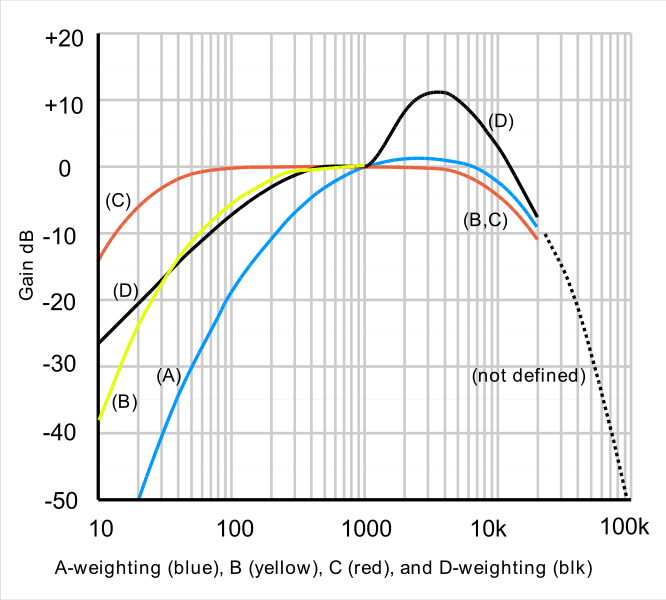
A-weighting was originally created for measuring low sound levels where human hearing sensitivity is much more attenuated on the low end than at, say, 80 Phon. The B- and C-weightings were created to measure medium and loud levels, respectively. Actually, A-weighting may not be so great for estimating potential damage from loud, low-frequency noise.

Cheers,

Otto
 
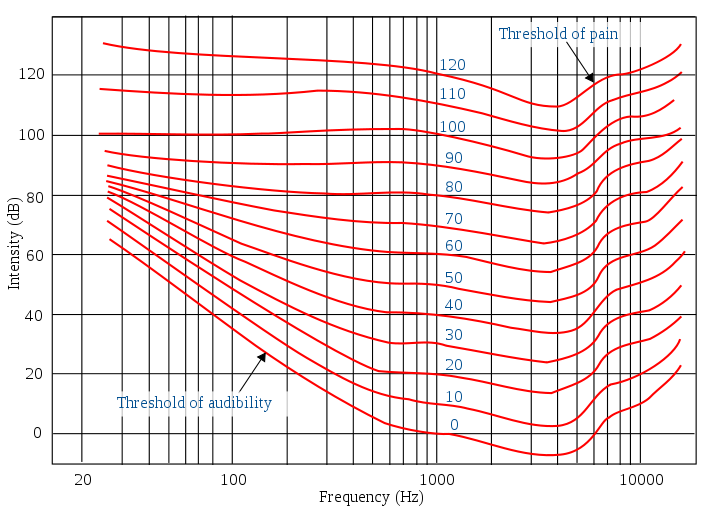
The relationship between the two is easy to spot. Human hearing is more easily damaged at the frequencies it is most sensitive to.

666px-Acoustic_weighting_curves.svg.png


714px-FletcherMunson_ELC.svg.png
 
Last edited:
The relationship between the two is easy to spot. Human hearing is more easily damaged at the frequencies it is most sensitive to.

I suppose, but most damage is caused by levels of 80 dB and up, where sensitivity is much more nearly flat than A-weighting. I'm not disputing what RevMen says about it being a reasonable indicator, because I don't know the research. However, assuming it is, that is just luck, because A-weighting doesn't correspond to sensitivity at the levels and frequencies of interest, as your graphs clearly show.

Cheers,

Otto
 
I've been in vehicles that was doing 151 dB on a termlab microphone, and that isn't considered " really loud" in the car audio world. I also had a stereo in my car that can pull a 140+ dB easy.

The reason why I'm not deaf right now is because human ears are not very sensitive to low frequency but very sensitive around the vocal range and higher. A blast of 150 dB at 40 Hz is loud but the perceived loudness won't be nearly as horrible as having 150 dBs worth of 3000 Hz coming at you going 1126 feet a second, the latter will also instantly and permanently damage your ears.


At home though, perceived loudness takes over as ambient noise is typically very low, around 30~40 dB or less. 110 dB in a room is plenty loud but again that's for midrange and tweeters, bass in the 120dB region is franky not that hard to obtain and that is also plenty loud.


... but it's never wrong to own something that's more capable than it really needs to be for your setup :D
 
As an interesting, shameless name-dropping aside, I once did a little work with Tom Danley, creator of the Servodrive Contrabass and many other great speakers. He formerly worked at NASA creating acoustical drivers (e.g. speakers) that could produce SPL levels high enough to levitate objects and thereby simulate zero gravity. True story.
 
Back
Top Bottom