• The move to the new server is done. There are some software and database maintenance updates in process. This has us passing the hat around to help out. We appreciate any donations. Seriously, even a dollar helps. The payment page may be found here - https://www.audiokarma.org/support.html

How Loud in db is LOUD?

kman77

Member
newbie on this forum
listening to stereo on and off since the 70's
just getting back into listening seriously
the last couple of months

my question to you folks in terms of db - is 100 db loud??
In my youth we never knew how loud anything was ( no iphone )
and we did play it loud
I downloaded a free iphone app the measures db
and I cranked it what I now think is loud and it measured
around 100 db.
is that considered loud ??? or something higher like 110db??

thank you
kman - living the dream
 
Register to hide this ad
100dB will ruin your hearing fairly quickly, so I'd call that loud.

wow -- thanks i am surprised my hearing ( i think it is good ) is what is now that I am in my 50's
because just now with my db iphone app 100db sounded loud but i know
in my youth i played it for long times at probably higher db than 100
ooops

thank you very much for the info

so is 90db a reasonable number?? for not damaging my hearing??
 
wow -- thanks i am surprised my hearing ( i think it is good ) is what is now that I am in my 50's
because just now with my db iphone app 100db sounded loud but i know
in my youth i played it for long times at probably higher db than 100
ooops

thank you very much for the info

so is 90db a reasonable number?? for not damaging my hearing??

The chart I posted above says problems start at about 90dB, although I think you need at least a few hours a day to hurt your ears at 90dB. People's ears also differ, some are tougher than others. I think the first thing that happens is high frequency hearing diminishes. People get tinnitus, too.
 
thank you all for the info

actually 80 to 90 db sounds real good to me on my new
paradigm atom bookshelves

now to shoot for 115db ( the wife is at the store for 1 more hour )
and crank open a cold one
 
Personally I think 100db is extremely loud. Still, it depends upon the individual, the room, the room's acoustics, the equipment being used, and the music being played. A lot of variables come into play.

cubdog
 
The chart I posted above says problems start at about 90dB, although I think you need at least a few hours a day to hurt your ears at 90dB. People's ears also differ, some are tougher than others. I think the first thing that happens is high frequency hearing diminishes. People get tinnitus, too.

No point in posting "I listen at 100db and its loud", there is no meaningful reference in that.
Loudness with regards to human hearing is always taken using dbA.
Then there are different time constants and averaging, so really all these parameters need to be stated when measuring for perceived loudness.

90dbA is actually quite loud, and personally too loud for me for any meaningful critical listening.
I find for me 82-87dbA with peaks at 89-90dbA to be the upper end of my loudness.

I can show my system off for short periods with certain types of music at 100dbA + with fast averaging, and it gets pretty scary up at those levels.

As a guide, most outdoor rock concerts are at 100ft (or at the mix position) between 103-107dbA.
I have done a few shows where the engineer for the act was mixing at 108 with peaks at 112dbA (slow) and that is way past the point of being too loud....and that is as loud as any modern stadium system will go these days....
When I am system engineering (setting systems up, not mixing the band) I always use hearing protection, I want some hearing left, and to be able to enjoy listening to music for the rest of my life.....
 
According to my Radio Shack analog db meter and the Dayton Omni Mic measurement system normal, close proximity conversation becomes difficult to hear from 85-90 db. That's about where I listen as that's the point my speakers really start to create some tactile sonic energy. When I'm actually playing with real musicians in a room it's generally around 110 db...and I make it a point to wear ear plugs under those conditions. I've played live gigs that reached sustained 115 db and I was pretty pissed at the sound man afterwards. Wasn't much fun for the audience, either.
 
I listen in the low 80s. I can't imagine willingly listening at over 90dB for any length of time.
 
130 db is the threshold of pain.

I believe the threshold of pain and serious permanent damage starts well before 130db.....and is that dbA or dbC?
According to my Radio Shack analog db meter and the Dayton Omni Mic measurement system normal, close proximity conversation becomes difficult to hear from 85-90 db. That's about where I listen as that's the point my speakers really start to create some tactile sonic energy. When I'm actually playing with real musicians in a room it's generally around 110 db...and I make it a point to wear ear plugs under those conditions. I've played live gigs that reached sustained 115 db and I was pretty pissed at the sound man afterwards. Wasn't much fun for the audience, either.

dbA or dbC? Sounds reasonable for in a room, when I was mixing in smaller venues and clubs with bands who were loud in stage sometimes we were up around 108dbA, even at that volume I always found it unpleasant....However, stage volume is another story, some bands can reach phenomenal levels onstage....

When I am mixing I like to work around 95-98dbA, maybe the occasional peaks slightly over 100dbA....but thats it.....any more and it is horrible, it becomes difficult to mix properly....
 
No point in posting "I listen at 100db and its loud", there is no meaningful reference in that.
Loudness with regards to human hearing is always taken using dbA.
Then there are different time constants and averaging, so really all these parameters need to be stated when measuring for perceived loudness.

90dbA is actually quite loud, and personally too loud for me for any meaningful critical listening.
I find for me 82-87dbA with peaks at 89-90dbA to be the upper end of my loudness.

I can show my system off for short periods with certain types of music at 100dbA + with fast averaging, and it gets pretty scary up at those levels.

As a guide, most outdoor rock concerts are at 100ft (or at the mix position) between 103-107dbA.
I have done a few shows where the engineer for the act was mixing at 108 with peaks at 112dbA (slow) and that is way past the point of being too loud....and that is as loud as any modern stadium system will go these days....
When I am system engineering (setting systems up, not mixing the band) I always use hearing protection, I want some hearing left, and to be able to enjoy listening to music for the rest of my life.....

forgive my lack of knowledge on this subject
but what does dbA mean? you mean an average between the peaks and valleys??

just trying to learn new stuff ( never too old for that )
 
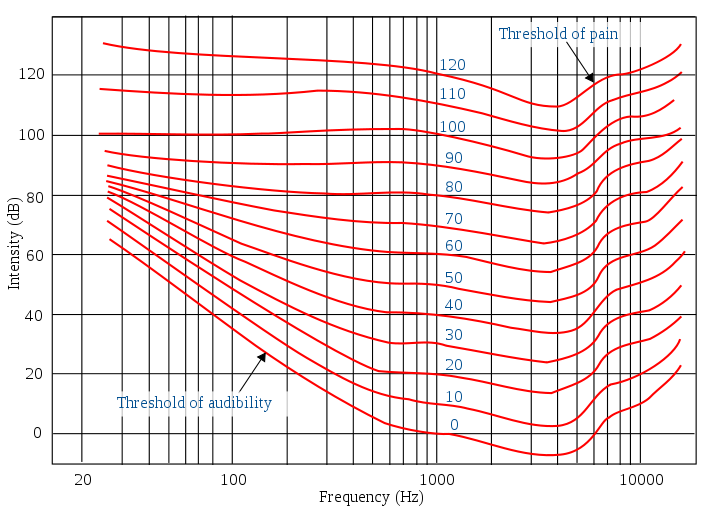
Many recording studio engineers will work at around 85db (A-weighted) for creating a final mix. This is done because the human ear theoretically has the flattest frequency response around that point. (Fletcher-Munson, etc)
 
714px-FletcherMunson_ELC.svg.png


Human hearing is most sensitive around the voice frequencies. That is why A-weighting puts so much emphasis on those frequencies.
 
Last edited:
thank you all for the info

actually 80 to 90 db sounds real good to me on my new
paradigm atom bookshelves

now to shoot for 115db ( the wife is at the store for 1 more hour )
and crank open a cold one

I've got those speakers also and 80-90 db is pretty much all you should push them at anyways:):scratch2:
 
so it appears that 70dbA to 90 dbA is a normal/good level.
and if it is and i can crank it to that with no problems with my 70 watt
amp ( room size - 14 x 17 ) there is no reason for me to own an amp
with more power?? is that correct or am i missing something?
I realize that if i moved this particular setup to a larger room in my house the sound level maybe all different
please educate me
 
I've got those speakers also and 80-90 db is pretty much all you should push them at anyways:):scratch2:

so when you guys judge how much power is feeding the speakers
you usually us a db meter to judge that?
i.e my little atoms should not really go over 90 db
and how do you know how much db for a particular speaker??
please dont think i am being a smart butt
 
Sometime back I had to do a bunch of acoustic calculations and found this site to have the best descriptions and formulas for various weighting methods.
 
Back
Top Bottom