• The move to the new server is done. There are some software and database maintenance updates in process. This has us passing the hat around to help out. We appreciate any donations. Seriously, even a dollar helps. The payment page may be found here - https://www.audiokarma.org/support.html

Inner Groove Distortion...

You know, I looked over this entire thread and not once did you mention what cartridge you are using, where you got it, how old it is, whether it is a new or old stylus. This turntable may not be an award winner, but I assure you it is not junk. What you paid has no bearing on its quality. People here have scored TOTL vintage turntables for $30. It is possible that some of your records have inner groove damage, but it is also quite possible that the stylus is bad.

First tell us about the existing cartridge and stylus. That may be the whole problem.


I beg to differ. The first message I put down to create this thread tells what stylus I have on the unit. It's original Pioneer stylus. No numbers, no model number, nothing. The only thing that is seen is "PIONEER" and "Made in Japan" and "3MC" that's all.
 

Attachments

  • DSC06829.jpg
    DSC06829.jpg
    46.7 KB · Views: 15
  • DSC06830.jpg
    DSC06830.jpg
    59.6 KB · Views: 12
  • DSC06831.jpg
    DSC06831.jpg
    41.5 KB · Views: 18
According to http://akdatabase.org/Pioneer/Turntables.htm the PL-S40 turntable should have come with a PC-5MC moving coil cartridge, but I think that is an error. The table also says that the PL-S40 was introduced in 1985 and the PC-5MC cartridge wasn't introduced until 1988. The PC-3MC was introduced in 1985 so that seems to be the correct cartridge that came with the turntable. Your cartridge does have at least part of the model number.

http://akdatabase.org/Pioneer/Turntables.htm also indicates that this is one of the rare moving coil carts with a replaceable stylus, the PN-3MC, which seems to be available online (turntableneedles.com carries it).
 
I beg to differ. The first message I put down to create this thread tells what stylus I have on the unit. It's original Pioneer stylus. No numbers, no model number, nothing. The only thing that is seen is "PIONEER" and "Made in Japan" and "3MC" that's all.
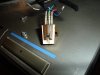
Sorry, missed that. Yes, I agree, you need a new cartridge or stylus.
 
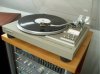
I am after my friend's Pioneer PL-560 (not the 1980's black plastic PL-560) He's looking for a replacement turntable, as soon as he gets one, I will have his PL-560. It looks like a beautiful solid machine. Probably then I will invest in a good cartridge. I will still need alignment though.
 

Attachments

  • PL-560 (1).jpg
    PL-560 (1).jpg
    109.4 KB · Views: 8
  • PL-560 (2).JPG
    PL-560 (2).JPG
    17.2 KB · Views: 10
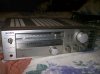
I am also after this Sony STR-V25. The person who listed it is asking for $50. I offered $35 but I don't think he will budge. That, also, looks like a decent piece equipment.
 

Attachments

  • STR-V25.jpg
    STR-V25.jpg
    50.9 KB · Views: 14
I am after my friend's Pioneer PL-560 (not the 1980's black plastic PL-560) He's looking for a replacement turntable, as soon as he gets one, I will have his PL-560. It looks like a beautiful solid machine. Probably then I will invest in a good cartridge. I will still need alignment though.
It is a nice machine. When you get it post back. There is another diagram for the PL-560 alignment, and easier to line up, I think, because the headshell is straight, not bent as on the PL-2.
 
Okay, the three variables in determining geometry are mounting distance (pivot to spindle), effective arm length and offset angle. The MD is fixed. The manufacturer chooses the null points. They don't necessarily have to coincide with any known protractor, but the Japanese mfrs used points that were close to Stevenson. The choice of points dictates the arm length (221 in this case) and the offset angle, which they designed to be the same as the headshell angle. That's why they say to make the cartridge square with the headshell. Most of the time the cartridge ends up somewhere in the middle of the slots.

The two null points are basically the two solutions to the Side-Side-Angle triangle formula. If you change a Stevenson table to Baerwald or Loefgren, you are changing the third leg of the triangle, therefore the arm length and offset angle must change. The arm length will now be greater than 221mm. Most of time this will push the cartridge forward beyond the limitation of the slots. The cartridge will also have to be skewed out of square with the headshell. If you have slot room in the headshell, you can do it, but for most users it is just so much easier to use what the mfr had in mind.

You won't have enough room in these straight arm headshells. But on s-arms, by using a Technics headshell, which is longer and has slots farther forward than most other Japanese s-arm shells, you can do Baerwald or Loefgren if you want. And some users choose to.

Yes, thanks I understand all that. What I dont understand is why B&L works on some Japanese arms, and not others. I guess it's due to certain arms that end up with "odd" effective lengths, mounting distances, or offset angles (or combinations of which) and I suppose (like you inferred) many were adjusted for OE specific null points that do not conform to B/L/S (although perhaps "close" to Stevenson) I did notice in the 2 primary tonearm databases that they often list the null points for specific OE arms so perhaps the OP can find something close there (PL1250?) if you are not getting good results with a test record.

http://www.cartridgedb.com/default_arms.asp

http://www.vinylengine.com/tonearm-database.shtml

So for a great many of the Japanese decks it's "SET THE OVERHANG, ALIGN THE CARTRIDGE SQUARE AND GO!" Got it!

I guess your diagram is essentially advising the 58mm on the Pioneer arms in order to establish the correct overhang.
But I still dont understand where you are measuring from. (Perhaps if I seen the arm it would make more sense)

Thanks for help

To the OP another possibility (besides a bad cart) for the type of distortion that you describe is the tonearm leads getting "tight" near the end of the LP and moving enough that it rubs off the insulation somewhere inside the arm or in the pivot tower creating a circuit fault. I'm not at all familiar with the Pioneers but you may want to open it up and at least inspect and possibly "adjust" the routing of the tonearm wiring as it enters the tower, or just rewire it.

Good Luck
WopOnTour
 
Yes, thanks I understand all that. What I dont understand is why B&L works on some Japanese arms, and not others. I guess it's due to certain arms that end up with "odd" effective lengths, mounting distances, or offset angles (or combinations of which) and I suppose (like you inferred) many were adjusted for OE specific null points that do not conform to B/L/S (although perhaps "close" to Stevenson) I did notice in the 2 primary tonearm databases that they often list the null points for specific OE arms so perhaps the OP can find something close there (PL1250?) if you are not getting good results with a test record.

http://www.cartridgedb.com/default_arms.asp

http://www.vinylengine.com/tonearm-database.shtml

So for a great many of the Japanese decks it's "SET THE OVERHANG, ALIGN THE CARTRIDGE SQUARE AND GO!" Got it!

I guess your diagram is essentially advising the 58mm on the Pioneer arms in order to establish the correct overhang.
But I still dont understand where you are measuring from. (Perhaps if I seen the arm it would make more sense)

Thanks for help

To the OP another possibility (besides a bad cart) for the type of distortion that you describe is the tonearm leads getting "tight" near the end of the LP and moving enough that it rubs off the insulation somewhere inside the arm or in the pivot tower creating a circuit fault. I'm not at all familiar with the Pioneers but you may want to open it up and at least inspect and possibly "adjust" the routing of the tonearm wiring as it enters the tower, or just rewire it.

Good Luck
WopOnTour
I really think the OP's problem is trying to use a cartridge with a 25 year old stylus. Had I read that more carefully in his first post, I think we could have cut to the chase. Once he has a new cartridge, I'm sure the 56mm diagram will work just fine. You'd have to see the tt to understand, but it's measured to the end of the headshell. There's a clear delineation between the end of the headshell and the rest of the arm.

B&L will work on just about any arm as long as you can choose the mounting distance and/or offset angle and/or have some slot room to play with the arm length. Once any or all of them are fixed, that limits the geometry--that's why they won't work on certain arms.
 
I also have a Realistic LAB36 Turntable I completely forgot about with Shure R47TX cartridge on it. There seems to be much less IGD on the Realistic compared to the Pioneer. Tonight, I will try to install the SHURE on the Pioneer and see how that goes.

Cheers;
Des
 
Hey;

I have a Pioneer PL-S40 turntable (I know not the best out there) with the original Pioneer stylus. I am having inner groove distortion problems. It happens with every LP I play on either side when the last song on each side plays. From what I read on Google, it is caused by either damaged record, poor tonearm alignment or a bad stylus. All of the LP's I tried were used, however, I have about 15 factory sealed, brand new LP's. I am planning on sacrificing one and see if the same problem occurs. Meanwhile, I am looking for a decent stylus which will eliminate or at least minimize the problem. I am leaning towards Rega Bias 2

http://cgi.ebay.com/Rega-Bias-2-Mov...39:1|66:2|65:12|240:1318&_trksid=p3286.c0.m14

Any ideas on the inner groove distortion problem and suggestions on quality stylus is welcomed.

Cheers;
Des


other possible problems: tracking force is off; anti-skating is off; vertical tracking angle is off. all of these as well as those you provided above are critical to accurate playback. when things are just right, inner groove distortion should be negligible at the most.
 
Hi again everybody and many thanks for your input and time. I replaced the PIONEER 3MC cartridge with the SHURE R47TX I took off from my Realiestic Lab 36. The difference is PHENOMENAL, even without alignment. I am not getting any inner groove distortion on any records I have. I get very little (totally negligible considering the condition of the LP is 6/10) IGD in Screaming For A Love-Bite by Accept which was unbearable with the 3MC. I can't wait to get a real good cartridge. That sort of answers my question. The problem was the cartridge... so far anyway. Relief.

Cheers;
Des
 
If you want to minimize inner-groove distortion, I would highly recommend the Audio Technica AT440MLa. One of it's characteristics is that it's supposed to greatly reduce inner-groove distortion. I'm using it right now and, for the most part, that's what it does. I'm not saying you won't ever notice it, but it will be greatly reduced.

You can find it for about 90-100 bucks new including shipping if you look around.

EDIT: I'm sure there are other carts out there that will achieve a similar effect, but this is the one I'm most familiar with, as I just got one on Tuesday.

funny you should mention that. i just started noticing a lot of inner-groove distortion with my AT440MLA. it seems to be very sensitive to alignment. i tried moving the cartridge more toward the front of the headshell and i guess i didn't have it as straight as before, and it made the end of Stairway to Heaven practically unlistenable. i'm going to straighten it out and move it back to where it was to see if that makes it better. i also don't know how old my AT is, so maybe i should just buy a new one and keep this as a backup.
 
funny you should mention that. i just started noticing a lot of inner-groove distortion with my AT440MLA. it seems to be very sensitive to alignment. i tried moving the cartridge more toward the front of the headshell and i guess i didn't have it as straight as before, and it made the end of Stairway to Heaven practically unlistenable. i'm going to straighten it out and move it back to where it was to see if that makes it better. i also don't know how old my AT is, so maybe i should just buy a new one and keep this as a backup.
When you hear inner-groove distortion it just sounds really scratchy, almost like when you push small speakers too hard and the sound starts to get all distorted, right? Because, if that's the case, I can honestly say I only hear it on a couple odd records here and there. When I have a nice, clean copy of something I can't hear much, if any, IGD.

But yeah, I would totally agree about the MLa being highly sensitive to alignment issues. The stylus is really tiny and there's a lot of room for error. I kinda want to move my stylus up in the headshell just a hair, but I don't want to risk screwing something else up because, as of right now, everything seems to be working well.
 
most of these are old, dirty, somewhat beatup records. i'd describe the distortion as an extra crackling that occurs toward the end of rising melodic passages, and really with higher pitched stuff in general. and when i say high, i mean as low as the higher end of the male vocal range, like Plant during the Stairway solo. it's pretty consistent between the records, i'd say. is that what you meant by pushing small speakers?
 
Back
Top Bottom