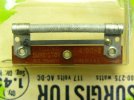
Thing is, just from looking at the picture of the device, it looks like the metal piece is completely disconnected when it is open, so there appears to be no current flowing through it to keep it warm. I may be missing something, though.My understanding is that the metal piece stays warm enough because of current flow through it to keep the contact closed. It only opens again once power is cut and it completely cools. Would be pretty useless to have it just open and close constantly.


You are using an out of date browser. It may not display this or other websites correctly.
You should upgrade or use an alternative browser.
You should upgrade or use an alternative browser.
Inrush current limiters, my thoughts and yours.
- Thread starter Carbsandcaps
- Start date
-
- Tags
- inrush limiter
I put sleeves (spaghetti) of various colors on all the bare component leads on my homebrewed stuff just for the appearance. Colors can also be used to signify where HVDC is (red, maybe), where AC heater voltage is (green, maybe), and where other circuitry is. When poking around with meter probes, the insulation also prevents accidental temporary shorts caused by careless probe positioning. I can see where I would not do this is I were banging out production units, though. For my own stuff however, nothing's too good for my little Fi-fi. N-n-nothing!Have been in plenty of old gear with no or very limited amounts of sleeves. Its not a bad idea and i use it in places but not on every single lead. Anywhere things cross gets a sleeve though

when open it uses resistor heat to close it, once closed it relies on current flow through the metal piece to keep it shut.Thing is, just from looking at the picture of the device, it looks like the metal piece is completely disconnected when it is open, so there appears to be no current flowing through it to keep it warm. I may be missing something, though.

I remember seeing the name "Surgistor," but don't think I ever saw the device itself. This is TV junk. Those Amperite delay relays OTOH were used in quite a bit of commercial transmission equipment and ham gear in order to pre-heat MV rectifiers. Failure rates were pretty low, especially when they were used in tandem with a relay to handle the brunt of the current.
Jack
Jack

Did they actually use the type shown in the earlier photo? I would have thought that would be way below Heathkit standards.I think the most well-known use of the surgistor was in the Heathkit W-5M as an official update to alleviate the initial high-voltage surge and perhaps related power transformer failures.

I'm gettin' a headache...


As I watched my fisher tube amp short out, zap like a welder for a full second and literally catch fire for a short time the other day due to a stray wire shorting B+ to ground the fuse did eventually blow but it got me thinking. I think a fast blow fuse is the better option for basically anything.
Can someone recommend a general inrush limiting setup for a tube amp? Maybe a thermistor part number or specification. Should it got directly to the B+ line or the 110v input? Would a delay start be better? The amp in question is an x-202-b using 7591 tubes.
Wouldn't a dim bulb tester with like a 60W bulb in it have avoided this melt down?

Yes. He'd need to watch the bulb as he ramped-up the voltage with each fire-up.Wouldn't a dim bulb tester with like a 60W bulb in it have avoided this melt down?

I have a large box of those in various configurations, but haven't found a use for them yet. This would be the way to go IMO for a Dynaco ST-70 clone with a SS power supply. I would have used one in my last amplifier, but there wasn't enough unused real estate to squeeze it in. Next time maybe...Thanks for the visual reminder of the time delay tubes. I haven't seen those in a long time, but recall a few supply drawers full of those of various values and contact arrangements, from back in the '80s.

WopOnTour
Hoarder Extraordinaire
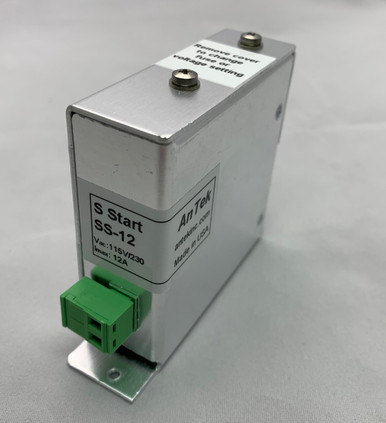
What do you all think of these Antek soft start modules? Seem simple enough. Perhaps combine them with a CL80?
 WOT
WOT

Attachments

Last edited:


Pio1980
AK Member
I recall seeing them I television sets, mainly series string heaters iirc."back in the day" there was an even lower tech solution for this. The heat from the resistor would close the bi-metal contact and current flow through the contacts kept it shut to bypass the resistor. Somehow I can't help but wonder about the long term reliability of this thing, and of course all the exposed mains voltage.
View attachment 3071565
May add more solid-state complications to the tube circuit.What do you all think of these Antek soft start modules? Seem simple enough. Perhaps combine them with a CL80?
WOT
More things to fail?

Lavane
Lunatic Member
Those I've seen.I think the one in the Heathkit is this style, but functionally the same sort of device. There is an Eico amp that uses this too but I don't remember which one.
View attachment 3071869
Pio1980
AK Member
Electronic repair parts suppliers had these and many other related items on wall cards behind the counter, Walsco?Those I've seen.