

You are using an out of date browser. It may not display this or other websites correctly.
You should upgrade or use an alternative browser.
You should upgrade or use an alternative browser.
Is this arcing?


Ah, good info on both posts -- you guys are tube university professors.
So... pretend scenario -- let's say I install a new (old) rectifier, and I don't notice that there is a short by visual inspection... I install it and fire the amp up, and by unfortunate circumstance, the fuse is faulty and fails to blow. How would this 'movie' play out? Would it be immediately obvious through other signs and events that something is seriously wrong, or would it rather be sort of a 'silent killer' where a few minutes later I start to smell smoke, as the transformer wires melt and other things overheat and burn?
Hi tea_hous, In the event you had a short circuit that does not give any visual clues, the first thing you'd likely notice would be a reduction in the amp's performance. Any short circuit will pull the voltages low resulting in a dramatic reduction in the sound output. If, for instance your amp usually pisses off the neighbors at volume level 5, but now you need to push it past 11 to get em bitching, that'd be a sign that something has dragged your amp's efficiency down, that something possibly being a short circuit. Of course there are other failures that can reduce your amp's performance that are not quite as dramatic as the short circuit, weak tubes for just one example or resistors who have drifted in value, but the short circuit will always present itself with reduced output, excessive current being drawn, and excessive heat being produced


tea_hous
Member
Beautifully detailed story init4fun  . Thank you! Actually, I'm surprised that the effects of a short would be this subtle / gentle (that is, until it isn't). I'd imagine you might see some abnormal 'glow pattern' visually in the tube as well.
Man... story of my life
. Thank you! Actually, I'm surprised that the effects of a short would be this subtle / gentle (that is, until it isn't). I'd imagine you might see some abnormal 'glow pattern' visually in the tube as well.You might be overthinking this.
Man... story of my life
Beautifully detailed story init4fun
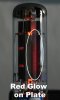
Sometimes yes, sometimes no, depending on the degree of the malfunction. One sign of distress for any tube, be it a rectifier or power output tube, is what's called "Red Plating" . A tube being forced to pass too much current will develop a red glow on it's plate (s) to indicate it's displeasure at being driven too hard. Things like shorted coupling capacitors and improper bias can cause this, and it's cause for an immediate shutdown and examination to find the fault.
tea_hous
Member
Oh right, I just saw a lot of mention about this as well while I was initially searching around for my issue. I'm glad to learn about this stuff 'by the books' following a (presumably) minor / non-detrimental tube failure... lemonade from lemons, so to speak. Now I'll know to keep my eye out for these signs in my future of running tubes. I guess I'm on the steep section of the 'tube' learning curve, after owning almost all solid state gear for decades (with the exception of a few small buffer tubes in preamps and DACs).


tonyg88
Super Member
I remember about over 10 years ago there was a youtube video of a teenager (must of been around 16yo and i can't find it now) describing his fisher 400 in one video how great it sounded. It was obviously all original and wasn't recapped and he made a 2nd video about one of the tubes having sparks going off inside and he left it playing and then you could see a little fire going on in the amp I'm guessing something shorted after that the sparking tubes.He had it in the wooden case still so it was hard to see exactly what was going on and the video was kind of dark. I believe it was the powertube some how sparking inside as the 400 has no rectifier tube..
tea_hous
Member
Another question for you profs.
Would you consider arcing or a short to be the bigger danger? I started thinking, isn't an arc basically just a short, only it lasts for microseconds instead of being constant? The arc finds a path through 'space' to temporarily 'short' two conductors...
This leads me to think that a short would be much more detrimental. If it takes a little time for a short to really do damage to other components (heating up the transformer windings, for example), I'm failing to see how the mere microseconds that an arc occupy would be of much danger at all...
I'm missing something here... I searched around, but didn't find much clear-cut info on this regarding vacuum tubes in particular.
Would you consider arcing or a short to be the bigger danger? I started thinking, isn't an arc basically just a short, only it lasts for microseconds instead of being constant? The arc finds a path through 'space' to temporarily 'short' two conductors...
This leads me to think that a short would be much more detrimental. If it takes a little time for a short to really do damage to other components (heating up the transformer windings, for example), I'm failing to see how the mere microseconds that an arc occupy would be of much danger at all...
I'm missing something here... I searched around, but didn't find much clear-cut info on this regarding vacuum tubes in particular.

arcs have a tendency to become shorts is the problem.
high current in very short bursts isn't good but a sustained short is a much bigger problem. If your amp can run into a dead shorted rectifier without blowing the fuse, the fuse is too big and/or it needs an HV fuse added.
high current in very short bursts isn't good but a sustained short is a much bigger problem. If your amp can run into a dead shorted rectifier without blowing the fuse, the fuse is too big and/or it needs an HV fuse added.
Got it -- this is in line with where my thinking was leading me.
Thanks everyone for sharing your knowledge -- superb community. Where should I send tuition payment?
Your welcome, and yes you'll find this a great site with many people willing to share knowledge.
If your serious about the payment thing, please consider becoming a "Subscriber" here for $25 . Among the upgraded features is access to "Barter Town" , this site's for sale / wanted to buy section.
tea_hous
Member
I was teasing about the tuition payment, but just yesterday I was considering becoming a subscriber -- specifically when I read in a couple other threads that Barter Town is where people get a lot of their tubes. I've received a ton of help and input through here in the past as well, so it seems right to contribute.

I've not seen any mention of WHY OP's rectifier tube lit up like that to begin with. When they nuke out like that, it's likely the tube puking on something like a junk electrolytic cap in the HV circuit, or even a toasted HV secondary feeding to the plates. The fact that it reacted immediately on power-up would get me checking that HV circuit prior to just pokin' another tube in there & hoping it too didn't freak out. The only rectifiers where bright blue-purple glow is normal are gas rectifiers (0A3, 0D3, etc.). These have no heated filaments per se.
Last edited:
tea_hous
Member
Ha, just when you think you're out, they pull you back in again! 
Well this doesn't sound good, but I'm glad you brought it up. Perhaps another prof will weigh in.
It's a bit confusing at this point... Most sources point towards a bad tube... For example, one site says,
"Purple glow – A cloudy purple or violet glow around the inside of the components although looks pretty, is a clear indication that there's a leak somewhere within the tube. If spotted, replace immediately before attempting to use the amp again."
Then, counterpointing this, here's an excerpt from a Sweetwater article:
"Fluorescence
This type of glow is usually violet in color and most noticeable around the inside surface of the glass bulb. It is most pronounced on power tubes and is the product of electron bombardment of the glass taking place within the tube. It generally has no adverse affect upon receiver performance, and in fact, tubes displaying this phenomenon are particularly good with respect to gas content."
Ooook . If I were to base my sole judgment on these two articles alone, it sounds like the main differentiating factor is whether the purple glow is more visible on the inside surface of the glass, or rather more concentrated around the conducting elements in particular (filaments, plates, etc.). It's a very fine line between the two descriptions.
In my case, if I were to choose, it actually seems more like the gas is 'behind the inside surface of the glass', so in that respect it must be a really healthy tube... However, I don't actually believe this due to other factors, such as the majority opinion of those who wrote in this thread, and the flashing that occurs at startup.
Eh, what's my point... I guess, simply, that this is a topic with more divergent information and opinions then I expected, and while I've learned a lot through talking and reading, I'm still not 100% sure what is happening with my tube.
Well this doesn't sound good, but I'm glad you brought it up. Perhaps another prof will weigh in.
It's a bit confusing at this point... Most sources point towards a bad tube... For example, one site says,
"Purple glow – A cloudy purple or violet glow around the inside of the components although looks pretty, is a clear indication that there's a leak somewhere within the tube. If spotted, replace immediately before attempting to use the amp again."
Then, counterpointing this, here's an excerpt from a Sweetwater article:
"Fluorescence
This type of glow is usually violet in color and most noticeable around the inside surface of the glass bulb. It is most pronounced on power tubes and is the product of electron bombardment of the glass taking place within the tube. It generally has no adverse affect upon receiver performance, and in fact, tubes displaying this phenomenon are particularly good with respect to gas content."
Ooook
. If I were to base my sole judgment on these two articles alone, it sounds like the main differentiating factor is whether the purple glow is more visible on the inside surface of the glass, or rather more concentrated around the conducting elements in particular (filaments, plates, etc.). It's a very fine line between the two descriptions.In my case, if I were to choose, it actually seems more like the gas is 'behind the inside surface of the glass', so in that respect it must be a really healthy tube... However, I don't actually believe this due to other factors, such as the majority opinion of those who wrote in this thread, and the flashing that occurs at startup.
Eh, what's my point... I guess, simply, that this is a topic with more divergent information and opinions then I expected, and while I've learned a lot through talking and reading, I'm still not 100% sure what is happening with my tube.
Last edited:

trobbins
Super Member
Some extra comments:
A tube could arc due to a few reasons, including the vacuum is becoming gassy, and cathode material has sputtered off on to the mica and that has reduced the PIV capability. Diode valves like the 80 can become gassy for a few reasons, including not being used for some time (ie. the getter hasn't been recently called on), and getting hotter than normal (ie. anode and glass outgassing has overwhelmed the getter's capability in the short term), and of course seal leakage and used-up getter.
Arcing current could reach the peak prospective current due to the peak winding voltage and the circuit loop resistance (which may include one of the diode's on-voltage/current characteristic). The diode's turn-on transient peak current rating indicates how high that current could peak to without degrading a good cathode that is initially cold, but parts of the cathode may get stressed at turn-on and splutter off some cathode material, and that could likely get worse and worse from each power up.
If you've paid a hefty price for a rectifier tube, and it has started to 'arc', then the ss diode mod may allow you to keep using that 'bad' tube and still retain the same diode voltage drop 'goodness' and 'sound quality' that made you pay big bucks for starters. The caveat is that the tube still shows normal on-voltage characteristics - which you may or may not be able to confirm - and hasn't become grossly gassy. Many will say just replace it and forgo the lost fortune - but if you don't retrofit ss diodes as well then you never know when lightning could strike twice imho
A tube could arc due to a few reasons, including the vacuum is becoming gassy, and cathode material has sputtered off on to the mica and that has reduced the PIV capability. Diode valves like the 80 can become gassy for a few reasons, including not being used for some time (ie. the getter hasn't been recently called on), and getting hotter than normal (ie. anode and glass outgassing has overwhelmed the getter's capability in the short term), and of course seal leakage and used-up getter.
Arcing current could reach the peak prospective current due to the peak winding voltage and the circuit loop resistance (which may include one of the diode's on-voltage/current characteristic). The diode's turn-on transient peak current rating indicates how high that current could peak to without degrading a good cathode that is initially cold, but parts of the cathode may get stressed at turn-on and splutter off some cathode material, and that could likely get worse and worse from each power up.
If you've paid a hefty price for a rectifier tube, and it has started to 'arc', then the ss diode mod may allow you to keep using that 'bad' tube and still retain the same diode voltage drop 'goodness' and 'sound quality' that made you pay big bucks for starters. The caveat is that the tube still shows normal on-voltage characteristics - which you may or may not be able to confirm - and hasn't become grossly gassy. Many will say just replace it and forgo the lost fortune - but if you don't retrofit ss diodes as well then you never know when lightning could strike twice imho
from the first post
just my 2 cents, I wouldn't read too much into why it may have failed based purely on the fact it was just shipped. Bang these things around and bad stuff can happen.
I just purchased a Yamamoto A-08s, and one of the tubes was damaged in shipping (despite being packed very well).
just my 2 cents, I wouldn't read too much into why it may have failed based purely on the fact it was just shipped. Bang these things around and bad stuff can happen.

cademan
Lunatic Member
One or two types of blue or purple glow described for rectifier tubes usually only pertains to gas rectifier tubes. Any directly or indirectly heated rectifier tubes should not have any blue or purple glow such as the 80, 5Y3, or 5U4 family of rectifier tubes.
Blue glow in output tubes such as 6V6, 6L6, 6AQ5, 6BQ5, 6550, EL34 etc. is perfectly normal.
Just get another 80 tube and be done with it.
Too bad you live far from me or I would bring over my spare 80 tube to check out your amp.
Blue glow in output tubes such as 6V6, 6L6, 6AQ5, 6BQ5, 6550, EL34 etc. is perfectly normal.
Just get another 80 tube and be done with it.
Too bad you live far from me or I would bring over my spare 80 tube to check out your amp.
Last edited:
tea_hous
Member
You guys are the best.
Trobbins -- that's deep knowledge -- you added some points that I hadn't read anywhere else. Thank you.
Ya, I'm going to follow this advice. I ended up buying two RCA globes (one will be a backup I suppose). Luckily, they are pretty cheap, so not that concerning if they die of natural causes (as long as the damage is isolated just to the tube). I'll update here when I finally get to try the amp with the replacements.
Ah, very generous - cheers to that!
Trobbins -- that's deep knowledge -- you added some points that I hadn't read anywhere else. Thank you.
just my 2 cents, I wouldn't read too much into why it may have failed based purely on the fact it was just shipped. Bang these things around and bad stuff can happen.
Just get another 80 tube and be done with it.
Ya, I'm going to follow this advice. I ended up buying two RCA globes (one will be a backup I suppose). Luckily, they are pretty cheap, so not that concerning if they die of natural causes (as long as the damage is isolated just to the tube). I'll update here when I finally get to try the amp with the replacements.
Too bad you live far from me or I would bring over my spare 80 tube to check out your amp.
Ah, very generous - cheers to that!