• The move to the new server is done. There are some software and database maintenance updates in process. This has us passing the hat around to help out. We appreciate any donations. Seriously, even a dollar helps. The payment page may be found here - https://www.audiokarma.org/support.html

Is your Lenco 'project' just sitting idle?

Hey again, "Conrack"
I have a B-52 as well as heavy plattered Lencos - and you're right, the light plattered version is less desirable because they lack the "flywheel" effect on speed stability as well as allowing more noise transmission to pass through the thin, pressed-out steel (mainly idler "whoosh").
That said, it certainly isn't a poor turntable - the motors are basically the same and they most often come with a metal idler wheel. I've recently been working with one to bring it up to all it can be. But sadly because of the smaller bearing, you can't just plop in the heavy 9 lb. platter.
- Mario
 
Yeah, you'd wreck a non-heavy platter unit trying pop a heavy platter in. I also think it doesn't fit.

Jean Nantais's approach is what turned attention to the possibilies of the heavy platter Lenco's, there are more people around that have the skills and knowledge to turn it into a great table. I hope mine will turn into that anyway. :D
 
Last edited:
I got a L75 years ago with the full intention of building a heavy plinth but... I found that replacing the original tonearm with a Decca International and fitting in some metal cone footers into a heavy base of birch ply and mdf was so satisfying that I never got around to actually building the heavy plinth. I hear absolutely no rumble and the sound is so clear and punchy that I've just lost the motivation. Maybe some day...
 

Attachments

  • Lenco 1.jpg
    Lenco 1.jpg
    83.3 KB · Views: 59
  • Lenco 2.jpg
    Lenco 2.jpg
    72 KB · Views: 70
  • Lenco 3.jpg
    Lenco 3.jpg
    77.5 KB · Views: 92
Yes, yes it is. :tears:

attachment.php


Steve
 
Last edited:
Yeah, you'd wreck a non-heavy platter unit trying pop a heavy platter in. I also think it doesn't fit.

Jean Nantais's approach is what turned attention to the possibilies of the heavy platter Lenco's, there are more people around that have the skills and knowledge to turn it into a great table. I hope mine will turn into that anyway. :D

You can convert some light platters to a heavy platter. Its a safe upgrade to do. I'm not sure of which decks can be converted though. But, I do know that the B51 is convertible, as I've done that one myself, and it works great.
Its the deck, that I suggested earlier in the thread, that I'm stuck on, due to the lack of a tonearm. I did the heavy platter conversion some time ago, and then just this past weekend, I set it up on some bean cans, and rigged a tonearm beside it. I was really impressed with what I heard with it on the skeletal bean can plinth. Its going to be a really nice deck when I finally get it finished.

adding:
The B51 is the first Lenco light platter TT that has the motor nose oriented to the left rear corner, which makes a huge difference in how a cartridge reacts with the motor. The earlier light platter decks had the motor nose closer to being below the tonearm, and it could result in EMI noise and vibration. With the motor to the left rear corner, you decrease this motor presence issue.
 
Last edited:
My L-75 is still sitting in its temporary spot in the middle of the lounge room, connected to my LM3886 amp and my diy phono pre. The joys of being single.
I've filled my time lately cleaning a 150 LP purchase. No RCM here.:scratch2: As well, I've taken on a huge "project" converting 2 poor condition VW Golfs (Rabbit) to 1 hopefully very nice one. I should post that up in the appropriate forum to put the pressure om myself. I need it...the pressure that is.
 
the motor nose
Which part is this mfrench?

I found that replacing the original tonearm with a Decca International and fitting in some metal cone footers into a heavy base of birch ply and mdf was so satisfying that I never got around to actually building the heavy plinth.
Sounds to me like you already have a heavy plinth. Is the top plate still floating or did you fix it to the plinth?


Ps I see in my cystal ball this is gonna be a looooong thread. :D
 
I have a Bogen B-52 as well. It's painted Army Green and I saw somewhere on Ebay where one like mine was being sold as an Army Signal Corps turntable. However, the B-52 is not a heavy platter table. I thought that only the heavy platter Lenco's (and Bogens) were the ones that were capable of being turned into audiophile quality tables. Although I also understand that the motors on these tables are all similar. So can I add a heavy platter to my B-52 to reach the L75 level of quality? This puzzles me greatly as my thought was that the heavy platter was determinative of whether such a table could be made to reach the level of quality that experts like JEAN NANTAIS are capable of turning into an audiophile quality table.

You are correct about the heavy-platter Lencos being the ones that can be upgraded into REALLY nice TTs. However, ones like the B52 are not so shabby, and since the motors are the same, you CAN add more mass to the platter, and it will still drive with stability.

Some people in the Lenco "community" have been "doubling up" or "stacking" the heavy platters, creating platters with twice the mass, and therefore much greater inertial momentum. You could do something similar to the B52, perhaps adding another platter atop it, or just a circular slab of a given material. The only concern would be over-stressing the bearing, which is a bit smaller than the bearing for the heavy-platter Lencos. Still, the bearings are over-engineered somewhat to begin with, so adding SOME mass to the platter should be okay.

You COULD even change the whole thing: platter AND bearing, but that would involve more work, as the alignment between the bearing center and the idler wheel should be maintained precisely.

I have an L78, L75 and a Bogen B52 (same as Lenco B52 if I'm not mistaken). I'm using the stock L78 as my main table, despite the usual issues with v-blocks and saggy tonearm stub, as well as it being still spring mounted. All have been in my hands for less than a year.

However, I have the 'desmo" v-blocks in the mail, so when they arrive I anticipate a flurry of activity to replace the blocks, sort the stub, sort the anti-skate weight, clean the bearing and a general fettling, as well as removing the springs and hard mounting the plate to the plinth. This is for the L78.

From there, time permitting (not likely in the next year) I'll plot out and build a new plinth, and install the MAS-282 tonearm I have.

The B52 is in one of those "record player" boxes, with an amp and speaker. The tonearm is broken (stub broke off due to stupidity). I simply haven't any idea of what I'm going to do with it, though the speaker should be a decent project. Too bad the amp is SS.

If you are planning to construct a 'layered" plinth with the whole original Lenco drive mechanisms underneath, there is a template on the Lenco Heaven site which you can download, print out (enlarged) and use to cut the layers from. It will save you a lot of work. It was made for the L75, but with just slight modification will work for other, similar models.

Please let us know how the "desmo" blocks work out for you. There are so many alternatives for V-blocks, it's hard to be sure which route to take, when replacing them.

It might be a fun project to see what you could do to "tweak up" the record-player box unit, adding as much mass and dampening/stiffening as you could, bolting the top-plate down with solid contact, etc... without restricting air-flow too much and overheating the amp (perhaps adding a silent fan?). Since you'd be deliberately transferring vibration into the box/plinth, you might have to isolate the amplifier some, instead of the TT. Add some mu-metal or other shielding, to reduce motor-generated interference in the amp, and to isolate noise from the transformer/amp from the cartridge, etc... Upgrade to high-grade discrete components in the amp. Just challenge yourself to "make a silk purse out of a sow's ear." It would fun to see peoples' jaws drop when they hear "one of those old things" sounding really almost "audiophile" good! :D

Which part is this mfrench?


Sounds to me like you already have a heavy plinth. Is the top plate still floating or did you fix it to the plinth?


Ps I see in my cystal ball this is gonna be a looooong thread. :D


Ooooooh, I hope your crystal ball is correct! If it is, that will be a refreshing change from half of the threads I start, which fall down like lead counterweights! :D

:scratch2:... And maybe if it stirs a few people to get those Lenco projects moving forward, it won't be a complete waste of server space, either. :D

 
Found out Peter's Top Plate is made by a guy form Amsterdam! Yay! (Not sure if I'm gonna use it yet..)

Anyway, I picked up my L78 yesterday. I never touched a heavy platter Lenco before, but man.. This is something else.. Slap another arm on this, brace the plinth a bit and you've got yourself something great already... Also didn't know my unit would come with a fluid cleaner, there are also two differently sized anti-skating weights present.. But the arm is gonna go anyway.

 
Which part is this mfrench?


Sounds to me like you already have a heavy plinth. Is the top plate still floating or did you fix it to the plinth?


Ps I see in my cystal ball this is gonna be a looooong thread. :D

The motor nose,...
The Lenco motor is essentially a triangular shape. The drive spindle is part of the motors rotor. The spindle is supported by a thrust plate on its rear end, in the stator. And, the opposite end is supported by a bushing and a small screw that contains a spring and a small thrust pad. This screw is referred to as the nose screw. The portion of the motor case that holds the nose screw is referred to as the motor nose.
The nose screw allows for a tensioning adjustment to keep the spindle from moving back and forth on the horizontal plane. Its orientation essentially has it pointed towards the left rear corner of the deck, towards the 11 o'clock position.

Sounds to me like you already have a heavy plinth. Is the top plate still floating or did you fix it to the plinth?

I do have several (4), and the top plates definitely get fastened down to the plinth. I also try to attach the platter bearing to the plinth to prevent top plate flexing (extremely heavy platter).
I've not used a PTP, but thats his most essential premise, is the attachment of the bearing to the plinth, and rigidity.
 
Last edited:
The 2nd question was for ejman ;)

Thanks for clearing up what the motor nose is, now I have to open up the L78 to look at the parts to 'place' your description. ;)
 
The second question,...
I'm still not awake yet - but I do have my coffee in hand now. So there is hope for the day.
 
The 2nd question was for ejman ;)

;)

I built some internal braces into the original Lenco base box so I could attach the metal cone footers. The Lenco top plate is attached by screws to the box and hence the braces. So I guess the contraption is sort of a quick and dirty heavier plinth. I sure wish I could compare it to a true heavy plinth to see if there is still more beautiful sound to come out of the old gal. Unfortunately, I don't think there are too many heavy plinthed Lencos in the wilds of South West Oregon to compare to.
 
ejman,

I think your internal additions will produce a very nice deck!
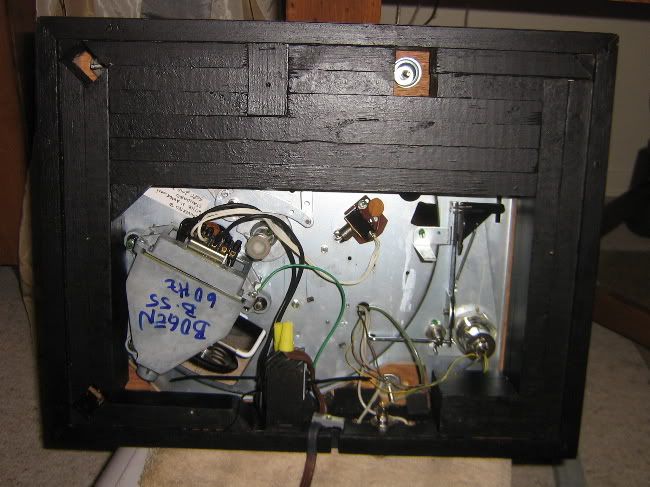
I built this one out for a friend of mine. I took a 50hz L75 deck, and converted it to 60hz (beside the point), and made an internally massive plinth.
I added 1x2 wood stock to the plinth body, and, though not in this picture (I stupidly forgot to take pictures of the added s.stone), I added pieces of soapstone scrap from other plinth projects. The s.stone scraps were screwed to the outer edge of the 1x2 wood strips, and were intended to act the part of a constrained layer that is to damp out vibrations and resonance of the wood.

IMG_0682JPG.jpg


I did critically compare this sleeper build to my more traditional massive plinths, and the results were very favorable.
 
ejman,

I think your internal additions will produce a very nice deck!
I built this one out for a friend of mine. I took a 50hz L75 deck, and converted it to 60hz (beside the point), and made an internally massive plinth.
I added 1x2 wood stock to the plinth body, and, though not in this picture (I stupidly forgot to take pictures of the added s.stone), I added pieces of soapstone scrap from other plinth projects. The s.stone scraps were screwed to the outer edge of the 1x2 wood strips, and were intended to act the part of a constrained layer that is to damp out vibrations and resonance of the wood.

IMG_0682JPG.jpg


I did critically compare this sleeper build to my more traditional massive plinths, and the results were very favorable.

Its good to know that the comparison to the massive plinths was favorable, any idea of what the additional weight of the wood slats + soapstone might be?
 
Well, it was most of an 8' stick of 1x2 oak that I used (garage scrap). And I did actually weigh the soapstone, at 6lbs. So, I wouldn't be surprised at all if I added ~10lbs to the plinth, maybe a bit less. I easily doubled its weight, and maybe double and a half'd it. In total the shipped package weighed just ounces under 40lbs (but I pack for air drop delivery). It made a very stout deck.
It also gave me an opportunity to far more substantially support the platter bearing, by bringing the plinth out to that area, so that I could build a contact support that much closer. This is a substantial upgrade.
 
Last edited:
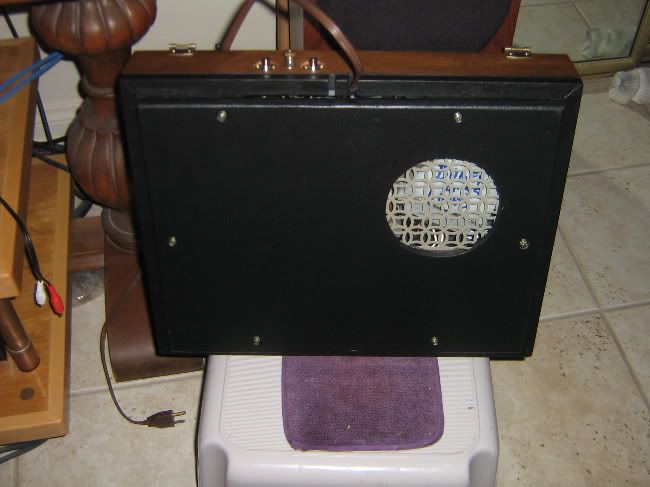
This is how I finished off the bottom of this deck, ^^.
IMG_0686JPG.jpg

The original plinth had a 1/8" thick piece of masonite covering the bottom.
When I put the wood slats into the plinth, I had one more layer in mind beyond the slats, and it was a .70"/18mm piece of birch finish plywood as a base plate. The vent screen is from another plinth building project, as scrap, reassigned.
What I'm not showing is three added 1/4-20 t-nuts and adjustable starter-level feet that were added to the base for leveling the deck. Sometimes I just forget about the camera.
The base plate attached to the inner layers of wood made for a fairly solid plinth upgrade.

At any rate,... I'm sorry if I've highjacked the thread. I'm just hoping to inspire some folk with some simple effective modifications that can easily be done. You don't have to go outwardly massive to get massiveness. And because its on the inside, mistakes don't show up; a great DIY starting point.
Do a lube job on the motor, and spindle bearing, mass out the interior, and you've got a hot rod.
 
Well, I finally started disassembling my L78,

I intend to use the original top plate in the 1st iteration of the conversion.
Does anyone know a set of pics or good info on how to mount the motor/idler assembly to the top plate?
 
Well, I finally started disassembling my L78,

I intend to use the original top plate in the 1st iteration of the conversion.
Does anyone know a set of pics or good info on how to mount the motor/idler assembly to the top plate?

I know I documented my cleaning. Ill see if the pics are on my computer.
I should at least be able to tell you where the short spring (motor mount) goes.

attachment.php


attachment.php


Steve
 
Last edited:
Thanks for the details Westy, I see projects using Peter's Top Plate mount the assembly to a separate section of the top plate;

9fmeqv.jpg
 
Back
Top Bottom