

You are using an out of date browser. It may not display this or other websites correctly.
You should upgrade or use an alternative browser.
You should upgrade or use an alternative browser.
Is your unobtainium power switch worth $5 and an hour or so of your time?
- Thread starter K7sparky
- Start date


i guess it would be in my best interest to turn the switch on when it's on the shelf not being used then. i'll leave a note on the cord.I’ve never tried anything like this before so YMMV, but it seems like a tiny amount applied to just the sanded surface of the contacts would help keep them clean during all the OFF time.


Scott Muni
Well-Known Member
I have used dielectric lubricant on low power switches. Have had no problems for several years since cleaning and applying the goo.
This is different than dielectric grease. Nye makes several products specifically for switches.
This is different than dielectric grease. Nye makes several products specifically for switches.
they seem pretty proud of that stuff.I have used dielectric lubricant on low power switches. Have had no problems for several years since cleaning and applying the goo.
This is different than dielectric grease. Nye makes several products specifically for switches.
Scott Muni
Well-Known Member
I get this from work with a 5 finger discount, same stuff.they seem pretty proud of that stuff.

No mod to switch so full voltage will keep destroying the surface. With mod to lower the voltage, current will help greatly. Still hard to tell how long or if will be a lasting fix if the contacts are as described.i had to edit my post.
so i need to ask if your answer is based on triac or no triac?
If mine would be looking for a replacement switch in better condition to use with mod.

i know this post is 10 years old but what are you guy's collective thoughts on contacts that were so pitted that i had to sand them with 1500grit?
it zeros out on the ohmmeter but there is no plating left, obviously.
edit: i need to add that i am asking about how long it will last with a triac.
Well, I’ve done the mod on two units. The first was my Nikko receiver. I had damaged the switch on that one by turning it on and off a hundred times in trying to track down a no protection relay delay problem. One time the contacts welded themselves together and it wouldn’t shut off. I shut it off at the power strip first, then turned the switch off. After 3 or 4 times doing that it made a different kind of click and the switch worked fine again. I then did the triac mod but I never took the switch apart to check. I know those contacts couldn’t have looked very good. But that was many months ago and it has been working fine since then.
The second was on a Marantz 2238B. The switch worked fine on that so that doesn’t help. I say do it!
Cheers………………..Todd


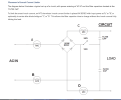
I've used the Ametherm inrush current limiter thermistor and the Quencharc snubber and they both work just as good as the triac mod, but with less wiring. NTC thermistor wired in series in either ac power in wire. The quencharc is wired in parallel with the power switch. Triac and NTC thermistor about the same price $2-3 each. The quencharc is expensive at around $15-25 each. I'd say triac mod is still the better option?
be
be
Last edited:

I've been using Quencharc Arc supressor/snubber RC network in place of a triac, it does the job and it is so easy to install. Installed parallel on power switch like a snubber.Thank you for that, very much and sincerely
I have long labored under the impression that once these devices, NTC thermistors designed specifically for inrush protection, had "opened"* for lack of a better term, that that was that, it's presence then only represented a small resistance value of about 14 ohms or less, depending on model
The spec sheets claim they are self-heating and once inrush current has settled, normal current is just that, normal and unimpeded by the device with a fairly substantial recovery time depending on model selected.
I have only used them with tube amps but have considered them for applications such as the one up for discussion
The cooling and subsequent resistance will fluctuate/go up that rapidly on a SS amp at idle?
What are these folks using them on here? Computer power supplies? Kind of amateurish video, but they are clearly embedding these in Solid State and some sort of switching supply?:
Just no good?
They do make a big distinction between these types and those used to monitor and control temperature on the various websites (manufacturers')
Thank you for the nice post
Joe
*as in open the door and let 'em in

Gknokers
New Member
Howdy @martin_pjr@y, Recently I was referred referred over to this thread and I stumbled along to your posts. I have and STA-85 with the same issues (at the very least any way). I just aquired mine and upon start up my light were flickering. Hows your unit holding up since your upgrade?Just finished performing this mod on my Realistic STA-85. Attached the Triac to an existing hole in heat sink. Luckily I was able to remove the alps portion of the switch and clean and reassemble it without to much difficulty. Running it through it paces now but seems to be fixed with no more flickering lights on power-up. Used Triac Q4025J6TP and 100 ohm gate resistor.
View attachment 3173090
I am new member and new at attempting electronic repair. I'm going to install a triac and resistor in the power on circuit. I looked on Mouser and found the triac, Q6025J6TP and I think I have the correct resistor 660-CFS1/2CT52R104J. I'm hoping someone can verify those part #s as this is my first run at shopping too.

Your part number for the resistor is a 100k ohm but you want a 100 ohm. Here's the same part family but a 100 ohm version.
The triac looks like what I remember.
The triac looks like what I remember.
Gknokers
New Member
View attachment 3160128Your part number for the resistor is a 100k ohm but you want a 100 ohm. Here's the same part family but a 100 ohm version.
The triac looks like what I remember.
Thanks! Is there a different part family I should be looking at? I will not be using the PCB, I will attach the resistor to the triac and switch with a wire. I saw thick film resistors too with different temp ratings, ( 588-TFSB100RJE )Does that make more or less sense to use? I already feel bad about the newB questions but I do want to get it all right including aesthetics.

CharlieBee
Super Member
It is good vintage hi fi practice to move the receiver volume control to minimum position before switching on the receiver or preferred, the switchable power switch to ON. If other stereo gear is also plugged into the switchable power switch it is also good practice to have those stereo gears power switches to OFF. This will put lower power across the switchable power switch and the closed receiver power switch also.
The use of switchable power switches used to protect the power switches of hi fi gear is still the lowest cost, easiest and quickest (5 minutes & no soldering) way to prevent having to change out a ruined gear power switch.
Charlie
The use of switchable power switches used to protect the power switches of hi fi gear is still the lowest cost, easiest and quickest (5 minutes & no soldering) way to prevent having to change out a ruined gear power switch.
Charlie
Thanks K7sparky, here it is in a Pioneer A400 rescuing the originally very sooty power switch.
Using 240v here.
Had the load on mt2 first attempt, it was inert, but swapped them over and seems to work. Reversed the flow through the switch so everything is after the fuse.
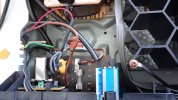
The littelfuse triacs were £6 for a pack of 2 from RS Components.
Using 240v here.
Had the load on mt2 first attempt, it was inert, but swapped them over and seems to work. Reversed the flow through the switch so everything is after the fuse.
The littelfuse triacs were £6 for a pack of 2 from RS Components.
Last edited:

cuda440
Well-Known Member
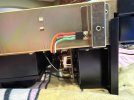
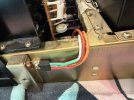
My client discovered this modification and wanted his SX-750 to have it done so here's my version of the triac installation using the Littlefuse Q4025L6TP.
Here's the switch end after the modification. The brown wire remains where it was and the orange wire is removed and replaced with a 100ohm 1/2W resistor as well as a new lead (white) heading to the gate of the triac. The snubber is removed.
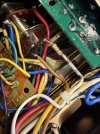
At the other end I added a new wire (brown of course to match the original) from the switched side of AC. This one goes to the M2 lead of the triac.
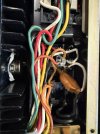
The original AC in (orange) is rerouted to M1 of the triac.
I puzzled for some time trying to figure out where to mount the triac. I then saw a great spot that didn't require any drilling.
Thanks to all who contributed to this mod.
Here's the switch end after the modification. The brown wire remains where it was and the orange wire is removed and replaced with a 100ohm 1/2W resistor as well as a new lead (white) heading to the gate of the triac. The snubber is removed.
At the other end I added a new wire (brown of course to match the original) from the switched side of AC. This one goes to the M2 lead of the triac.
The original AC in (orange) is rerouted to M1 of the triac.
I puzzled for some time trying to figure out where to mount the triac. I then saw a great spot that didn't require any drilling.
Thanks to all who contributed to this mod.