• Please note that Audiokarma will be offline briefly for updates early on Monday morning, September 28th.

Is your unobtainium power switch worth $5 and an hour or so of your time?

I have placed several orders with Digikey and never been happy with the results. I much prefer Mouser.
I ordered a Q4025J6TP from Mouser for a Kenwood KR-6050........& I feel the same about them vs. digikey. Two day shipping from Mouser is always 2-2.5 days.......digikey is always a day later & costs more. I'll use digikey if mouser doesn't have stock of what I need. Might be because I'm on the west coast, who knows.
 
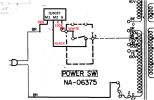
Installed as shown in this drawing and it is not acting as a on/off switch, is constantly on. What may I have incorrect?

1732378190297.png
 
Quick sanity check. With switch off, verify with meter that M1 goes to one side of AC plug. Easy to get M1 and M2 switched.
 
Thanks for the input from all. I found that i had forgotten to remove the snubber on the back side of the circuit board. It was hidding itself from plain sight.
 
I installed Q4025J6TP to a Au999 project I'm restoring. Works awesome, The unobtainable power switch will live for another 50 years.

Measured a 1.3 volt drop, assume is that an expected value? It's not even warm to the touch.


​

 
The Kenwood 6050 is the first one I've done & it was a good one to start with.......plenty of heat sink space right near the switch & ample room to work. The switch was still in decent shape......some pretty bad pitting on contacts but a good amount of pad left to sand down & polish. The unit works great now.
 
long thread but want to do this to my kenwood KR-6030 that is currently working ok. Hope i ordered correct parts.
576-Q4025J6TP or 576-Q4025L6TP from mouser .
And i remove snubber.
But was wondering how heavy of a wire to use coming off triac where resister is used ????
 
Last edited:
long thread but want to do this to my kenwood KR-6030 that is currently working ok. Hope i ordered correct parts.
576-Q4025J6TP or 576-Q4025L6TP from mouser .
And i remove snubber.
But was wondering how heavy of a wire to use coming off triac where resister is used ????
On the kr-6050 I did the original wiring feeding the switch seemed to be around 20awg solid core, so that's what I used since I had some. But the lead with the resistor is the "gate", & it won't be handling much current so I probably could've used 22awg safely.
 
On the kr-6050 I did the original wiring feeding the switch seemed to be around 20awg solid core, so that's what I used since I had some. But the lead with the resistor is the "gate", & it won't be handling much current so I probably could've used 22awg safely.

Is 576-Q4025J6TP (mouser) the correct part and remove snubber from switch
 
I just repaired a Kenwood KR-5010 that had crusty power switch contacts. Took the switch out to find contacts carboned up so I cleaned them with contact cleaner then aligned them for a better surface to surface contact. The switch is similar to the one pictured in post #17, first page.
When replacing the switch I added an alternistor to save the contacts. Getting the switch out wasn't easy and getting it back in was just as much fun.

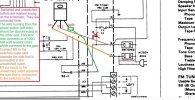
The schematic below explains most of what needs to be done. The left switch wire (looking from the front) runs back to the upright power board to the right of the transformer. Find where it's soldered on and remove it there. If using an alternistor the snubber cap isn't needed and that can be removed too. It's just below that wire you removed. If using a triac, keep the cap.

The wire you removed will now have a 100Ω ½watt resistor attached to it, then the resistor attaches to the Gate.
Next run a wire from M1 to the unswitched outlet side that isn't connected to the switched outlet.
Then run a wire from M2 to the switched outlet side that isn't connected to the unswitched outlet.

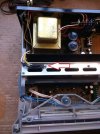
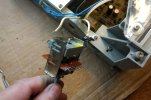
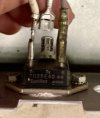
The pic below shows where I connected the alternistor. The yellow wire from M2 runs back to the switched outlet, the white wire from M1 runs back to the unswitched outlet.

IMG_20250425_134928015.jpg
Screenshot (218).jpg
 
I now use external On/Off switches on all my vintage gear to prevent further power switch wear. An ounce of prevention.......
 
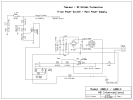
Here is a triac power switch from an AB International amp design (I redrew the schematic).

Works great I retrofitted it into a Phase Linear PL700B.


1745681796963.png
 
I just repaired a Kenwood KR-5010 that had crusty power switch contacts. Took the switch out to find contacts carboned up so I cleaned them with contact cleaner then aligned them for a better surface to surface contact. The switch is similar to the one pictured in post #17, first page.
When replacing the switch I added an alternistor to save the contacts. Getting the switch out wasn't easy and getting it back in was just as much fun.

The schematic below explains most of what needs to be done. The left switch wire (looking from the front) runs back to the upright power board to the right of the transformer. Find where it's soldered on and remove it there. If using an alternistor the snubber cap isn't needed and that can be removed too. It's just below that wire you removed. If using a triac, keep the cap.

The wire you removed will now have a 100Ω ½watt resistor attached to it, then the resistor attaches to the Gate.
Next run a wire from M1 to the unswitched outlet side that isn't connected to the switched outlet.
Then run a wire from M2 to the switched outlet side that isn't connected to the unswitched outlet.

The pic below shows where I connected the alternistor. The yellow wire from M2 runs back to the switched outlet, the white wire from M1 runs back to the unswitched outlet.

View attachment 3489917
View attachment 3489918

I had a KR-4010 that I did this to, and mounted it in the exact same spot. I have vague memories of taking out the switch which meant desoldering a ton of pins, cleaning it, reinstalling, finding that it still didn't work and no parts were available on ebay from donors, finding this thread, taking the switch out again, wiring this thing in, and having it finally work without the flickering. Sold the Kenwood years ago, but it was a really nice little receiver.
 
I had a KR-4010 that I did this to, and mounted it in the exact same spot. I have vague memories of taking out the switch which meant desoldering a ton of pins, cleaning it, reinstalling, finding that it still didn't work and no parts were available on ebay from donors, finding this thread, taking the switch out again, wiring this thing in, and having it finally work without the flickering. Sold the Kenwood years ago, but it was a really nice little receiver.
A dozen pins.

Was a bit of a challenge getting it back in. All pins had to be aligned right.

IMG_20250425_104636337.jpg
 
Is there any functional reason not to use a grossly oversized Triac?
I found this 25 amp 400v unit in a microwave oven that tests out fine.View attachment 3550015
Check the spec sheet on the Triac in question.
Make sure it is designed for inductive circuits.

As for current rating, I would expect most units would draw enough current to keep the Triac latched on.
I think I read a caution on this in a spec sheet may years ago.
You can always use an isolated scope and monitor the wave form
 
Last edited:
Back
Top Bottom