

You are using an out of date browser. It may not display this or other websites correctly.
You should upgrade or use an alternative browser.
You should upgrade or use an alternative browser.
JBL L100 crossover kit--Murphy or Troels Gravensens
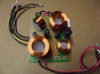

Coolhandjjl
Embiggened Pompatus
Foilcals are the metal labels on the baffle. They need to be removed to gain access the the fourth screw holding the crossover board in place.
They can be removed by first removing the drivers, heating the foilcals with a hair dryer, and carefully lifting them up with a wide putty knife
They can be removed by first removing the drivers, heating the foilcals with a hair dryer, and carefully lifting them up with a wide putty knife
R Swerdlow
Active Member
@Dale Hobbs10-15 minutes of practice with a soldering iron is probably all you need to learn how to do a simple crossover. YouTube University offers classes every day.
I think removing the foilcal without damage is a bigger challenge.
It doesn't have to be pretty since it will be inside the cabinet. I would recommend testing them outside the cabinet (run long wires through port tube) until you are sure they are right.
I thought about this same project years ago before I sold off my L100s. I would try the Dennis Murphy version over the TG version.
Last but not least, keep the old crossover intact just in case you go to sell them and someone wants to revert to original (or use as an excuse to beat you up on price). Ditch the old twist-style speaker wire connectors and replace with decent 5-way binding posts if you didn't do it already.
All of donprice's advice is good. Practice soldering before you try to do anything that is meant to be for keeps. When I built the new crossovers for my L100As, it was the second time I built crossover boards. My first work, was a much simpler 2-way crossover.
For what it's worth, I never tried to remove those foilcals. I simply left them as they were. I also left the original JBL crossover boards in place. I removed the woofer, and cut the wires running from them to the drivers and binding posts, leaving about 6 inches for me to work with as I attached the new much larger board.
And yes, definitely replace those original JBL spring-loaded binding posts with decent 5-way binding posts. You'll probably find that job is the easiest to do.
I did discuss all this in more detail in my write up.
Last edited:
R Swerdlow
Active Member
Is that photo the same as this?Thanks for the reply. Sorry, newbie here..whats the foilcal? Also, are you familiar with this crossover from Laspada Audio for the
https://www.laspadaaudio.com/product-page/laspada-audio-bl-3w-1920-3-way-crossovers-pair-1
Don't use that crossover in your JBLs. That expensive ($275 per pair!) generic 3-way crossover will not work well in your JBL speakers. When Dennis Murphy designed the crossover I described in my write up, it was custom made for the woofer, mid-range, tweeter, and cabinet that JBL used in the L100A speakers. No off-the-shelf generic crossover can substitute, or even come close.
R Swerdlow
Active Member
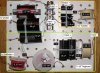
If it helps, here's that same photo of my crossover board, labeled to show woofer, mid-range, and tweeter circuits, and to show values for each part. When I took that picture, I hadn't yet soldered anything, nor had I attached any wires to the board.

Lou F Quincy
Super Member
Nice work.
My vanity refuses to show my sloppy result.
My mid circuit was merely a Parts Express 800h to 5kz band pass with an added 1 ohm resistor.
I notice your mid circuit has 3.5 ohms of r. Does that much resistance de-emphasize the mid presence?
What is your overall ohm reading at 5 ways?
https://www.parts-express.com/800-5...uqFxlapc-91VyI1odT3NvrtrOConNXaoaAp64EALw_wcB
My vanity refuses to show my sloppy result.
My mid circuit was merely a Parts Express 800h to 5kz band pass with an added 1 ohm resistor.
I notice your mid circuit has 3.5 ohms of r. Does that much resistance de-emphasize the mid presence?
What is your overall ohm reading at 5 ways?
https://www.parts-express.com/800-5...uqFxlapc-91VyI1odT3NvrtrOConNXaoaAp64EALw_wcB
Last edited:
R Swerdlow
Active Member
I found it was much easier to get nice looking results if I gave myself lots of room on the board. That board was 7×10".Nice work.
My vanity refuses to show my sloppy result.
I never looked to see what the overall DC resistance is. Loud speakers see an AC music signal. Here is an impedance vs. frequency sweep. Overall Impedance is the black line, blue line is the woofer, red is the mid-range, and green is the tweeter.I notice your mid circuit has 3.5 ohms of r. Does that much resistance de-emphasize the mid presence? What is your overall ohm reading at 5 ways?
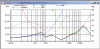
The three resistors in the mid-range circuit are there, along with several of the other components, to create a band pass filter between 950 Hz and 5 kHz. That mid-range driver loudness differs widely between those frequencies, and it had to be leveled and balanced. See the raw frequency response of the mid-range driver below. It ain't even close to being flat.
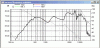
The rest of those components (see the schematic below) help shape the roll-off curves of the band pass filters so they work better with the roll-off curves of the woofer and tweeter, and help filter out the shrill sounding resonance peak at 6-7 kHz seen with the old JBL crossover. It took a lot of work to get that to be decent. The woofer and tweeter networks were easy in comparison.
Lou F Quincy
Super Member
I was all set to do the Murphy plan when I got intrigued by the XSim free download crossover design program and started experimenting with theoretical component options. It was a fun project to plan and put together.
Mine turned out much simpler and I'm not regretting it, but I would like to hear what I'm missing from the Murphy.
Winter is here, perhaps I'll tinker with them some more.
Btw, I did the side by side before- and-after, left-right testing for several weeks. Quite fascinating what a difference there was.
Mine turned out much simpler and I'm not regretting it, but I would like to hear what I'm missing from the Murphy.
Winter is here, perhaps I'll tinker with them some more.
Btw, I did the side by side before- and-after, left-right testing for several weeks. Quite fascinating what a difference there was.
IndianRider
Member
Hi @R Swerdlow
I saw your writeup on the L100 Murphy. Nice job.
I am sourcing the inductors from Madisound. They will unwind inductors that are too big for a small up charge which is fine with me. They indicated that the parallel caps, inductors and resistors aren't as critical with the actual sound quality as compared to the series elements? Sounds like C1021, C2081, C3061 could all be a basic capacitor like a Dayton or Bennic, and then the series elements C2011, C2031, C3011 and C3031 could bump up to a clarity cap or some other. I've heard that the Solen and Dayton may sound a little harsh. Who know if that is real or BS?
Thanks. Bob
I saw your writeup on the L100 Murphy. Nice job.
I am sourcing the inductors from Madisound. They will unwind inductors that are too big for a small up charge which is fine with me. They indicated that the parallel caps, inductors and resistors aren't as critical with the actual sound quality as compared to the series elements? Sounds like C1021, C2081, C3061 could all be a basic capacitor like a Dayton or Bennic, and then the series elements C2011, C2031, C3011 and C3031 could bump up to a clarity cap or some other. I've heard that the Solen and Dayton may sound a little harsh. Who know if that is real or BS?
Thanks. Bob
Last edited:
R Swerdlow
Active Member
The audio signals that pass through these crossovers are AC, not DC. The idea that parallel crossover components matter less than series components might apply to DC circuits, but not AC circuits. In an AC circuit, all components can effect the sound. At least, that's what I've been taught.I am sourcing the inductors from Madisound. They will unwind inductors that are too big for a small up charge which is fine with me. They indicated that the parallel caps, inductors and resistors aren't as critical with the actual sound quality as compared to the series elements? Sounds like C1021, C2081, C3061 could all be a basic capacitor like a Dayton or Bennic, and then the series elements C2011, C2031, C3011 and C3031 could bump up to a clarity cap or some other. I've heard that the Solen and Dayton may sound a little harsh. Who know if that is real or BS?
I find that sound quality is not audibly different when low-priced polypropylene film capacitors are compared to high priced poly caps, when all other things are equal.
Does a pecking order exist in sound quality due to the price of different brands of poly caps? That idea is supported by some, but not others. It's been widely argued in internet audio forums for as long as I can remember. A few efforts have been made to scientifically settle the question. They've all ruled out the possibility of audible differences. Cap brand names as well as their purported sound qualities, are only audible if the listener knows, in advance, what brand caps are in use. Despite that, the debate continues … as you've noticed.
What I have found to be definitely audible is when caps deviate more than 10% from the specified value in the schematic diagram. But that problem fades away as poly film caps are now widely available in many capacitance values, and with ±5% tolerances.
It's your crossover build, so you can do what ever you like. But I think these crossovers are already expensive enough. Don't spend more money than you have to. I have used inexpensive poly caps from Dayton Audio, Bennic, Audyn Q4, and Solen, without problems.
Last edited:

trikster
Well-Known Member
I know this is an old thread, but still valuable. Are the crossover networks for the L100’s the same as in the 4312c’s? I literally stumbled upon a set that were set out by the garbage. I grew up listening to the L100’s hooked up to a Marantz 2015. I still have the receiver, but the L100s didn’t survive 30 years in a wet basement. My new speakers sound good, one is much better than the other though. Caps are more than likely dried out and the knobs are super scratchy on one speaker. If the crossovers are the same, I will do the Murphy boards and eliminate the LPads.
Attachments
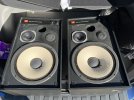
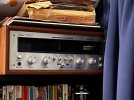
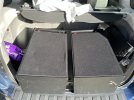
R Swerdlow
Active Member
Years ago, when I first got my L100s, I used them with a Marantz 2230 receiver. It still works today. Here's what I've been able to learn about the 4312c speakers that might help answer your questions:I know this is an old thread, but still valuable. Are the crossover networks for the L100’s the same as in the 4312c’s? I literally stumbled upon a set that were set out by the garbage. I grew up listening to the L100’s hooked up to a Marantz 2015. I still have the receiver, but the L100s didn’t survive 30 years in a wet basement. My new speakers sound good, one is much better than the other though. Caps are more than likely dried out and the knobs are super scratchy on one speaker. If the crossovers are the same, I will do the Murphy boards and eliminate the LPads.
JBL 4312c specs
From JBL's specs, it looks like the 4312c uses similar woofer & mid-range drivers, with a different tweeter, a 1" titanium dome tweeter to replace the older 1½" cone tweeter. Based on the crossover frequencies of 1.5 and 7 kHz, I'm guessing that the crossover network is the same as the older models. The tweeter should have improved responses above 10 kHz compared to the old cone. The woofer & mid-range are probably not identical to those in the older models, but they may be similar sounding.
Based on the specs, I'd say go ahead and use the redesigned L100 crossovers on your 4312c speakers. Install it in one of your speakers, and leave the old crossover in place while bypassing it's wires. That way you can listen and compare the new and old crossovers in single speakers. It may not be ideal, but it will be a far sight better than the old inadequate crossover.
Title-tatle on JBL 4310, 4311, and 4312 series studio monitor speakers
This is translated from Chinese, but the first part seems to read alright, and then it gets harder to understand. I didn't see much that directly answered your questions, but I also didn't see anything that might warn against using the new L100 network for these newer 4312c speakers.
And finally, before you order anything & start building, test out all the drivers in your street-find to make sure they all work. Use the 1.5V battery test so you can know for certain what their polarities are.
Good luck with your crossover build. If you have any questions about crossover parts availability or anything else, just ask.

donprice
Wound up workin' at a gas station....
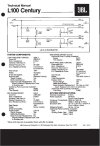
Crossovers are not the same...the 4312C is only 4 parts. Search for info on the 035TiA - I think it has a foam plug that can turn to goo over time. Run the L-pads back and forth a hundred times to try to fix the scratchiness. It might be that simple. Not much else to go wrong. Great find! New thread time?
Good luck!
Good luck!
Attachments
vishal2410
New Member
I have a 4312 se to which I added the titanium tweeter from the new l100 classics...
Anyone has a schematics of the new l100 classic speakers?..
Or suggest any alternative crossover.
Feel the treble is a bit overpowering
Anyone has a schematics of the new l100 classic speakers?..
Or suggest any alternative crossover.
Feel the treble is a bit overpowering

z-adamson
Addicted Member
Just add a fixed lpad to the tweeter and/or mid. You are not going to find a pre-engineered, proper crossover for what you have unless you DIY..I have a 4312 se to which I added the titanium tweeter from the new l100 classics...
Anyone has a schematics of the new l100 classic speakers?..
Or suggest any alternative crossover.
Feel the treble is a bit overpowering

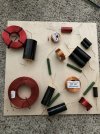
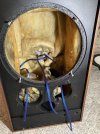
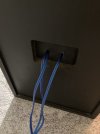
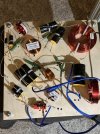
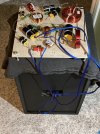
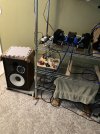
R Swerdlow
Active Member
Thanks for the feed back and photos. They will help other owners make up their minds.Speaking of the Murphy crossover. I did it and am very pleased.
Here are some build pics…
4311 rather than l100.
External crossover.
You may be the first person who installed the Dennis Murphy crossover in JBL 4311 speakers. You are the first person, I know of, who told me of your results. Thanks! I'm glad to know you like how it works.

flavio81
Turntable technician
The three resistors in the mid-range circuit are there, along with several of the other components, to create a band pass filter between 950 Hz and 5 kHz. That mid-range driver loudness differs widely between those frequencies, and it had to be leveled and balanced. See the raw frequency response of the mid-range driver below. It ain't even close to being flat.
View attachment 2729467
The rest of those components (see the schematic below) help shape the roll-off curves of the band pass filters so they work better with the roll-off curves of the woofer and tweeter, and help filter out the shrill sounding resonance peak at 6-7 kHz seen with the old JBL crossover. It took a lot of work to get that to be decent.
First of all, thanks to you and mr. Murphy for the crossover design.
Now, thanks for the curve on the LE5, frankly i am not impressed by the frequency response, I thought this was a better driver.
Of course I understand it should have taken you guys a lot of time to correct that response into something acceptable.
I see your crossover is a bit more elaborate than Troels', you are using 3rd-order electrical slope on the mid and high. Very interesting.
flavio81
Turntable technician
I have a 4312 se to which I added the titanium tweeter from the new l100 classics...
Anyone has a schematics of the new l100 classic speakers?..
Or suggest any alternative crossover.
Feel the treble is a bit overpowering
The L100 Classic is an entirely different speaker and AFAIK has a more sophisticated crossover.
The crossover on the L100 Classic was designed using modern technology and knowledge, if the treble is overpowering you should look elsewhere, for example try changing speaker position, damping the room (maybe the room is exaggerating the treble), etc.
R Swerdlow
Active Member
I also thought the LE5 driver was good. At least the JBL marketing buzz had led us to think that back in the 1970s. And then I saw it's unfiltered frequency response. Yes, it took the most work to correct its many flaws. Compared to the LE5, the woofer and tweeter were pretty good.First of all, thanks to you and mr. Murphy for the crossover design.
Now, thanks for the curve on the LE5, frankly i am not impressed by the frequency response, I thought this was a better driver.
Of course I understand it should have taken you guys a lot of time to correct that response into something acceptable.
I see your crossover is a bit more elaborate than Troels', you are using 3rd-order electrical slope on the mid and high. Very interesting.
Most of the crossover filters do look like 3rd order electrical, but if you look at the measured acoustic responses of the drivers when combined with those filters, they most closely resemble 4th order roll-on/roll-off slopes. That was the goal that Dennis Murphy wanted and got.