• The move to the new server is done. There are some software and database maintenance updates in process. This has us passing the hat around to help out. We appreciate any donations. Seriously, even a dollar helps. The payment page may be found here - https://www.audiokarma.org/support.html

JVC RX-401 display has gone dark

That will upset the whole circuit. Stick with incandescent fuse lamps...12V - 150mA.
I've seen an LED conversion on another model JVC with the amber display and it looked terrible!
If you decide to go LED, remove the zeners and work from there. It might not be a bad idea to just remove the zeners anyway.
 
The sole purpose of the Zener diodes is to provide lightning when one lamp is dead. Not really needed in my opinion because the lamps are so easy to replace.
 
I'm going to stick with the 12V 150mA fuse lamps....but ecluser is saying the Zeners are not needed because the lamps are easy to replace? On this unit they look really buried in there. The service manual has an exploded view but it looks like to get to them I'm going to have to take most of this thing apart. It would be amazing if I'm not reading that correctly. Once I have access to that fuse holder it will be really easy to pop a new one in but just getting at it looks hard.
 
Last edited:
If one lamp is dead, it's not really going to backlight properly.

The zeners were a bit of an odd design to try to 'keep things going'.
 
So...just remove the zeners entirely? Then I'd just have to replace a lamp every time the 1st one burns out? That might be a plan. I'll think about it.
 
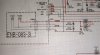
Here is the schematic showing the fuse lamps. Removing the zeners will leave a 11V line dangling there, which may also be able to be removed, at least partially. I will check the two resistors to see how they are doing. What about the capacitor?
 

Attachments

  • Fuse lamps.jpg
    Fuse lamps.jpg
    74.6 KB · Views: 20
The bulbs are connected in series and 22.8V will be applied to the. I believe when the bulbs are functioning, the zeners do nothing. Check the resistors upstream to make sure they did not burn up!
 
I suggested finding out what voltage is actually driving this circuit (feeding R807/808) some time ago:

I'd find out what the actual power supply is

We would at least know better what we are actually dealing with. The zeners could be taking some current to regulate the bulb brightness, dropping some voltage across R807/808.
 
The capacitor is kind of slow start circuit for the lamps, to reduce inrush current when the lamps are cold. That may extend the life of the lamps. The effectiveness of this capacitor is very limited.
 
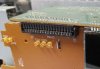
I am finally in the process of taking this apart so I can take some measurements and replace the lamps. I am stuck at this point. There are two circuit board connections that look like this one. I am trying to be very careful. The last thing I need is to crack a board. How does one disconnect this? It did not easily pop out by 1) pulling out 2) pushing up or 3) rotating it

Again, I didn't try real hard with any of these things because I don't want to break something. But it's not obvious at all to this noob which way these come out. The small board that has the fuse lamps is buried underneath that top board, and behind lots of ribbon cables. So I can't get at it without pulling this top board out of the way.
 

Attachments

  • Capture.JPG
    Capture.JPG
    32.8 KB · Views: 18
Alright so I did figure out that top PCB does rotate up on those connections and I was able to get at the lamps finally.

I measured 24V across both, which is what it should be. Removing the lamp gives me the one disconnected end I needed to be able to measure the resistors. They are in parallel and together they measure 11.6 ohms, which is what it should be as well (individually they are supposed to be 22 ohms each).

So I went ahead and put in the new lamps. One is shining a lot brighter than the other. I am wondering if the fried diodes have something to do with that. I may just remove them and break that connection and see what happens. There should still be 24V there. If I just take them out of the circuit both lamps will go dark if one burns out. So I'll just have to replace one every time but not a huge deal. Hopefully that is years away.

I think I'm also going to go ahead and replace the two large 6800uF 50V capacitors while I'm doing all this. They have some seepage coming from them onto the board. They are still functioning but I bet they've lost a little juice.
 
One is shining a lot brighter than the other. I am wondering if the fried diodes have something to do with that.
What lamps did you use? If 12V 150mA then I would guess one of the zeners shorted. Use your meter and measure the voltages across each bulb.
 
I think I'm also going to go ahead and replace the two large 6800uF 50V capacitors while I'm doing all this. They have some seepage coming from them onto the board. They are still functioning but I bet they've lost a little juice.
Is this leakage wet or dry. It is most likely glue and not a leaky cap. Post a picture please.
 
Back
Top Bottom