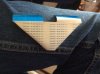
there is this old adage about insulating a tip of the dmm probes with heat shrink before poking in there.
In reading this I see phrases like 'lighting up like a roman candle', exploding in my face, blew output transistsor, etc.
STOP.
If ANY of those conditions were true then something along the line that a very wise tech here would call 'racing to destruction' has raced.
You need to desolder EVERY output and EVERY driver transistor and every flame proof resistor. if possible remove every line from the power supply to the amp board and work on the power supply FIRST.
Over the years I have done/am doing a *lot* of what I call 'computer receivers'. The digital display stuff with 100w drivers (or more) and chipsets and all sorts of stuff. they typically have *at least* 5 power supply voltages: +/- for the main amp in the 30-40-50 volt range, +/- voltages for the driver board typically in the 12-16v range, and 5v for the chipsets
That yours requires the lights to be on to power something else connected to the driver board to get the protection relay to fire is just damn weird, but not unheard of.
So, if this were mine and I wanted it to work - out of spite by this time, the computer receivers are so prolific for cheap it might be easier to get another - I would do thus:
Disconnect what I told you before.
Investigate replacing the fuse lights with warm white festoons from parts express (on sale right now, $5 for 5 and whack the voltage to 8v. a 78M07 or 78M08 regulator following a rectifier and small cap if the line is AC works fine for me. now it wont draw jack for current and will create no heat.
Next, dive into the power supply. Every single diode and every single power transistor and zener will be available from mouser. test all the parts OUT OF THE MACHINE. if off by any amount, replace. You can go up in PIV and If on the diodes at will. You can go up on voltages and Power dissipation on the power transistors. You may not alter any facet of any flame proof resistor - same ohmage, same tolerance same wattage. These things are in there to act as fuses AND they are oft elevated from the board to bleed heat as they are designed to run at the red line.
Once the DMM says you have perfect output power with no wavering THEN you can goto the next step...check every flame proof and ANY low value resistor in the driver and amp board and replace if off by any amount. Check the driver transistors - typically the to92s and in some cases 220s, or even sot32's (without looking at your schematic at all)
You are allowed to get the driver section up and running with no outputs, you can test for DC offset and you can oft feed it thru a resistor to the aux input of another amp to see if indeed there is glorious music on the line. The resistor bleeds the voltage/current back down to something the aux input of something else will appreciate.
Lastly after testing the output transistors you can re-insert after you test any and all emitter resistors and center any dc balance pots and minimize any idle current pots.
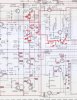
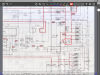
if in doubt on what does what, post a section of the PDF here and dozens will point out what not to lick.
If you have a modern, non-servo amp with no DC offset adjustment (weird, but not unheard of) then simply buying the drivers matched to each other as close as possible will negate offset pretty well. oft they are only pennies on the dollar so you can buy dozens at mouser and use the Hfe setting on your whizbang really good DMM to test em. Yeah, you can prolly use the autotune DMM from advance auto for MOST stereo fixin stuff, but Ill be honest, since the demise of the shack, I dont even know where to go to get a decent DMM nowadays.
I will close with: since the advent of computer receivers, and since the advent of very cheap high power outputs, everything is 100w and everything runs very hot and everything is assembled by a parts picker and run thru essentially an easy bake oven.
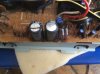
Since everyone sticks them in cabinets and covers them and etc with no ventilation, the normal hot running they do becomes nu-cu-lah hot running and they literally desolder themselves. Depending on the order in which stuff comes unglued sometimes sh*t happens. personally, I find that the onkyo A-RV series likes to loosen up the negative driver supply and if the zener comes off first a few components follow quickly and permanently - but I digress. The fix I like is to get laptop cooling pads from like big lots for cheap and rip out the fans. either tap in a small voltage regulator or increase the power handling of the 5v supply and create a blowing upward fan that comes on with the power. its a $5 (or less) modification that extends the life - but then once again, you REALLY have to like it cuz the BPC computer stuff is everywhere.