DC is ~36V, (bulb in Dbt 150W )Lets check the DC balance real quickly to make sure we are in the ballpark. Set your meter for DC volts clip the + lead to the left side of the Q5 resistor.
Be careful not to short that left lead to the terminal strip or the screw head. It looks close to the screw but it could just be the angle.
Clip the minus side of the meter to the chassis. Using the DBT turn the unit on and look for a DC voltage in the neighborhood of 43 volts.
Turn it off and report back. Also a nice closer picture of the bottom of the other channels heatsink please.


You are using an out of date browser. It may not display this or other websites correctly.
You should upgrade or use an alternative browser.
You should upgrade or use an alternative browser.
Kenwood Ka6000
- Thread starter Dart07
- Start date

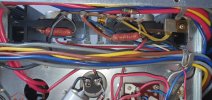

A bit low but lets check it without the DBT and see how much it moves.DC is ~36V
last time I started it without DBT, the transistors in this channel burned out ... now 37.8V still lowA bit low but lets check it without the DBT and see how much it moves.
I missed that somewhere in the thread. So DON'T power without the DBT for now. Lets do a quick bias check and see where we are at.last time I started it without DBT, the transistors in this channel burned out ... now 37.8V still low
Set the meter for DC volts or DC mV if it has that range. Clip the meter leads across R171, polarity does not matter. Again watch the screw and terminal strip.
Turn the amp on and see what the voltage drop across the resistor is and if it is changing over time. It probably will change but it should be gradual. Watch it for a minute or so.
I don't know how fast it gets hot, we don't want to cook things, you have to judge that.
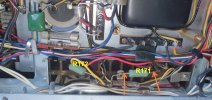
on the meter ~140mV, after a minute it gets warm, not hot, but I didn't test it longer , thank you for Your helpI missed that somewhere in the thread. So DON'T power without the DBT for now. Lets do a quick bias check and see where we are at.
Set the meter for DC volts or DC mV if it has that range. Clip the meter leads across R171, polarity does not matter. Again watch the screw and terminal strip.
Turn the amp on and see what the voltage drop across the resistor is and if it is changing over time. It probably will change but it should be gradual. Watch it for a minute or so.
I don't know how fast it gets hot, we don't want to cook things, you have to judge that.
View attachment 3569778
OUCH, that is almost 300mA, way too high. With that static current draw I would expect your bulb to have a bit of a glow.on the meter ~140mV, after a minute it gets warm, not hot, but I didn't test it longer , thank you for Your help
With the power off locate VR905 on the main amp driver board, note it's position and turn it back and forth from end to end a few times and then place it back where it was.
Put your meter back across R171, turn on the amp with the DBT and slowly adjust VR905 one way or the other and see if the voltage goes down, if it does see if you can get it in the neighborhood of 10mV.
Last edited:
vr905 is very sensitive and unstable, I set it to 10.2~10.6 because the result fluctuates in this range, after turning it on again I have 12mV but I can't adjust it anymore because it's breaking... after 4 minutes it is not warmOUCH, that is almost 300mA, way too high. With that static current draw I would expect your bulb to have a bit of a glow.
With the power off locate VR905 on the main amp driver board, note it's position and turn it back and forth form end to end a few times and then place it back where it was.
Put your meter back across R171, turn on the amp with the DBT and slowly adjust VR905 one way or the other and see if the voltage goes down, if it does see if you can get it in the neighborhood of 10mV.
Last edited:
That is good news and expected bad news. Good news, you can adjust the bias which gives us a good feeling about amplifier health. Expected bad news, the trimmers are crappy and need replaced. I expect they are the open frame carbon style trimmers. Can you grab a picture of the top area of that amplifier board so I can see if that is what you have.vr905 is very sensitive and unstable, I set it to 10.2~10.6 because the result fluctuates in this range, after turning it on again I have 12mV but I can't adjust it anymore because it's breaking... after 4 minutes it is not warm
the old trimmers are imprecise but I can replace them later... I connected a meter to the second channel and I got 0.00mVThat is good news and expected bad news. Good news, you can adjust the bias which gives us a good feeling about amplifier health. Expected bad news, the trimmers are crappy and need replaced. I expect they are the open frame carbon style trimmers. Can you grab a picture of the top area of that amplifier board so I can see if that is what you have.
Attachments

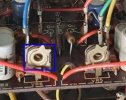
That is mostly what I expected to see. That style of trimmer should probably be replaced. You can try to clean them.
I find that the biggest problem area is where the center pin connection and the moving contact slide on top of each other.
The actual resistive element and the wiper are on the other side of the control. You can see it on VR04 in your large picture.
Note the position of them. and gently squirt a little of a deoxit type cleaner on the metal surface and work the trimmer back and forth several times. Return to the previous position. You need a deoxit type cleaner, the no residue quick dry stuff won't work. Obviously you don't do this with the power on.
After the cleaning go back and see if the control behaves better. It will probably still be sensitive but it should smoother and not jump around as much.
Just an FYI, it looks like VR3 may have been replaced at one time?
I find that the biggest problem area is where the center pin connection and the moving contact slide on top of each other.
The actual resistive element and the wiper are on the other side of the control. You can see it on VR04 in your large picture.
Note the position of them. and gently squirt a little of a deoxit type cleaner on the metal surface and work the trimmer back and forth several times. Return to the previous position. You need a deoxit type cleaner, the no residue quick dry stuff won't work. Obviously you don't do this with the power on.
After the cleaning go back and see if the control behaves better. It will probably still be sensitive but it should smoother and not jump around as much.
Just an FYI, it looks like VR3 may have been replaced at one time?
What does "it's breaking" men?vr905 is very sensitive and unstable, I set it to 10.2~10.6 because the result fluctuates in this range, after turning it on again I have 12mV but I can't adjust it anymore because it's breaking... after 4 minutes it is not warm
a metaphor, it means that if I want to improve by 5 mV, it changes by 150... it's bad trimmers, I connected a meter to the second channel and I got 0.00mV a bit weirdWhat does "it's breaking" men?
I'll clean it and there's something else I can adjust for the time being ? I also checked the DC voltage at the speaker outputs, there is a jump to 22v and drops to: Lch ~ 500mV, Rch ~ 300mV, and what about the too low center voltage of 38V instead of 43V?
Last edited:
I have already set ~43V on both channels, unfortunately without an oscilloscope, only a metera metaphor, it means that if I want to improve by 5 mV, it changes by 150... it's bad trimmers, I connected a meter to the second channel and I got 0.00mV a bit weird
I'll clean it and there's something else I can adjust for the time being ? I also checked the DC voltage at the speaker outputs, there is a jump to 22v and drops to: Lch ~ 500mV, Rch ~ 300mV, and what about the too low center voltage of 38V instead of 43V?
That is a nice change since it was 38v before. You will find that the bias and center voltage will interact a bit.I have already set ~43V on both channels, unfortunately without an oscilloscope, only a meter
Did you try cleaning the bias trimmer pot(s)?
I cleaned them a bit but I'll repeat it again... because the VR906 doesn't work, I move it and the meter readings don't change...That is a nice change since it was 38v before. You will find that the bias and center voltage will interact a bit.
Did you try cleaning the bias trimmer pot(s)?
I also ran a little test to check the progress of the repair... I connected the signal and speakers... and it works
 , time to restoring...
What do you think... will these transistors be suitable? The parameters are slightly better than the 2SC898
BDY56 (Pc): 115 W, |Vcb|: 150 V, |Vce |Vce| 120 V, |Veb|: 7V, |Ic max|: 15 A, (Tj): 200 ?C, (ft): 10 MHz, (hFE), MIN: 20
Last edited: