NickDeO
Active Member
Hello AK,
This has been discussed before by other members in similar situations, but I felt that due to the rarity of these speakers and the number of differences between varying serial numbers, a separate post might better help others in the future.
BACKGROUND:
*Feel free to skip if you’re already familiar with these speakers. Restoration process and questions will be posted below.*
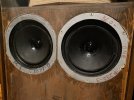
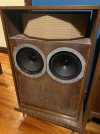
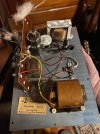
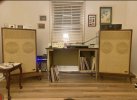
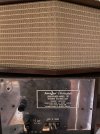
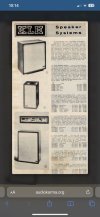
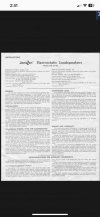
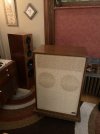
Last week, I was lucky enough to acquire a really nice set of KLH Model One low frequency speakers, including a matching set of Janszen Model 130 electrostatic speakers. The Model One was the first of the original lineup of KLH speakers that were made available In 1957 after Henry Kloss left AR. They were quite pricy at the time, and were offered in a few different finishes. Mine happen to be the walnut cabinets, which were the most expensive offering of the KLH line at the time of their release. Being that these speakers each contain only two 12” woofers (with no crossovers!), they were intended to be paired with something else that would produce the higher frequencies needed for listening. KLH did offer an option for this (which I admittedly know very little about), but the highest option being paired with the Model One was the Janszen 130 — a small, stand-alone electrostatic loudspeaker that sat in the upper shelf of the KLH cabinet. In most cases, these were hidden behind the grille cloth and remained unseen. From what I understand, however, it was a much more common practice to a Janszen 130s with an AR-1/AR-3 loudspeaker turned on its side. Nevertheless, these little electrostatics, which were designed and built by Arthur Janszen in Pennsylvania, are very easy on both the eyes and ears.
Looking back to 1957, I like to think that the landscape of hifi audio was still in its “adolescent era”. Consumers were past the point of wax cylinders and tabletop phonographs, but still had a decade or so before they began to enjoy “the golden age of audio”. As most people reading this might agree, Henry Kloss was one of the pioneers of the modern day loudspeaker as we know it today. Many of his innovations with AR, KLH, and Advent had a great impact on the market and boldly helped to shape the world of audio. With that said, I believe the KLH Model One truly gives us a unique glimpse back to these early days of hifi loudspeakers — right at the cusp of stereophonic sound. In 1957, when KLH first began selling these high dollar units, people were still listening to monophonic recordings, therefore they were only needing to buy just one of these speakers. Today, if you’re lucky enough to come across a stereo pair, it’s likely that they might have different color cabinets and serial numbers that are nowhere near close to each other. The same goes for the Janszens, or whatever else the previous owner(s) were using at the time. Because these are great speakers, many folks had taken the time to hunt down a second one to enjoy listening in stereo. Oddly enough, mine seem to have been sold as a pair from the start, as indicated by their sequential serial numbers (0644 & 0645) and matching cabinets. The same goes for the Janszens (#7256 & 7271), which are likely from the same production run. My best guess is that they were originally sold and hooked up together as a mirrored mono or “pseudo-stereo” setup. Whoever bought these new must have been living quite comfortably, to say the least. A single KLH Model One with the walnut trim (sans Janszen or other mid/tweeter option) sold for $390 before tax — that’s close to $4,500 in today’s money. I can’t find any info on the list price for the Janszen Model 130 at the time, but I know they weren’t cheap. My best guess is that pulling the trigger on this purchase back in the day would be similar to dropping around $15,000 or more on a pair of new speakers today. For the vast majority of us, that’s little more than a pipe dream!
In terms of previous owners, I know I am only the third, as the guy who sold them to me purchased them from the first owner, who at the time was in his late 90s. Supposedly, he told me these speakers were driven for most of their lives by a Marantz Model One and Model Two, which I found to be pretty interesting. I was able to audition them at the last owner’s house on an old Sherwood integrated tube stereo and I was told that “they seem to always sound better with a tube amp”, but I have yet to draw any conclusions of my own.
As a bit of a disclaimer, I was not alive when these speakers were built. In fact, when I was born, these speakers were already ten years older than I am today. If I’ve managed to misinterpret some of the history or leave any interesting details out, please feel free to make corrections. There really isn’t a whole lot of information out there about these speakers, so I’m hoping to do my part in preserving their history. Again, I wasn’t alive to experience this first hand, so the best us younger generations have for finding much of this info is online forums like this one. If you are lucky enough to have the life experience I lack, please feel free to fill in the gaps!
TLDR: A brief history on the KLH Model One & Janszen Model 130, their historical significance, etc. These are pretty old and rare (as far as speakers go), so any other historical insight would be greatly appreciated. There’s not a lot of info online regarding these speakers, so hopefully this will serve to help others in the future.
I will continue to include pictures and links to other helpful threads as I find them.
*A comprehensive restoration post (with a few questions for the experts) will be posted shortly.
This has been discussed before by other members in similar situations, but I felt that due to the rarity of these speakers and the number of differences between varying serial numbers, a separate post might better help others in the future.
BACKGROUND:
*Feel free to skip if you’re already familiar with these speakers. Restoration process and questions will be posted below.*
Last week, I was lucky enough to acquire a really nice set of KLH Model One low frequency speakers, including a matching set of Janszen Model 130 electrostatic speakers. The Model One was the first of the original lineup of KLH speakers that were made available In 1957 after Henry Kloss left AR. They were quite pricy at the time, and were offered in a few different finishes. Mine happen to be the walnut cabinets, which were the most expensive offering of the KLH line at the time of their release. Being that these speakers each contain only two 12” woofers (with no crossovers!), they were intended to be paired with something else that would produce the higher frequencies needed for listening. KLH did offer an option for this (which I admittedly know very little about), but the highest option being paired with the Model One was the Janszen 130 — a small, stand-alone electrostatic loudspeaker that sat in the upper shelf of the KLH cabinet. In most cases, these were hidden behind the grille cloth and remained unseen. From what I understand, however, it was a much more common practice to a Janszen 130s with an AR-1/AR-3 loudspeaker turned on its side. Nevertheless, these little electrostatics, which were designed and built by Arthur Janszen in Pennsylvania, are very easy on both the eyes and ears.
Looking back to 1957, I like to think that the landscape of hifi audio was still in its “adolescent era”. Consumers were past the point of wax cylinders and tabletop phonographs, but still had a decade or so before they began to enjoy “the golden age of audio”. As most people reading this might agree, Henry Kloss was one of the pioneers of the modern day loudspeaker as we know it today. Many of his innovations with AR, KLH, and Advent had a great impact on the market and boldly helped to shape the world of audio. With that said, I believe the KLH Model One truly gives us a unique glimpse back to these early days of hifi loudspeakers — right at the cusp of stereophonic sound. In 1957, when KLH first began selling these high dollar units, people were still listening to monophonic recordings, therefore they were only needing to buy just one of these speakers. Today, if you’re lucky enough to come across a stereo pair, it’s likely that they might have different color cabinets and serial numbers that are nowhere near close to each other. The same goes for the Janszens, or whatever else the previous owner(s) were using at the time. Because these are great speakers, many folks had taken the time to hunt down a second one to enjoy listening in stereo. Oddly enough, mine seem to have been sold as a pair from the start, as indicated by their sequential serial numbers (0644 & 0645) and matching cabinets. The same goes for the Janszens (#7256 & 7271), which are likely from the same production run. My best guess is that they were originally sold and hooked up together as a mirrored mono or “pseudo-stereo” setup. Whoever bought these new must have been living quite comfortably, to say the least. A single KLH Model One with the walnut trim (sans Janszen or other mid/tweeter option) sold for $390 before tax — that’s close to $4,500 in today’s money. I can’t find any info on the list price for the Janszen Model 130 at the time, but I know they weren’t cheap. My best guess is that pulling the trigger on this purchase back in the day would be similar to dropping around $15,000 or more on a pair of new speakers today. For the vast majority of us, that’s little more than a pipe dream!
In terms of previous owners, I know I am only the third, as the guy who sold them to me purchased them from the first owner, who at the time was in his late 90s. Supposedly, he told me these speakers were driven for most of their lives by a Marantz Model One and Model Two, which I found to be pretty interesting. I was able to audition them at the last owner’s house on an old Sherwood integrated tube stereo and I was told that “they seem to always sound better with a tube amp”, but I have yet to draw any conclusions of my own.
As a bit of a disclaimer, I was not alive when these speakers were built. In fact, when I was born, these speakers were already ten years older than I am today. If I’ve managed to misinterpret some of the history or leave any interesting details out, please feel free to make corrections. There really isn’t a whole lot of information out there about these speakers, so I’m hoping to do my part in preserving their history. Again, I wasn’t alive to experience this first hand, so the best us younger generations have for finding much of this info is online forums like this one. If you are lucky enough to have the life experience I lack, please feel free to fill in the gaps!
TLDR: A brief history on the KLH Model One & Janszen Model 130, their historical significance, etc. These are pretty old and rare (as far as speakers go), so any other historical insight would be greatly appreciated. There’s not a lot of info online regarding these speakers, so hopefully this will serve to help others in the future.
I will continue to include pictures and links to other helpful threads as I find them.
*A comprehensive restoration post (with a few questions for the experts) will be posted shortly.
Attachments
-
 72948927-7A2E-49FB-BB26-C523324A3D30.jpeg101.2 KB · Views: 43
 -
 AD9AB666-8724-41F1-AF3E-25BB2E6FC41C.jpeg206.7 KB · Views: 45
 -
 89AF113E-622A-40BF-B5D4-EE35FAA9E453.jpeg66.3 KB · Views: 47
 -
 3932DBAA-95F7-466B-8CDC-341A1365BD1D.jpeg71 KB · Views: 44
 -
 1CD9DEDA-FB36-4B1F-820C-95B176F6E83D.jpeg119.1 KB · Views: 42