End Results & Conclusion
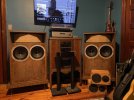
Well, it looks like I managed to get these things running in tip-top shape. Thanks to those who were able to help.
@RxDx, hopefully this thread will motivate you to get your Janszens up and running again… it’s definitely worth it.
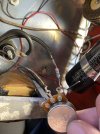
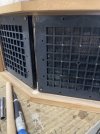
For a better description of installing the new resistors, pots, capacitors and diodes, see attached photos. As it turns out, the diode polarity on my particular schematic seems to have been correct. I purchased everything from Parts Express and was pleased to see that the pots I ordered needed hardly any modification to be installed. The Janszen knobs fit on the shaft perfectly and only a small tab on the pot had to be nipped off. I like when no cosmetic modification to the antique gear is required, so installing these without having to do so felt good. The new Dayton capacitors also fit nicely into the original metal bands that held the old ones in place. Another win!
After recapping and replacing the aforementioned components, the Janszens fired right up on the first test run and blew me away. I wasted no time getting them set up with the KLH ones and all I can say is WOW!
Hopefully, this information will serve to help people with future restorations. I was lucky that no repairs were needed, but I can confirm that completing these steps resulted into a huge improvement in sound quality.
My review of these speakers:
FWIW, I don’t write for Sterophile, but with so few of these speakers out there in this configuration/condition, I figured this might be helpful for some.
At first, I could not believe that speakers were sounding this good back in the late 50’s. I’m still coming to terms with this discovery, but I still can’t help but feel a little shocked. In terms of clarity and tightness, both the KLH Model Ones and Janszen Model 130s still seem to hold their own when compared to modern speakers of similar size/price. In pairing them together, I feel that I’ve discovered a portal into the old “east coast” sound that I’d been looking for when I bought these. They’re clear, crisp, clean, and refined.
Could they rattle the windows and shake the walls? Maybe. But I can tell that they don’t want to, and likely never did in the first place. These aren’t JBL L100s, and they’re not meant for blasting Free Bird for the whole county to hear. Instead, Kloss, Vilcher, Janszen & co. sought out to bring recordings to life and transport the listener to the music. These are very good at that. They’re content playing heavier rock, but they seem to prefer classical, jazz, and lighter folk rock. These are not made to blast rap or dubstep, and I feel that doing so would be a criminal offense.
When I tested them with some old Keith Jarrett Blue Note recordings, I could close my eyes and feel like I was there. I have plenty of other speakers that share this superpower, but these really surpassed my expectations. The room around me disappeared and suddenly I was experiencing a live performance in NYC from the late 90s. The dynamics of Jarrett’s playing were flawlessly reproduced by the Janszens. For the first few minutes of listening, I didn’t notice the KLH Model Ones as they waited for their cue. After a few choruses, Gary Peacock came in on the double bass and the four KLH drivers seamlessly reproduced his solo. I play both the piano and double bass, so the realness of the reproduction is important to me. These passed the test with flying colors. The fact that a 70-year-old speaker can sound just like my double bass absolutely floored me.
After this, I listened to Diana Krall’s “How Deep is the Ocean”. This recording really showcased the low end abilities of the KLHs and the uncolored accuracy of the Janszens. After this, I moved on to Steely Dan and Paul Simon. Both are known for their excellent recordings , and both sounded great with this setup. Deep, controlled lows and crystal clear highs. No complaints here.
In terms of general usability, these earned another high score. They don’t seem to really mind what powers them, unlike most Magnepans, for example. They played nice with my Cambridge Audio AXR85, which can safely give these 16ohm speakers a little over 40W per channel. The KLH sealed cabinet design also allows me to cram these monolithic giants into a 12’x12’ room, where they sat maybe 10” from the wall. Unlike most ported speakers, these seem to be very forgiving in terms of room placement. Admittedly, the Janszens were a bit more difficult. They didn’t mind being close to a wall, but they certainly do “beam” and create both sweet spots and dead spots. This is just the way it goes with electrostatic speakers. The array in which Janszen placed the drivers minimizes this effect to a certain extent, but there is still a blatant sweet spot that they create. Leaving this zone results in a strange effect where you have to check if there is maybe something wrong with your ears. For attentive listening, where one can place a sofa in the sweet spot, you can’t beat the sound. For passive listening in a kitchen (where you’d be walking around the room), these aren’t the best choice. I hear that modern Janszens have eliminated this beaming effect and are even more forgiving in terms of room placement. For what it’s worth, it only took me about 20 minutes to get these arranged in a way that worked best in my space. From my seat, they sound wonderful.
When it came time to reinstall the grills, I decided not to… at least not now. I have a cat that once mistook a pair of Smaller Advents for scratching posts and I fear the similar fabric would be too enticing for him to resist. The KLH speakers are admittedly pretty ugly without the grills, but at least the Janszens are nice to look at. Since they’re not in the living room, I chose to not let this bother me. I’d rather preserve the like-new condition of the original grills and maybe make a new set if it does bother me. We’ll see.
In terms of the separate components, the Janszens sound incredibly transparent — much more so than anything else I’ve ever heard from a vintage speaker (and many newer ones, too). I can’t sing their praises enough. I fear that these have instilled a love for electrostatics within me that will probably cost me a ton money in the future. If I win the lottery, I’ll be giving David Janszen another call and placing an order… Seriously - these things are really easy on the ears. Even at a higher volume, there’s no shrillness or listening fatigue to worry about, even after a few hours of enjoyment.
As for the KLH Model Ones, they delivered exactly what I was expecting: very tight, deep bass that is characterized by their acoustic suspension design. To me, it’s the epitome of “more surface area = more better”. It does not come as a surprise that these four massive drivers in two huge cabinets sound this good. How could they not? Sealed enclosures also mean easier room placement and more accuracy in sound reproduction, among other things. Historical significance aside, these are still some really nice sounding speakers. Not quite as shockingly nice as the Janszens, but a big step up from my old OLAs. If anything, it’s closer to the low end presence of stacked OLAs, but the Model One still takes the cake.
Looking back, Janszen’s design hit the market a couple of years before KLH, so it seems to me that the Model One was designed to perfectly compliment the Janszen Model 130. Even the little shelf at the top of the cabinet fits them like a glove. The two come together seamlessly and perform very well. I have not heard the KLH Model Five tweeters and likely never will, but I’d be surprised if they could beat these electrostatics.
I started this “journey” when I decided I wanted to pick up an old pair of KLH speakers. I was searching FB Marketplace for the Model 6 when I came across these and I’m glad I went the route I did. In the end, all I can say is that if you see these for sale in your area, buy them! You won’t regret it.