• The move to the new server is done. There are some software and database maintenance updates in process. This has us passing the hat around to help out. We appreciate any donations. Seriously, even a dollar helps. The payment page may be found here - https://www.audiokarma.org/support.html

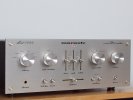
Leestereo's Marantz 1090 Restoration/Upgrade

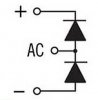
The "dual diodes" appear to be DS-133 (common cathode). If so, how about something like the On Semi MUR1620? (TO220 package)?

The 1090 dual diode is DS-133A and is not common cathode, but with a cathode to anode middle pin.

 

Attachments

  • DS-133A.jpg
    DS-133A.jpg
    10.5 KB · Views: 44
So, I'm curious what characteristics caused you to choose the polystyrene over polypropylene? I thought the ECW series was de rigeur? Perhaps it's capacitance availability?

Polystyrene film capacitors are considered to be closer to the ideal capacitor than polypropylene types. I think that only teflon capacitors garner more praise. Many of the higher end Marantz models used polystyrene capacitors in the RIAA equalization (appear as silver colored foil encased in plastic tube). But polystyrene capacitors are harder to find, largest value is about 10nF and are susceptible to heat damage during installation (solder with a heat sink attached to the lead).
 
OK, so the MUR 1620 definitely won't work. How about joining a pair of UF5004 diode anode to cathode and inserting into the 3 lead positions? Certainly not elegant.

Also many thanks for the information on the polystyrene capacitors. I would have missed using the heat sink.
 
Hi Leestereo,

I am pleased to see that someone has talked about polystyrene capacitors on this fourm site, because as you say these are considered by many (on other forums & web information) to be the best option when it comes to low capacitance film capacitors, but many of our forum members who do a lot of work with capacitors do not appear to use these.

As you say, they are difficult to come across but I have found; Xicon at Mouser, Parts Connecxion (as patfont mentions), About Just Radios & HiFicollective (very expensive) all carry good ranges of polystyrene capacitors. I find it interesting that other than the Xicon, none of the others have a brand name, does anyone know why this is? And are these all NOS?

Leestereo, you mention about the polystyrene being very sensitive to heat and when soldering these into the PCB you should use a heat sink. Can you explain what and how you would use a heat sink? As I would imagine that you would have the capacitor mounted off the board with sleeving over the wire leads, so the only other place to connect a heat sink would be on the leads on the side being soldered, would this be sufficient?
I would be interested in any ones comments on polystyrene capacitors.

Tony

Polystyrene film capacitors are considered to be closer to the ideal capacitor than polypropylene types. I think that only teflon capacitors garner more praise. Many of the higher end Marantz models used polystyrene capacitors in the RIAA equalization (appear as silver colored foil encased in plastic tube). But polystyrene capacitors are harder to find, largest value is about 10nF and are susceptible to heat damage during installation (solder with a heat sink attached to the lead).
 
Last edited:
...I find it interesting that other than the Xicon, none of the others have a brand name, does anyone know why this is? And are these all NOS?

Leestereo, you mention about the polystyrene being very sensitive to heat and when soldering these into the PCB you should use a heat sink. Can you explain what and how you would use a heat sink? As I would imagine that you would have the capacitor mounted off the board with sleeving over the wire leads, so the only other place to connect a heat sink would be on the leads on the side being soldered, would this be sufficient?...
The polystyrene caps from Mouser are identified as Xicon when you order them, but the actual caps have no markings on them apart from capacitance and tolerance, e.g., "270J". There aren't many polystyrene capacitors that are currently being manufactured; my guess is that most of the ones available now are NOS.

Your description of how to install polystyrene capacitors is how I typically install them. I do solder one lead then wait a bit for the cap to cool down before doing the other one.
 
Main Power Amp Restoration/Upgrade


Signal Path Capacitors:


The stock capacitors in the input high-pass filter (C701, C702) were 2.2µF low leakage electrolytic capacitors and these were replaced with 1.0µF Panasonic stacked polyester film capacitors. The F3 of this high-pass filter is 3.1Hz.

The stock capacitors in the low-pass filter (C705, C706) were ordinary 100pF ceramic capacitors. These were replaced with Wima FKP2 polypropylene capacitors of the same value. The F3 of the low-pass filter is 1.6MHz.

The stock C733, C734 capacitors, which determine the low end cut-off of the negative feedback loop, were garden-variety 100µF/16V, 85°C polar electrolytics. These were replaced with 100µF/16V Nichicon MUSE ES bi-polar audio grade capacitors.

The stock phase compensation capacitors (C740 and C741) in the negative feedback loop were ordinary 20pF ceramic capacitors. These were replaced with C0G/NPO capacitors of the same value.


Non-signal Path Capacitors

The capacitor (C704) which shunts the input differential stage zener, was a 10µF/35V electrolytic and was replaced with a 33µF/50V Panasonic FM 105°C low ESR type.

The local decoupling capacitors (C735, C736) were 10µF/50V electrolytics and were replaced with 47µF/50V United Chemicon LXZ low ESR types.

The filtering capacitors for the protection circuit (C711 and C712), were 100µF/35V electrolytics and these were replaced with 120µF/50V Nichicon PW low ESR types.

The capacitors C723, C724, C725 and C726 which shunt the output sampling diodes in the protection circuit were 10µF low leakage electrolytics and these were replaced with 10µF/35V Silmic II audio grade capacitors (somewhat overkill here, but these were the only "low leakage" 10µF caps I had on hand).


Other Upgrades

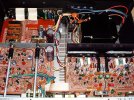
The open frame trimmer resistors (R771 and R772) used for setting the bias current were replaced with 500ohm mutlti-turn types. The idle current was increased to 25mA from 13mA (the heat sink is still very cool to the touch at the higher setting).

The capacitors in the preamp muting circuit, CV03, CV04 and CV05 were replaced with same value capacitors. Note that CV04 was a 330µF/10V capacitor rather than a 220µF/10V as indicated on the schematic; similarly, CV05 was a 47µF/63V capacitor rather than a 47µF/6.3V as indicated on the schematic.

1090 main amp label.jpg
 
Last edited:
. . . The open frame trimmer resistors (R771 and R772) used for setting the bias current were replaced with 500ohm mutlti-turn types. . . .

Where did you get these? Do you have a Mouser / Digikey part number?
 
Last edited:
Ben thanks for the tour of the amplifier section I am following the scat and your description as I walk through your rebuild. Very informative.

If any one has interest in cap placement whys/hows it does not get any better then this.:thmbsp:
 
I'm curious why you replaced C733/C734 with bipolar electrolytics if the original were polarized.
 
I'm curious why you replaced C733/C734 with bipolar electrolytics if the original were polarized.

Since C733/C734 are in the negative feedback loop, there will be no DC voltage on the capacitor and under these conditions a bipolar capacitor will have less distortion than a polar one in this position. A bipolar capacitor was likely not originally used due to availability and/or cost. One sometimes sees the use of two polarized capacitors installed back to back in the negative feedback loop (which essentially forms a bipolar capacitor). Also, note that an electrolytic bipolar capacitor should not be used to replace a polar capacitor when there is a significant DC voltage present since it will not be long-lived under this condition; a film capacitor can be used to replace a polarized capacitor in this situation.
 
Thanks for the explanation/education. I had heard that it wasn't a good idea to use a non-polarized cap in place of a polarized one - but didn't know why. This explains it.
 
Sound Impressions of Restoration/Upgrade

Before I started the restoration/upgrade, I listened to the Marantz 1090 for a couple of days. I even took a few notes of these initial listening impressions since I didn't want to rely on just my sonic memory (especially after a period of >1 month). The 1090, even in stock form, was pleasant to listen to, it does have the Marantz "house" sound: somewhat "warm" sounding with a full bass. It didn't sound as smooth as the early-to-mid 70s Marantzes that I have heard (e.g., the 2270 receiver or the capacitor-coupled 1060 integrated amp); it was more like the later 70s Marantzes (e.g., 1152DC, 170DC). I did make a note that the treble range was a bit "brash" sounding; nothing too obvious, but noticeable at higher sound levels and with recordings with lots of percussion or brass instruments.

In the ~4 weeks since the final upgrades to the 1090, its been played for a couple of hours most evenings. IMO, the restoration/upgrade has changed the sound for the better (did anyone expect otherwise?). The differences in sound are not "night and day", but are readily noticeable with attentive listening. Previous to the restoration/upgrade, as mentioned, the treble range was a bit "brash", but now the treble range is very natural sounding with lots of detail (e.g., the different cymbal sounds are easily discerned).
The sound of the bass range (<300Hz) has also changed, but not as much as was noticed in the treble range. The bass is now subjectively deeper and "tighter" sounding. I think that what is often referred to as "bass transients" is also better, but this may be attributed to an improvement in the reproduction of the middle frequencies. Indeed, reproduction of vocals does seem very clear now, all of the little vocal "ticks" and 'hiccups" are easily discerned and hard to decipher "mumbled" lyrics can now be understood.
An unexpected improvement was in the noise "floor"; there was a very slight background noise/hiss that was easily heard with the volume control turn up past 11 o'colck, but that is now completely absent, even with the volume set to maximum. At typical listening levels, the music seems to emerge from a "blacker" background silence. Playing CD and LP recordings that I'm very familiar with (e.g., Steely Dan/Aja; Miles Davis/Kind of Blue; Dire Straits/Love Over Gold; Beatles/Abbey Road; Fournier/Bach Solo Cello Suites; Duke Ellington Orchestra/Digital Duke), I was hearing the little details that are in the background much more clearly.

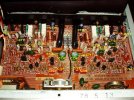
I have noticed that many on the Marantz forum have an admiration for the lower powered units. I do not think that is misplaced, the lower powered units often have a simpler signal path and this contributes to their good sound. I think that this is one reason that tube topologies often sound quite good, they have much simpler signal paths. What the lower models often lacked is the use of the best quality parts, e.g., whereas the higher and TOTL Marantz units would have film capacitors the lower units would have to make do with electrolytics or even ceramics. The sound of any unit is the result of the circuit topology and the implementation of the topology. The sound of a good vintage design can be much improved by upgrading with better parts that weren't available (or were deemed too costly by the bean counters) when the unit was originally manufactured. Conversely, a poor design will continue to sound poor even with the most costly capacitor upgrades. The 1090 is definitely in the former group; its design is quite advanced (e.g., fully discrete transistor design with a high capacity power supply; a DC-coupled main amp with class A driver stage; practical tone controls that can be switched out). Admittedly the build quality of the 1090 isn't as robust as the earlier series (and this cannot be changed) but its sound with the restoration/upgrade is without doubt, top tier.

1090 overview ak.jpg

1090 old caps AK.jpg

1090 AK.jpg
 
Last edited:
Is it fair to assume that you didn't change the PF01 section of PCB400 because you operate without the tone controls engaged or was nothing there worth changing?
 
Sound Impressions of Restoration/Upgrade
The 1090, even in stock form, was pleasant to listen to, it does have the Marantz "house" sound: somewhat "warm" sounding with a full bass. It didn't sound as smooth as the early-to-mid 70s Marantzes that I have heard (e.g., the 2270 receiver or the capacitor-coupled 1060 integrated amp); it was more like the later 70s Marantzes (e.g., 1152DC, 170DC). I did make a note that the treble range was a bit "brash" sounding; nothing too obvious, but noticeable at higher sound levels and with recordings with lots of percussion or brass instruments.

Your description on how this model sounds in its stock form is very accurate and similar to the 1090's I have had. The 1090 is not one of my favorite models due to its "later 70s Marantz(es)" sound. If you modifications helped tame the treble , then it was certainly worth the effort.
 
A couple of capacitor questions:

Why the twelve-fold increase in C424 (from10/50 to 120/50)?

Why Nichicon FW series instead of the FG or KZ series?

Why Panasonic ECQ series vs. ECW? Voltage availability (it seems that the ECW aren't much smaller than 250V).

Thanks.
 
Is it fair to assume that you didn't change the PF01 section of PCB400 because you operate without the tone controls engaged or was nothing there worth changing?

You're right, I typically have the tone controls switched out. But I did intend to replace the 2 ceramic caps, CF11 and CF12, that are in the treble circuit with C0G types. I just forgot to order them; will have to wait until my next shipment.
 
Your description on how this model sounds in its stock form is very accurate and similar to the 1090's I have had. The 1090 is not one of my favorite models due to its "later 70s Marantz(es)" sound. If you modifications helped tame the treble, then it was certainly worth the effort.
Yes, the treble range of the 1090 is much improved after the upgrades. In the stock form, it's the use of garden variety ceramics in the low-pass filters and the feedback loop that spoils the sound of the treble in this model and others the same series. In many of the earlier Marantz series, the preamp stage didn't incorporate a low-pass filter, or use a phase compensation ceramic capacitor in the feedback loop, so less sound degradation.

The treble sound of the 1090 is now very neutral and extended. I did some sound comparisons against a single gain stage tube preamp that I recently built (see http://www.audiokarma.org/forums/showthread.php?t=580444 for details) and was paired to a Marantz 170DC power amp. The 1090 was not slaughtered in this comparison, it held its own. IMO, the tube preamp and 170DC is better sounding but not as much as one would initially suppose; its more lush sounding with a warmer bass. The 1090 sounds less euphonic and has a more forward presentation as well as a narrower soundstage. I did switch back and forth between the two set-ups a couple of times to confirm the sound differences.
 
Back
Top Bottom