• The move to the new server is done. There are some software and database maintenance updates in process. This has us passing the hat around to help out. We appreciate any donations. Seriously, even a dollar helps. The payment page may be found here - https://www.audiokarma.org/support.html

Leestereo's Restoration & Upgrade of a Rotel RA-970BX

Leestereo

Super Member
On the bench for restoration and upgrade is a Rotel RA-970BX integrated amplifier. Although consensus is relatively rare in the audio press, the RA-970BX has managed to garner praise in the Stereophile Recommended Components list, the HiFi World Buying Guide and What HiFi? magazine; it is also very well regarded by enthusiasts/owners on Audioreview.com.

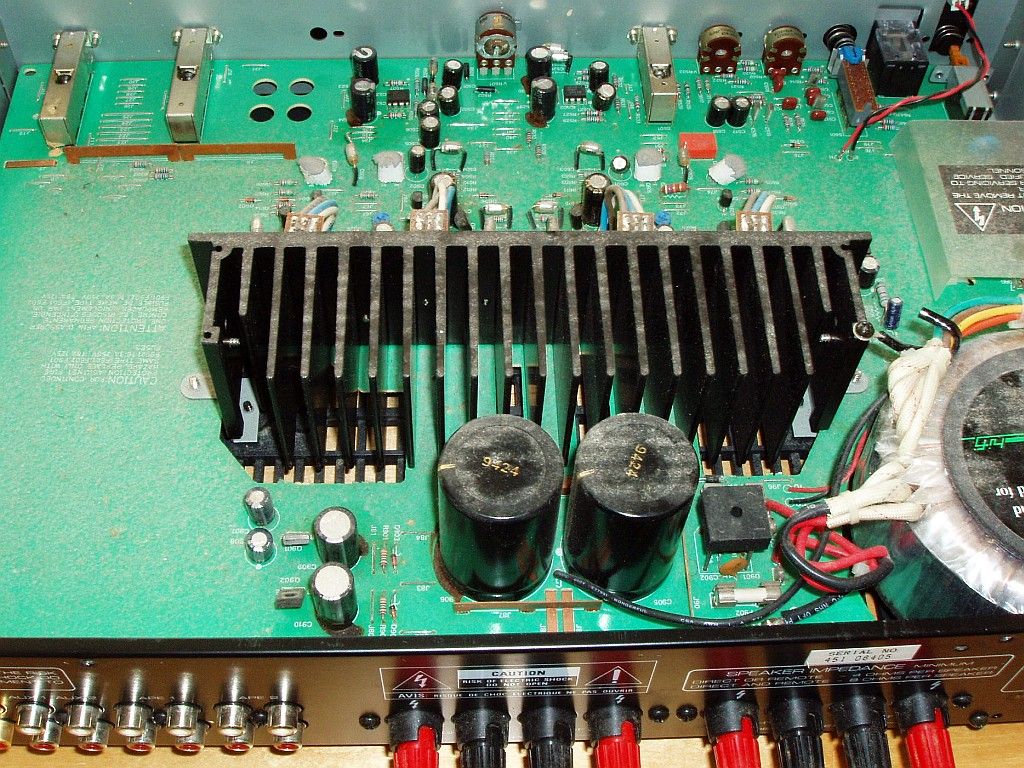
Despite being a relatively inexpensive, mass market consumer product, the RA-970BX is built with premium quality parts: large toroidal transformer, British-made "slit-foil" power capacitors, Roederstein metal film resistors, Vishay metal foil resistors, Black Gate coupling capacitors, and polystyrene capacitors.

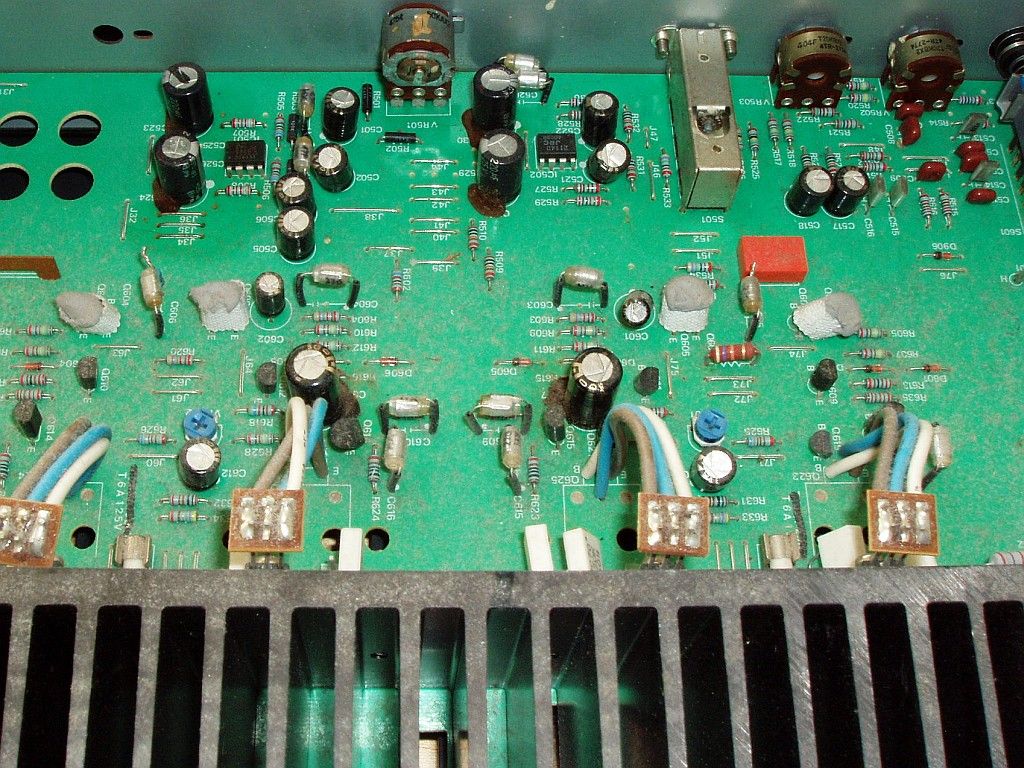
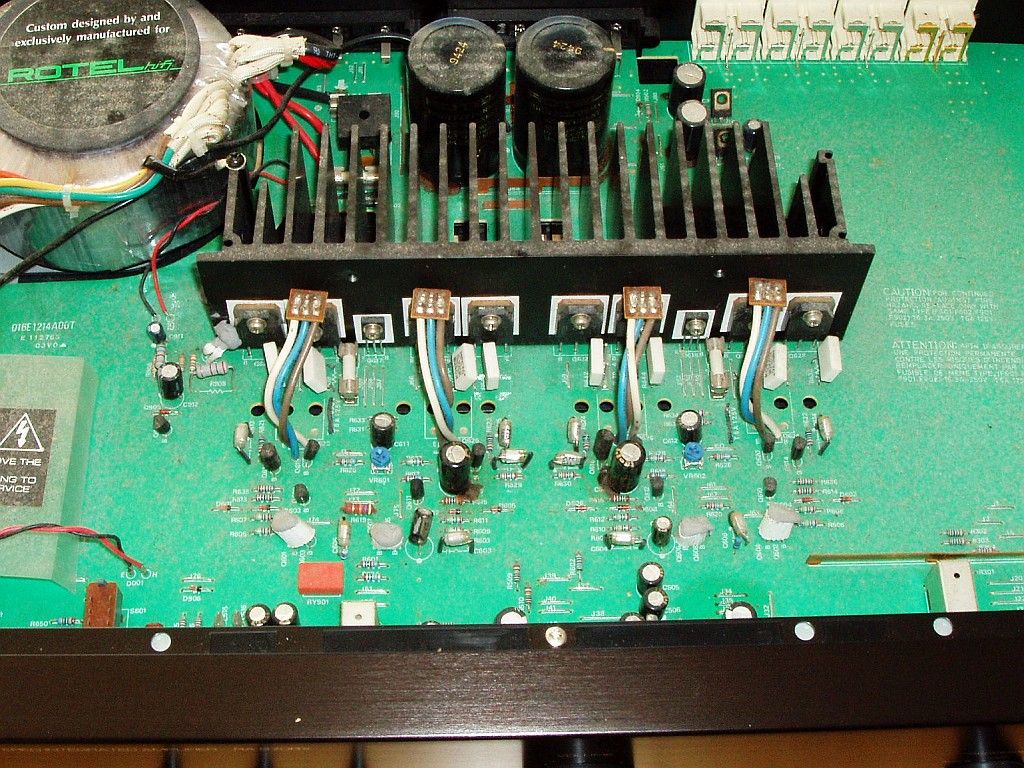
A couple of pictures of the stock unit (with the top off):
ra970%20before_zpshly8peg8.jpg


ra970%20before3_zpshvqfsgqc.jpg


ra970%20before2_zpsmowfp6qj.jpg


The restoration/upgrade plan:
1. Replacement of the small power supply electrolytic capacitors with low ESR types (increasing capacity where appropriate and physically possible).
2. Replacement of the reference zener diodes in the regulated power supply with precision 2% variants.
3.Replacement of all of the signal path electrolytic capacitors with miniature stacked film types (whenever possible) or bi-polar electrolytic types.
4. Replacement of any components damaged by the board glue (becomes corrosive as it ages).
 
Register to hide this ad
RA-970BX Power Supply

RA970BX%20Reg%20PS_zpsygvoutin.jpg


The RA-970BX utilizes a regulated ±16V power supply for the line and tone amplifier stages and an unregulated ±48V supply for the power amplifier stage. The large main capacitors, C905 and C906, filter the raw DC from the diode bridge for both the regulated and unregulated supplies. These 10,000µF capacitors are high quality UK-made "Slit-foil" types and did not need to be replaced as they are in excellent condition: capacitance measured within spec. and AC ripple was low at <20mV. Also, note the use of copper bus bars for connections to the main capacitors.

In the regulated supply, the reference zener diodes, D903 and D904, were replaced with low noise, precision (2%) BZX55B16 types. The capacitors C909 and C910 on the base of the pass transistors were replaced with Nichicon low ESR types of the same capacity as the originals (470µF). The final filtering capacitors in the regulated supply, C907 and C908, were originally rated at 100µF/25V and the replacements were low ESR types rated at 220µF/25V. Also, some of the jumpers were replaced due to damage from the corrosive board glue.

ra970%20Regulated%20PSa%20label_zpsdyizk3tp.jpg


ra970%20Regulated%20PSb_zpsahgdpgmm.jpg

 
I received the amplifier with a defective channel (dead 2SC2910 transistor), so I only spent a brief time listening to the channel that was working properly before starting the restoration/upgrade.

I'm a believer in getting to know the sound of the stock item. Therefore hopefully I can better assess the sonic contribution of any further changes away from stock.
 
My mains voltage here is pretty stable, mostly 120V or 121V throughout the day. Occasionally during a heatwave, and concomitant heavy use of air conditioning, the mains has dropped to 118V.
 
I'm a believer in getting to know the sound of the stock item. Therefore hopefully I can better assess the sonic contribution of any further changes away from stock.
I agree with this approach and whenever possible or practical, will do so, e.g., the "before and after" listening impressions of a Sansui AU-9500: http://www.audiokarma.org/forums/in...cribby31s-sansui-au-9500.654341/#post-8761210. In the case of the RA-970BX, the unit had several components damaged from the corrosive board glue and it was just practical to replace these and do the restoration before using the unit any further.
 
I've got a stock RA-970BX here that sees duty for TV and movie watching. A Dell Zino 410HD HTPC feeds HDMI to a Samsung TV and I loop out SPDIF optical to a Rotel RDP-980 DAC and into the 970BX running some Mordaunt Short MS40s. It's a neat little system.

I've always had a soft spot for Rotel's product range around that time and have collected quite a bit of it over the years. It is well designed, although their LF and HF response is typically 'British' and rolled off across all their products. Their selectors always need attention and must be completely removed and dismantled to clean, otherwise they will drive you nuts with channels dropping in and out. (get used to getting up, twisting the selector switch and sitting down again)

I have a Rotel pile for permanent gear testing purposes sitting next to my bench (preamp/tuner/power and cd player).

I'm happy to put my RA-970BX on my bench if you want some baseline test results to compare with any tests you may do on your tweaked unit.
 
...I've always had a soft spot for Rotel's product range around that time and have collected quite a bit of it over the years. It is well designed, although their LF and HF response is typically 'British' and rolled off across all their products.

I've always liked the minimalist design of the Rotel line-up from the late 80s to the mid 90s. IIRC, the amplifiers were Stan Curtis designs, or later on, derivatives of his designs. I did find the amplifier voicing to have a soft treble (but not as pronounced as the British NAD designs). Didn't notice any LF attenuation, in fact, generally thought that the bass range was quite extended and "tight".

Their selectors always need attention and must be completely removed and dismantled to clean, otherwise they will drive you nuts with channels dropping in and out. (get used to getting up, twisting the selector switch and sitting down again).

Cleaned the switches in this RA-970BX with a contact cleaner, and followed it with Faderlube; been fine for the last 9 months...
 
Yes, it sounds 'tight' in the bass, but not extended. Run a linear frequency response plot at 1 watt and half power from 120Hz down to 0Hz and you'll see what I mean. With typical UK made small bookshelf speakers sold with this gear it wasn't a big issue, but with decent full range speakers, the entire Rotel line sounds a bit 'bass shy'. DC-Daylight these Rotels are not.

I love their clean lines, they have stood the test of time well. I like the fluted end caps.

The RC-870BX and the RB850 pre/power combo are in another league internal quality wise from a year or two before.

I'll throw my 870BX on the bench in the next few days and update this thread.
 
RA-970BX Line Amplifier Stage

ra970%20preamp_zps1fn71vrm.jpg


Signal Path Capacitors:
Following the volume control, the signal passes through the input high-pass filter capacitors (C501, C502) which were originally 10µF Back Gate polarized electrolytic capacitors; these were upgraded to WIMA 2.2µF miniature stacked film capacitors. Note that the F3 of the high pass filter with the smaller film capacitor is still below 1Hz. Similarly, the 10µF Black Gate capacitors in the output high pass filter, C505 and C506, were replaced with WIMA 2.2µF film capacitors. Also, note that Rotel installed premium metal foil resistors in the signal path at R501-R504 (R503 and R504 are obscured by the WIMA capacitors in the image below).

Non-signal Path Capacitors:
The local decoupling capacitors, C523 and C524, for the line amplifier were rated 220µF/25V and their replacements were 105°C low ESR types of the same ratings. Film bypass capacitors (0.1µF/63V) were installed at C525 and C526 (these capacitors are detailed in the schematic and there are vacant silkscreen spaces for them on the board, but were originally absent in the unit).

ra970%20line%20amp%20after%20label_zpsk7gztith.jpg
 
RA-970BX Tone Amplifier Stage

ra970%20tone%20amp_zpshbmbwlqw.jpg


Signal Path Capacitors:
With the tone control "on", the signal passes through the tone amplifier stage. It utilizes the same op amp topology as the line amplifier stage, with high pass filters at the input and output. The filter capacitors at C517/C518 and C521/C522 were 10µF Black Gate types and they were upgraded to WIMA 2.2µF film capacitors.

Non-signal Path Capacitors:
The local decoupling capacitors (C527, C528), for the tone amplifier were 220µF/25V and their replacements were Nichicon 105°C low ESR types with the same rating. Also, 0.1µF film bypass capacitors were installed at C529 and C530 (these capacitors are detailed in the schematic and there are silkscreened spaces for them on the board, but were originally absent in the unit).

ra970%20tone%20amp%20after%20label_zps6jcm3gru.jpg


ra970%20preamp%20after_zpshakgjul3.jpg
 
Another fine thread. Very well thought out approach (as usual). A couple questions:

I understand why you'd replace electrolytics with film capacitors, but why replace them with bipolar electrolytics if films aren't viable?

What does the replacement of the zeners do?
 
Back
Top Bottom