

You are using an out of date browser. It may not display this or other websites correctly.
You should upgrade or use an alternative browser.
You should upgrade or use an alternative browser.
Looking for a budget DAC that can upsample... not finding much.
- Thread starter jmanusa6
- Start date
-
- Tags
- dac upsampling

W9TR
Super Member
Boytris is 100% correct that upsampling does nothing with respect to the information being processed. The process of upsampling and subsequent interpolation before D/A conversion increases the frequency gap between the highest desired audio information and the first image of that audio frequency.
How does it do that, and why do many DAC's upsample?
For a 44.1 kHz sampling rate and a 20 kHz signal, that gap is from fmax = 20 kHz to fsample - fmax (44.1kHz - 20 kHz)=24.1 kHz, or only 4.1 kHz. This calls for an analog reconstruction filter with a very steep slope that will pass 20 kHz but attenuate 24.1 kHz to a great degree. This type of filter is very hard to design and implement correctly and had undesirable characteristics (overshoot and ringing) in the time domain. {gap=fs-2fmax)
By upsampling, the first image frequency is moved higher by the integer amount of the upsampler/interpolator.
For 2x upsamling, the gap is from 20 kHz to (88.1 kHz - 20 kHz) = 68.1 kHz, or 48.1 kHz. This calls for an analog reconstruction filter that will pass 20 kHz but attenuate 68.1 kHz to a great degree. This calls for a much easier filter to design and implement, with a much slower rolloff and more desirable time domain characteristics {gap=Nfs-2fmax).
That is why a lot of DAC's upsample. You don't get more information out of the source - that's fixed by the bit depth and sample rate. But you do get the opportunity to design a better analog reconstruction filter.
Tom
How does it do that, and why do many DAC's upsample?
For a 44.1 kHz sampling rate and a 20 kHz signal, that gap is from fmax = 20 kHz to fsample - fmax (44.1kHz - 20 kHz)=24.1 kHz, or only 4.1 kHz. This calls for an analog reconstruction filter with a very steep slope that will pass 20 kHz but attenuate 24.1 kHz to a great degree. This type of filter is very hard to design and implement correctly and had undesirable characteristics (overshoot and ringing) in the time domain. {gap=fs-2fmax)
By upsampling, the first image frequency is moved higher by the integer amount of the upsampler/interpolator.
For 2x upsamling, the gap is from 20 kHz to (88.1 kHz - 20 kHz) = 68.1 kHz, or 48.1 kHz. This calls for an analog reconstruction filter that will pass 20 kHz but attenuate 68.1 kHz to a great degree. This calls for a much easier filter to design and implement, with a much slower rolloff and more desirable time domain characteristics {gap=Nfs-2fmax).
That is why a lot of DAC's upsample. You don't get more information out of the source - that's fixed by the bit depth and sample rate. But you do get the opportunity to design a better analog reconstruction filter.
Tom
No offense taken. I feel I have made my stance loud and clear towards TIDAL and MQA and have actually been lightening up with my rhetoric.
I didn’t join AK to argue with members that don’t share my views. Members may have their mind made up and never ever change their view. That’s fine; But why not let the benefits of the technology speak for itself instead of constantly trying to find faults with it.
Like I said, I feel I had to be extremely proactive because of all the negative publicity TIDAL and MQA receives to this day. Let readers judge for themselves what sounds best to them without all the added forum fighting, which does nothing for the reader but instill confusion and doubt.
I didn’t join AK to argue with members that don’t share my views. Members may have their mind made up and never ever change their view. That’s fine; But why not let the benefits of the technology speak for itself instead of constantly trying to find faults with it.
Like I said, I feel I had to be extremely proactive because of all the negative publicity TIDAL and MQA receives to this day. Let readers judge for themselves what sounds best to them without all the added forum fighting, which does nothing for the reader but instill confusion and doubt.
Last edited:
Once again another insignificant unsubstantiated reply missing the whole point. Your average reader doesn’t care if MQA is allegedly lossy. Most readers don’t even know or care what upsampling, lossy, MQA, reconstruction filters, jitter, time domain, and a bunch of other technical jargon we freely use even means. All they want to know is, “HOW DOES IT SOUND?”MQA is lossy and does upsampling. To some this is the future.
To Me MQA sounds almost Magical !!!
Last edited:
Allegedly? All one has to do is read details of the patent!Your average reader doesn’t care if MQA is allegedly lossy.
"The MQA encoder shown in Fig. 7A accepts a 96 kHz 24-bit input. This 24-bit input is immediately reduced to 17 bits using noise shaped dither (this is a lossy dithered quantization process that adds some noise above 20 kHz). The remaining 17 bits are split into high and low-frequency channels. "
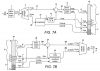
"Remaining" 17 bits of the 24 bit input?
Lossy is a simple concept. Musical information is irretrievably lost - hence the term - in order to save space in the hope that folks won't notice. Such was deemed necessary ten years ago...YMost readers don’t even know what upsampling, lossy...
Last edited:

JoeESP9
ESL's & tubes since 83
No offense taken. I feel I have made my stance loud and clear towards TIDAL and MQA and have actually been lightening up with my rhetoric.
I didn’t join AK to argue with members that don’t share my views. Members may have their mind made up and never ever change their view. That’s fine; But why not let the benefits of the technology speak for itself instead of constantly trying to find faults with it.
Like I said, I feel I had to be extremely proactive because of all the negative publicity TIDAL and MQA receives to this day. Let readers judge for themselves what sounds best to them without all the added forum fighting, which does nothing for the reader but instill confusion and doubt.
I have a problem with any file type that's proprietary, lossy and subject to DRM. Those three reasons are sufficient to sour me on MQA. DRM is a specter that all MQA users should consider before committing exclusively to it. That's part of the reason why I keep my music files stored locally.
JoeESP9
ESL's & tubes since 83
No offense taken. I feel I have made my stance loud and clear towards TIDAL and MQA and have actually been lightening up with my rhetoric.
I didn’t join AK to argue with members that don’t share my views. Members may have their mind made up and never ever change their view. That’s fine; But why not let the benefits of the technology speak for itself instead of constantly trying to find faults with it.
Like I said, I feel I had to be extremely proactive because of all the negative publicity TIDAL and MQA receives to this day. Let readers judge for themselves what sounds best to them without all the added forum fighting, which does nothing for the reader but instill confusion and doubt.
You continue to think and post as if you know what's best and or better for posters who are not as ignorant as you seem to think. Were this thread on Facebook you'd probably be right. However, this is AK and most posters here are not ignorant.

cpt_paranoia
Addicted Member
There is no value in up-sampling existing 16/44, 24/96 etc unless you have poor quality LPFs in your digital gear
The LPF is the reason DACs do upsample. By upsampling (either simple zero stuffing, or more usually, with an interpolating filter), we move the image alias products up in frequency. This allows the LPF to be less stringent (not quite so brick wall), allowing better amplitude and phase response within the audio band.
You can rely on the DAC chip to do the upsampling and filtering, or you can do it before it gets to the DAC, giving the potential to specify a custom interpolation filter design.
Upsampling is not entirely without technical merit.
Of course, this assumes it's possible to relax the reconstruction/anti-imaging filter in the DAC...
[edit] apologies to W9TR for repeating what he said; hit reply before reading the second page...
Last edited:
I not directing my general replies to AK posters or implying that they are ignorant. I write my post with the thought of casual web surfers inquiring about Hi-Res audio in mind; That happens to be in MQA format. I hope to counteract the confusing post, (in layman's terms) when visitors first encounter in these audiophile forums trying to research this controversial topic.You continue to think and post as if you know what's best and or better for posters who are not as ignorant as you seem to think. Were this thread on Facebook you'd probably be right. However, this is AK and most posters here are not ignorant.
Last edited:
cpt_paranoia
Addicted Member
I hope to counteract the confusing post, (in layman's terms) when visitors first encounter in these audiophile forums trying to research this controversial topic
Likewise, we try to post some more detail on the MQA process, to allow the 'layman' a chance to make a more informed decision.
I post on Facebook, YouTube, and other forums about MQA
This forum is about the only place I discuss this sort of thing, other than at work. I might respond to questions on one other forum, but that's generally populated by pretty smart people.
Very good explanationThe LPF is the reason DACs do upsample. By upsampling (either simple zero stuffing, or more usually, with an interpolating filter), we move the image alias products up in frequency. This allows the LPF to be less stringent (not quite so brick wall), allowing better amplitude and phase response within the audio band.
You can rely on the DAC chip to do the upsampling and filtering, or you can do it before it gets to the DAC, giving the potential to specify a custom interpolation filter design.
Upsampling is not entirely without technical merit.
Of course, this assumes it's possible to relax the reconstruction/anti-imaging filter in the DAC...
[edit] apologies to W9TR for repeating what he said; hit reply before reading the second page...


restorer-john
Addicted Member
The LPF is the reason DACs do upsample.
Not exactly. History says otherwise.
No doubt you were around at the same time the reasons were plainly articulated by Philips. They had no choice but to do something as they were in a rather desperate situation. They had gone out on their own and committed the 14bit TDA-1540D to silicon before the DAD working group (50+ manufacturers) had standardized on 16 bit. Philips couldn't achieve a linear 16 bit converter, so used the 4x O/S chipset on the 1540D (upsampling) solution as a stop gap to get CD to market. It gave them 'almost' 16 bit resolution (although THD went to hell below -60dB) In fact they had to have the entire worldwide release delayed by six months while they worked on getting their machines *reliable enough to sell at all. Soon after, they brought the dual channel TDA-1541 to market, but continued to use the 4x O/S chipset as it gave them a boost in performance and much lowered costs.
Sony agreed to delay the combined worldwide release, but not in Japan, where they got a six month head start as part of the deal. By the time the 'benefits' of FIR O/S filtering in terms of cost saving were realized, the D/A converters were fast enough to hang off the end of the new O/S filter chips. We had the bit and oversampling race on for young and old. It was a price driven, race to the bottom.
This allows the LPF to be less stringent (not quite so brick wall), allowing better amplitude and phase response within the audio band.
Less stringent and way less expensive. Those early Murata multi-pole LPFs were hand aligned and cost a ton of money, two per CD player.
The benefits of the upsampling (O/S) at the time were solely cost and face saving. The performance gains were not there, in fact they were worse than 16 bit NOS. Just as the first Bitstream PDM and early PWM converters were introduced solely as low cost, medium performance D/A converters. They never aspired to SOTA until several years later.
Now we have moved on, refined the techniques, and no serious D/A converter manufacturer will be laser trimming resistor ladders on his silicon anymore or hand grading D/A converters for the best linearity. Delta sigma rules.
* I believe it was the yield/reliability of the optical unit (Rodenstock), not their silicon. The Japanese had already put Philips chipsets in their entirety into marketable machines in their home market, but they were using Japanese optics, Sharp LDs and TAOHS (Olympus) or Sony laser units IIRC.
Last edited:
cpt_paranoia
Addicted Member
Not exactly. History says otherwise.
Yes, Philips used oversampling & interpolation as a way to get around the limitation of their 14-bit DAC.
That doesn't mean that oversampling isn't used to ease the design of the image rejection filter, for good reason, as W9TR and I have explained.
The tone of your post suggests you believe oversampling to be some sort of hokum or cheap cop-out. It isn't; it's a perfectly valid technique in digital signal processing. The fact that Sony had to build hand-crafted filters isn't something to laud as the pinnacle of digital engineering. Yes, simpler filters are cheaper. There's nothing wrong with that; one aim of engineering is to strive for efficiency of design. Using oversampling and a simpler, cheaper filter does that; it achieves the same (or better) technical characteristics using a simpler, cheaper method. Oversampling exploits the behaviour of a zero-order hold DAC to allow the design of the filter to be eased. Oversampling DACs are more complex, but are also cheap to produce due to advances in silicon processing (it's just adding a bit of simple digital logic to do the filtering, and requires a faster DAC). To me, it's a more elegant solution than a high-order, hand-crafted filter.
p.s. not trying to pick a fight: I'm genuinely confused about what point you were trying to make by harking back to the 'history'.
Last edited:
restorer-john
Addicted Member
To me, it's a more elegant solution than a high-order, hand-crafted filter.
Absolutely it has proven to be an elegant and inexpensive solution with much better filter characteristics than we could have imagined. However that 'solution' has also come with perceived problems of its own. So much so, the poor D/A converter manufacturers have found it desirable to offer filtering options which simulate the early IIR LPF filters of the first generation CD players due to their so-called 'natural' sound with no evidence of pre-ringing. Even they have to buy into the 'hokum' as you call it.
Remember, you stated:
The LPF is the reason DACs do upsample.
My point was the upsampling was employed due to problems with producing an adequate D/A converter, not because the LPFs were deficient. The LPFs used from day one had a passband ripple requirement of less than +/-0.2dB from DC-20Khz. Their amplitude response was excellent. Their phase response however wasn't good by modern standards. Extensive testing was done and it was determined that the phase delays at high frequencies were not in any way audible or identifiable, even in single D/A converter multiplexed systems. Even so, two D/A converters became de-riguer along to solve that 'problem'.
We are on the same page here. I do however find it useful to put the historical perspective behind the modern spin.

Last edited:
cpt_paranoia
Addicted Member
My point about the LPF wasn't that it's impossible to make one for a NOS DAC, but that an oversampling DAC makes the LPF design easier and more linear. That's the main reason it's used today.
It's interesting that experiments showed phase nonlinearity wasn't audible. A friend of mine at university at around that time (well, a bit later: 83/84) was doing a PhD into the way the ear/brain uses phase to determine direction of a sound source. I guess if both L & R channels had the same phase error, the brain would perceive no position difference. IIRC, the single DAC was followed by an S&H stage to equalise L/R delay. Or is that not right?
It's also interesting that, by using a 4x oversampling to create an effective 16-bit DAC with interpolation and averaging of a 14-bit DAC, Philips relaxed the requirements for their imaging filter...
It's interesting that experiments showed phase nonlinearity wasn't audible. A friend of mine at university at around that time (well, a bit later: 83/84) was doing a PhD into the way the ear/brain uses phase to determine direction of a sound source. I guess if both L & R channels had the same phase error, the brain would perceive no position difference. IIRC, the single DAC was followed by an S&H stage to equalise L/R delay. Or is that not right?
It's also interesting that, by using a 4x oversampling to create an effective 16-bit DAC with interpolation and averaging of a 14-bit DAC, Philips relaxed the requirements for their imaging filter...
restorer-john
Addicted Member
IIRC, the single DAC was followed by an S&H stage to equalise L/R delay. Or is that not right?
Most of the early machines (Japanese) used a single D/A converter with little or no effort to equalize the delay between the L and R. The early Japanese manufactured units that used the Philips chipset (SAA-7000/7010/7020/7030 and 2xTDA-1540D) had no such issues. Sony made a token effort on the CDP-101 but its interchannel at 20KHz (my scope shot attached) will show you how significant it was. Most of the early reviews used to show interchannel delay at 20KHz using a Lissajous plot on a Cro.
I have posted some of these before
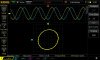
Here's the delay at 3.15KHz.
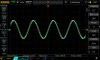
And just for fun, here's the impulse (single sample 0dBfs) and 100Hz square wave response of the CDP-101.
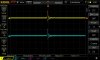
The thing about the above impulse response is it is an illegal signal. It can only exist in the digital domain and yet it is used relentlessly to demonstrate the filter characteristics.

IIRC the interchannel delay corresponds to approximately <4mm at sea level. Perhaps I should breakout the CDP-101 collection (I have several) to see whether I can hear it- last time I tried with test discs, it was imperceptible.
Who knows, maybe cost of the CX-20017 D/A was high enough (I have read figures of $50 due to yield issues) that they decided to use one for cost reasons alone and then justify it as a non-issue. Your friend with the PhD would no doubt be more qualified than me to advise whether these delays at frequencies where we are most sensitive are important or not.
cpt_paranoia
Addicted Member
The thing about the above impulse response is it is an illegal signal. It can only exist in the digital domain and yet it is used relentlessly to demonstrate the filter characteristics.
It is very good at demonstrating the impulse response of the filter, though. It's great for testing that your digital FIR filter has the right coefficients; stick a unity impulse into it, and it spits out the coefficients...
IIRC the interchannel delay corresponds to approximately <4mm at sea level.
Yes, about 3.9mm. It's good to think of it in those physical terms. If they were using muxing of the upsampled values, it would be even less.
Now I'm thinking about how I'd design the digital interpolation filter to cope with the 14-bit DAC... Mustn't cheat and look at the SAA7030 data sheet...
Okay, I cheated:
The SAA7030 is a stereo interpolating filter which quadruples the data sample rate from 44.1 to 176.4kHz and thus achieves the following:
1. It suppresses spurious spectrum lobes in the output data that occur between the baseband frequency and 176.4 +/- 20kHz. This allows the DAC to be followed by a low-cost filter of the linear phase, low-order analogue post filter type (a very high order, low-pass filter would otherwise be required to suppress the 44.1kHz +/- 20kHz lobe).
2. It performs noise-shaping so that a 14-bit DAC yields the same in-band quantizing signal-to-noise ratio as from a 16-bit DAC supplied with unprocessed 44.1kHz samples.
It used a length 96 FIR filter, with 12-bit coefficients. Interestingly, it only used a 28-bit accumulator, and yet the coefficient multiplier was the full 12*16 bits. Allowing for a sign bit in coefficients and samples (S.11*S.15), that would yield an SS.26 result. Dropping one of the duplicate sign bits would require 27 bits (S.26) to represent the full precision result. 96 samples would require another 7 bits (i.e. total 34) to allow the full potential range of input samples and coefficients to prevent overflow. However, they would have known the magnitude of the FIR impulse response (the bit spare would allow a total magnitude of 2.0), and the coefficients and samples would never all have been FSD, thus allowing them not to need the full 7 bit summation overhead for the entire 96 sample FIR. Even so, it included overflow (wrapping) protection on the accumulator to ensure unexpected overflow wasn't horribly audible. The datasheet doesn't show the impulse response, but using the trick mentioned above, it would be an easy matter to read out the exact FIR impulse response the chip uses, by injecting a single FSD sample...
So the primary purpose of the SAA7030, as stated in the datasheet, was to ease the design of the image rejection filter. That it also provided noise-shaping interpolation to enable the use of a 14-bit DAC appears to have been a secondary purpose.
Your friend with the PhD would no doubt be more qualified than me to advise whether these delays at frequencies where we are most sensitive are important or not.
Whether he'd remember from 35 years ago, I don't know. But more chance than me, too. But a quick use of the cosine rule suggests such a small difference would only give an angular offset of ~2.3 degrees for a speaker at 2m, and 200mm ear separation. I really can't see that being noticeable. I haven't looked at the effect of geometry for a stereo pair, but the same effect would be achieved by a distance mismatch in speaker placement, and I'm pretty sure we know such placement isn't that critical (we do know there's a 'sweet spot' for the listener, though). One for the Psychoacoustics forum at ASR, perhaps?
Last edited:

imral3
Enjoy the musics!!
Why not ask your friend what he was using?Was at a friends few months ago and he was upsampling CD 16/44.1 to 24/96 and I liked the difference, to me it did make CD Audio better. I don't remember what he was using to do this.

restorer-john
Addicted Member
So the primary purpose of the SAA7030, as stated in the datasheet, was to ease the design of the image rejection filter. That it also provided noise-shaping interpolation to enable the use of a 14-bit DAC appears to have been a secondary purpose.
No.
The primary purpose of the SAA-7030 (4x O/S) was to get Philips out of a big hole. As I mentioned much earlier, they had committed the 14 bit TDA-1540 converter to production. It already existed, long before the 4x O/S chipset and prior to the compact disc format even being announced. the SAA-7030 was created to fix a serious problem of being unable to resolve 16 bits of data. At the time, they were going it alone with 14 bit (non O/S), a completely different disc diameter and playing time, using that already developed 14 bit D/A converter.
The DAD convention was organized in September 1978 and comprised 35 Japanese manufacturers. They decided on 16/44.1.
In November 1978, the targets for the next Japanese working group were set.
In March 1979 Philips had a working system, the 115mm, 1hr playtime, 14 bit @ 44.33Khz prototype as above.
In October 1979 Sony and Philips finally joined forces.
In December 1979 the partners agreed to 16 bit 44.1KHz.
March 1980, Philips also finally agreed to 16 bit:
June of 1980 the partners announced the increase to 16 bit and the increase from 115mm to 120mm. EFM was also incorporated which gave a potential 30% playing time increase which ultimately was shelved in order to increase track pitch/pit length and improve disc/optical head yield which was low at that point.
So, Philips had to make a 16 bit D/A converter fast, or come up with a way to use the existing 14 bit one by the release date. Apparently, there was even talk of just truncating the last two bits* in order to release a product to market. That's how desperate they were. The 16bit converter was technically out of their reach (prototype TDA-1541 in 1984- sales in 1985) and it was obvious plan B (the O/S path) had to be pursued. The result was the SAA-7030 and the rest is history.
There's plenty out there confirming all this and I have some excellent articles and book links if you are interested.
http://www.dutchaudioclassics.nl/history_of_the_Philips_tda_d_a_converter/
http://www.dutchaudioclassics.nl/Collaboration_with_sony/
Digital Audio Technology, Nakajima H. 1979
The History of the Compact Disc Kees A. Schouhamer Immink (the inventor of EFM) interview attached as PDF
Bear also in mind, reagrding data sheets. The Philips or Signetics Data Handbooks are created to sell the IC products and provide information for application suitability and are compiled long after the chips have been manufactured and initially sold through. The data sheets available online are simply scans from the annual Signetics/Philips handbooks. I have a Signetics handbook here (1992) which lists the TDA-1541 with a February 1991 date on the individual data sheet and yet that chip was produced 1985-1988. So the 'blurb' is written afterwards and to paint the product in a good light and the dates on the datasheets are mainly dates when the description/grading was updated, not initially produced.
Consider the TDA-1540D ceramic packs were in 1st generation OEM machines by Kyocera in Japan in May 1982 and yet the Signetics data sheet dates it November 14, 1986.
 +
+And yet here is a pre-production prototype CD-100 with a TDA-1540 with a 1981 date code:

And here is the 16bit prototype chip that Philips couldn't get to market until 1984/5
http://www.dutchaudioclassics.nl/philips-tda1541.asp#tda1541-prototype
Nobody is denying O/S has benefits, but the chicken and egg question is perfectly clear. 14bit D/A came first, 4x O/S came out of desperation to get 16bit resolution, not filter considerations- that was a side benefit.
*Toshiba released a number of low cost CD players that actually only used their own 14bit (TD-6710an) converter and no O/S. I have a few of them and yet they bear the compact disc logo. Not sure how they got away with it. They just chuck the last two LSBs.
Attachments
Last edited: