Indeed they do change voicing.Hi Dave, I was responding to @Bushikan who said changing the tweeters maintained the stock sound.


Indeed they do change voicing.Hi Dave, I was responding to @Bushikan who said changing the tweeters maintained the stock sound.
I knew a guy over the commissary for the O'Charleys restaurant chain a while back. He decided to cheapen the ingredients in the food and by doing so HIS bonuses got bigger each year. One day I see my friend who had just talked to the genius manager who was asking people what they thought of his new honey mustard salad dressing after virtually all the honey had been replaced with corn syrup. My friend was silly enough to give an honest opinion which was the new corn syrup stuff stinks. The genius stated that people were stupid and they were going to educate them as to what they were going to like. It took a few years for the damage to become irreversible and the genius to get fired after he ran out of others he could blame the poor end results on.OEMs just adjusted to penny pinching consumer buying habits.

Swapped out the washers between the squawkers and the horns - the old ones were rock hard.next steps:
replace the capacitors, they're over 60 years old and are tired. while you're at it, replace the washers between the mid drivers and mid horns. They dry out over time and cause sibilance and distortion.

the crossovers could be leading to distortion. it might also be diaphragms in the mid or tweeter drivers; the tweeters were never great. first replace the caps and see where you get.Swapped out the washers between the squawkers and the horns - the old ones were rock hard.
Having said that - swapping them didn't help with the sibilance and distortion at all.
Any thoughts on what else might be causing that?
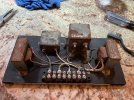
I still have the original crossovers...from 1968, and they have a fair amount of corrosion on them.
Understanding that looks don't necessarily translate to operation, could they be the cause?
Thanks. After I changed the washers on the squawkers (and it had no impact on the sibilance/distortion), I went through the cabinets and checked/tightened all fasteners; then took out the boards; removed all the screws; wire brushed the leads, the contact points on the board, and the screws, and put everything back together. No change. Seems like the caps by themselves (or the entire crossovers), and diaphragms are all that's left...?I would also loosen and tighten all the screws on each board.

I would run the input through the crossover as usual but remove the tweeter connection and see if distortion still there through the mid and bass. If distortion still there re-attach tweeter and remove midrange connection. If needed do the same for bass driver to see if you can isolate the offender.Thanks. After I changed the washers on the squawkers (and it had no impact on the sibilance/distortion), I went through the cabinets and checked/tightened all fasteners; then took out the boards; removed all the screws; wire brushed the leads, the contact points on the board, and the screws, and put everything back together. No change. Seems like the caps by themselves (or the entire crossovers), and diagrams are all that's left...?

They are some rough looking XO's! Think they need all new parts, maybe just get new XO's. Adding dampning material to the horns might also help. They can ring, that makes them sound bad. Think in the end, you will replace the Xo's, get new drivers, also dampen the horns.Thanks. After I changed the washers on the squawkers (and it had no impact on the sibilance/distortion), I went through the cabinets and checked/tightened all fasteners; then took out the boards; removed all the screws; wire brushed the leads, the contact points on the board, and the screws, and put everything back together. No change. Seems like the caps by themselves (or the entire crossovers), and diagrams are all that's left...?
Did you check the DC resistance?I started a new thread about chasing down sibilance/distortion in the Klipschorn, and it was suggested I keep this thread going vs starting new ones. So, I will do that, and let the other one die.
I'm troubleshooting the sibilance/distortion on my 1968 Klipschorn.
I've already changed out the washers on the Squawkers, and cleaned up the contact points on the connection bar (I'm sure there is a name for that, but I don't what it is).
Next I...
Disconnected the tweeters, squawkers, and woofers out of the system, and play them one set at a time.
I'm not hearing any problems when the tweeters or woofers re playing by themselves.
I only hear the problem when the K-55V squawkers are playing.
Are there any test I can run on the drivers?
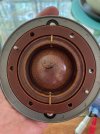
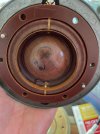
Am I looking at bad diaphragms?
If so - Crites is out of diaphragms - is there another good source for diaphragms for K-55V drivers.
The evolving plan is to change out the caps (should be here by week's end), and the tweeters (should arrive shortly after the caps).
Then see what (if anything) changed.
8.9 ohms sounds too low but someone with a bit more knowledge may be able to comment if that value is within reasonable range."Did you check DC resistance on the driver with a multi meter? If I recall correctly the meter should show a resistance somewhere around 11 ohms plus or minus. The KV55 is a nominal 16 ohm driver."
One driver (which has some distortion) is 10.8, and the other driver (which sounds far worst) is 8.9...
Thank you for your help. I have the tophat apart right now for other maintenance - I'll check this out.8.9 ohms sounds too low but someone with a bit more knowledge may be able to comment if that value is within reasonable range.
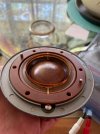
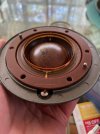
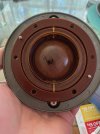
You might want to disassemble the K55 drivers and visually check. It is not too difficult. After screw removal they may feel stuck, but with gentle persuasion, they will come apart. Just be careful to lift straight up so as not to damage the voice coil. It is possible that there is dried up gunk in there or you might see physical damage to the diaphragm. You can also clean the voice coil gap. YouTube has videos showing cleaning methods to remove garbage from voice coil gaps. I remember when I changed out the washers on my K55’s for the first time, half of the metal screen was packed with dried up old washer material.
De-soldering will be required to remove the diaphragm from the driver assembly.
The Speaker Exchange may have the correct diaphragms in stock, although a bit pricier. As someone mentioned the A55G is also an option but again you would be spending more $$$.