• The move to the new server is done. There are some software and database maintenance updates in process. This has us passing the hat around to help out. We appreciate any donations. Seriously, even a dollar helps. The payment page may be found here - https://www.audiokarma.org/support.html

Low efficiency vs. high efficiency speakers?

-30dB down for 2nd order distortion is considerably higher than the -40 to -45dB down that the typical "good" dome tweeter exhibits.

:nono: :nono:

What I already said a good dome has a SPL of about 90dB.

The HF driver above has 0,1% at 112dB!

When that dome tweeter reproduces 112dB it will have distortion levels above 2%. So they will distort about 20 times more. :wave:

You have to compare on the same SPL level :yes:
 
Last edited:
I don't agree with you, at all. It should be compared at referenced sensitivity because no one in their right mind would try to use a dome tweeter at 110dB and expect good results. If you are going to try to make that argument, you'd have to compare distortion of the compression driver/horn system at 90dB.
 
I don't agree with you, at all. It should be compared at referenced sensitivity because no one in their right mind would try to use a dome tweeter at 110dB and expect good results. If you are going to try to make that argument, you'd have to compare distortion of the compression driver/horn system at 90dB.

I do not have problems with that. The fact that good horn drivers have very low distortion stays the same.:thmbsp:

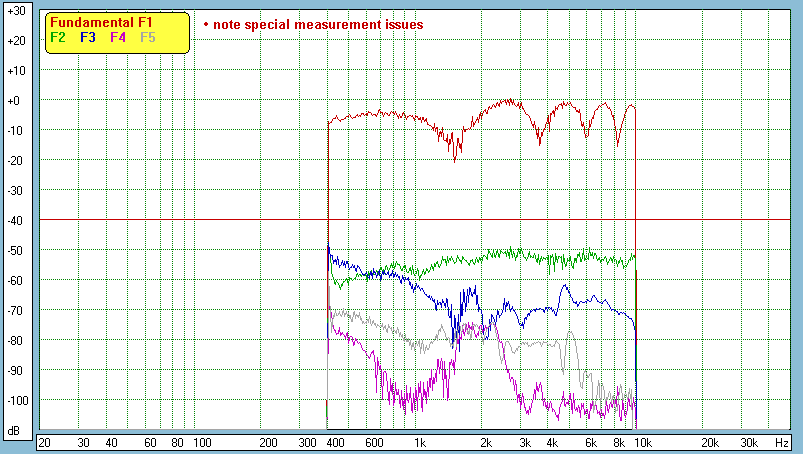
See the graphic of the eminence HF driver. Distortion measured <0,3% at 85dB 1mtr. It is not the best but all ready very nice

SCAN0001.jpg
 
Last edited:
Let's put it another way. At their designed/intended playback levels, dome tweeters will tend to have *significantly* lower distortion than a similar quality compression driver.

I'm a big compression driver/waveguide fan, so please don't take it that I'm slamming the technology.
 
btw, .3% should be roughly what, -50dB? That's not out of range of what a great dome tweeter can do. Add 5dB to that eminence and we are talking very similar levels.
 
btw, .3% should be roughly what, -50dB? That's not out of range of what a great dome tweeter can do. Add 5dB to that eminence and we are talking very similar levels.

Show me a measurement of those dome tweeters. The eminence has around 2% THD at 100dB.

The compression driver above 0,1% 112dB way enough for high quality replay, is that so hard to understand, at 90 dB it will do easy -40dB THD.


Again SPL, THD at a level no dome can compete with.

To calculate distortion. say -30dB


((-30/10) inverse log)100% = (-3 inv log)100% = 0,1%


A dome tweeter of 90dB/ 1Wmtr at 100W will do 110dB.
 
Last edited:
50 dB is five orders of magnitude (or decades or "logs" if you prefer). 1% (1 part in 100 or 0.01 or two orders of magnitude) is 20 dB down; 0.1% is 30 dB down; 0.01% 40 dB; 0.001% is 50 dB.
 
I'd like to echo what Coytee said back a ways the reason to play a high efficiency speaker with a high powered amp is quite simply to try to get as close as possible to concert level volume, image size, and dynamics. Although I don't have a god like system like his, my JBL Apollo C51s with an 030 load driven by a Sansui AU D11 II which has a beefy torroidal transformer and 130 clean watts per channel is the only speaker I have heard in person that approaches concert level sound for jazz and rock without sounding distorted. I believe the C51s are around 96 db/watt.meter which isn't bad for a dynamic woofer and ring radiator tweeter.

"Stupid loud" as Zilch would say. And no I don't play that loud very often or long and always when I am in the next room as I value my hearing.

I also have set of NHT SUper One low efficiency bookshelf speakers with a small sub in the basement when I want to do the lower volume, more restricted dynamics, modern speaker pin point imaging, detail, and extended high end frequency response thing.

 
Last edited:
A good performing dome. 0,1 % at 90 dB. Hobby hifi calls it extreme low distrosion. The compression driver above has 0,1% at 112dB.

mivochorn.jpg


horn.jpg
 
Last edited:
Helmuth, check the new peerless HDS dome tweeter, it approaches -50dB for 2nd order HD across most of it's usable range, drops to mid-low 40s at the very top end.

I am still a firm believer that you should be comparing distortion at referenced sensitivities, not trying to compare drivers intended for completely different applications.
 
I'd like to echo what Coytee said back a ways the reason to play a high efficiency speaker with a high powered amp is quite simply to try to get as close as possible to concert level volume, image size, and dynamics. Although I don't have a god like system like his, my JBL Apollo C51s with an 030 load driven by a Sansui AU D11 II which has a beefy torroidal transformer and 130 clean watts per channel is the only speaker I have heard in person that approaches concert level sound for jazz and rock without sounding distorted. I believe the C51s are around 96 db/watt.meter which isn't bad for a dynamic woofer and ring radiator tweeter.

"Stupid loud" as Zilch would say. And no I don't play that loud very often or long and always when I am in the next room as I value my hearing.

I also have set of NHT SUper One low efficiency bookshelf speakers with a small sub in the basement when I want to do the lower volume, more restricted dynamics, modern speaker pin point imaging, detail, and extended high end frequency response thing.


Interesting! I guess it all just boils down to what we are looking for and expecting out of our systems. Also, what defines low efficiency, high efficiency and LOUD.

I don't think my speakers have Stupid Loud capabilities. Possibly Ignorant Loud, but not Stupid Loud ;)

RC
 
V x F = C
E

This equation applies to dynamic driver loudspeakers with closed or vented alignment, where:

V= volume of enclosure
F = -3bB low frequency cutoff
E = efficiency
C = constant

More efficient dynamic drivers are superior to less efficient ones in general because all dynamic drivers exhibit substantial compression of dynamics which robs music of the life-like quality. Compression is secondary to voice coil heating and back EMF (kick back introduced by eddy currents introduced into the voice coil and magnet).

But, as the equation illustrates, one has to trade off between speaker size, low bass extension and efficiency. So if you want a very efficient dynamic driver with low compression and low distortion for good dynamics, you'll need a very large box if you expect much bass extension. Conversely, if you want your little bookshelf speaker speaker to reproduce a full symphony orchestra, bass drum and all, it will likely be very very inefficient (SPL <83 dB) and require enormous watts to drive it to reasonable levels, distortion and compression notwithstanding.

My present loudspeakers are definitely on the inefficient power hungry side of the spectrum. I estimate the Walsh 5000 to have a sensitivity of about 86 dB. They have lowish nominal impedance of 4-6 ohms. They need a lot of watts - my amps are rated for 550W into 8 ohms doubling into 4 ohms (amperage from wall outlets permitting!). These loudspeakers are the most dynamic and distortion-free I have ever owned. The key is to use a loudspeaker that has a power rating several multiples above what your room size demands, and an amplifier with at least 4-10 times the peak wattage likely to be needed. In my 2,000 cu ft room with intermediate acoustic damping, the Walsh 5000 (peak power rating ~700W) and the Wyred 4 Sound ST-1000 amps are loafing even at high music peaks of 100 dB which is about as loud as I need or care to expose my ears to. Compression problem solved. BTW, the Walsh 5000s are flat to the low 20s in my room and though they are a ported design, the bass is of a most excellent tight fast and tuneful quality that would be the envy of the best acoustic suspension designs.
 
The selenium driver wasn't a good example I found a better one. Other wise music lovers will be misled.
Let's not have music lovers be misled by the compressed 20 dB/div vertical scale.

You'll give up the same 7.5 dB flattening that one to 30° horizontal for uniform power response out to there. It's clearly not a 90° horn, either, and has already lost it at 10° in the vertical.... :thumbsdn:
 
Last edited:
See below...


Yup, so your .3% would be -25dB.

Here's a dome (Scanspeak 9500) that's down at least 40dB (or .01%):

ScanSpeak_9500-HD.gif

that grafic shows at 1k5 about -31 dB 0,08% second harmonic. 3k5 ,5k,8k2 also but it is good one indeed. so not -50dB

What I want to repeat is a horn driver can do better and certainly at high level.
And I want to say that because always every one mention distortion of a horn that isn't right.
 
Could it be that one type driver is more susseptable to odd versus even order distortion? And if say a horn would possibly have more odd order it could be why it sounds better with tube amps which tend to have more even order distortion :scratch2:

I don't pretend to be on same level of understanding of theory as you guys. Just thought I throw something on the wall to see what it looks like :D
 
Bad horns are loaded with lots of reflections dubbed HOMs (higher order modes) by Geddes. What it's similar to is early reflections in a home system that people try to kill with room treatment. The compression driver may have nice distortion characteristics but if you couple it with a bad horn, it's going to more than likely sound bad. Modern waveguides and specifically, certain horn profiles reduce HOMs. Geddes also uses open cell foam through most of his waveguides to further reduce the reflections.

All I can say is that it not only works, it works fantastically. It's got the dynamics of a horn with the sound of a soft dome tweeter. Imaging (and soundstage for Ron) is spot on.
 
Let's put it another way. At their designed/intended playback levels, dome tweeters will tend to have *significantly* lower distortion than a similar quality compression driver.

I'm a big compression driver/waveguide fan, so please don't take it that I'm slamming the technology.

I'll admit to ignorance on much of this technical stuff. This did however, make me think of something....

If I typically listen to my highly sensative horns at approximately 100 db peaks then wouldn't it be just as fair to use that number for both 'tests'?

Point being....if that is the peak level I might use then the horns would put out "X" distortion and again, if that is the peak level I use, then the domes would put out ?? distortion??

In other words, I'd wonder if it's not really fair to use the "intended" playback levels since it would probably be dangerous to listen at levels my system is capable of achieving. Since I never listen there, why use that as the benchmark?

(honest question)

I realize for commercial use, the benchmark numbers might mean something but for a homeowner, I'd think the levels used in the home would make more sense to analyze, no?
 
I understand where you are coming from and if that were the case, it would have to be compared at the level of the lower sensitivity driver to be remotely fair.
 
Evidently this will be the 100th post in this thread, so I suppose that I'll utilize my unique position as "The World's Foremost Authority" to declare that all else being equal, High Efficiency is better.

Moderator, you may now close this thread.

Best Regards,
TerryO
 
Back
Top Bottom