• The move to the new server is done. There are some software and database maintenance updates in process. This has us passing the hat around to help out. We appreciate any donations. Seriously, even a dollar helps. The payment page may be found here - https://www.audiokarma.org/support.html

MA12000: New Hybrid Integrated

My only aesthetic issue, really, is how would an MR88 tuner look perched on top of that MA12000 (with a little added clearance provided by four black hockey pucks). No one (meaning me) would ever see the "halo."

First thing the popped into my head on reading this is that you would not want to put anything on top of an 700-800 Watt amp, you need to leave air above it for ventilation. The MR would block convection cooling in the MA causing it to run and hot and the heat from the MA would go directly into the MR causing it to run hot - heat shortens the life span of the components. The MR88's back feet would be resting right on the heat sinks. Ventilation-wise, it would be better to put the MA on top of the MR but the MA's weight might crush the MR's chassis.
 
DSCF5834.jpeg
First thing the popped into my head on reading this is that you would not want to put anything on top of an 700-800 Watt amp, you need to leave air above it for ventilation. The MR would block convection cooling in the MA causing it to run and hot and the heat from the MA would go directly into the MR causing it to run hot - heat shortens the life span of the components. The MR88's back feet would be resting right on the heat sinks. Ventilation-wise, it would be better to put the MA on top of the MR but the MA's weight might crush the MR's chassis.

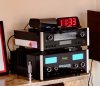
So how much room for ventilation? I'm using black hockey pucks now for an extra inch or so clearance above my MAC7200 for the MR88 tuner.

The MAC7200 replaced an MA5200 so needed the tuner then; now the FMHD function gives me programming not otherwise available with the receiver.
 
View attachment 2004072


So how much room for ventilation? I'm using black hockey pucks now for an extra inch or so clearance above my MAC7200 for the MR88 tuner.

The MAC7200 replaced an MA5200 so needed the tuner then; now the FMHD function gives me programming not otherwise available with the receiver.

I still wouldn't do that. The only time I'd place another component above my amplifier would be on a rack that had separate shelves and at least 4 inches of air space between the amp and the shelf above. Setting something directly on the amp's heat sinks can prohibit heat convection from the sinks. Might seem anal to some, but it's something I've always practiced.
 
A lot of hypotheticals here. My MC300 never gets above ambient temperature. Has anyone even put their hands on the heatsinks or measured them with the temp function of a DVM?
 
View attachment 2004072So how much room for ventilation? . . .

Check the operator's manual for your components which provide the engineering recommendations from McIntosh. I have some operator manual examples below for my stuff, but you should use your manuals to get the recommended clearance numbers for your components.


Here's cut and paste from my MC452 manual (for an example similar to the MA12000):

Always provide adequate ventilation for your MC452. Cool operation ensures the longest possible operating life for any electronic instrument. Do not install the MC452 directly above a heat generating component such as a high powered amplifier. If all the components are installed in a single cabinet, a quiet running ventilation fan can be a definite asset in maintaining all the system components at the coolest possible operating temperature.

A custom cabinet installation should provide the following minimum spacing dimensions for cool operation.

Allow at least 6 inches (15.24cm) above the top, 2 inches (5.08cm) below the bottom, 3 inches (7.62cm) behind the rear panel and 2 inches (5.08cm) on eachside of the Power Amplifier, so that airflow is not obstructed. Allow 2-1/2 inches (6.35 cm) in front ofthe mounting1 panel for clearance. Be sure to cut out a ventilation hole in the mounting shelf according to the dimensions in the drawing.


1 When the MC452 is installed together with other McIntosh Components, check clearances on all components before proceeding.


And here's cut and paste from my C47 manual (for an example similar to the MR88):

Always provide adequate ventilation for your C47. Cool operation ensures the longest possible operating life for any electronic instrument. Do not install the C47 directly above a heat generating component such as a high powered amplifier. If all the components are installed in a single cabinet, a quiet running ventila- tion fan can be a definite asset in maintaining all the system components at the coolest possible operating temperature.

A custom cabinet installation should provide the following minimum spacing dimensions for cool operation.

Allow at least 2 inches (5.1cm) above the top, 2 inches (5.1cm) below the bottom and 1 inch (2.5cm)
on each side
of the Preamplifier, so that airflow is notobstructed. Allow 20 inches (50.8cm) depth behind the front panel. Allow 1-7/16 inch (3.7cm) in front of themounting panel for knob clearance. Be sure to cut out a ventilation hole in the mounting shelf according to the dimensions in the drawing.
 
Check the operator's manual for your components which provide the engineering recommendations from McIntosh. I have some operator manual examples below for my stuff, but you should use your manuals to get the recommended clearance numbers for your components.


Here's cut and paste from my MC452 manual (for an example similar to the MA12000):

Always provide adequate ventilation for your MC452. Cool operation ensures the longest possible operating life for any electronic instrument. Do not install the MC452 directly above a heat generating component such as a high powered amplifier. If all the components are installed in a single cabinet, a quiet running ventilation fan can be a definite asset in maintaining all the system components at the coolest possible operating temperature.

A custom cabinet installation should provide the following minimum spacing dimensions for cool operation.

Allow at least 6 inches (15.24cm) above the top, 2 inches (5.08cm) below the bottom, 3 inches (7.62cm) behind the rear panel and 2 inches (5.08cm) on eachside of the Power Amplifier, so that airflow is not obstructed. Allow 2-1/2 inches (6.35 cm) in front ofthe mounting1 panel for clearance. Be sure to cut out a ventilation hole in the mounting shelf according to the dimensions in the drawing.


1 When the MC452 is installed together with other McIntosh Components, check clearances on all components before proceeding.


And here's cut and paste from my C47 manual (for an example similar to the MR88):

Always provide adequate ventilation for your C47. Cool operation ensures the longest possible operating life for any electronic instrument. Do not install the C47 directly above a heat generating component such as a high powered amplifier. If all the components are installed in a single cabinet, a quiet running ventila- tion fan can be a definite asset in maintaining all the system components at the coolest possible operating temperature.

A custom cabinet installation should provide the following minimum spacing dimensions for cool operation.

Allow at least 2 inches (5.1cm) above the top, 2 inches (5.1cm) below the bottom and 1 inch (2.5cm)
on each side
of the Preamplifier, so that airflow is notobstructed. Allow 20 inches (50.8cm) depth behind the front panel. Allow 1-7/16 inch (3.7cm) in front of themounting panel for knob clearance. Be sure to cut out a ventilation hole in the mounting shelf according to the dimensions in the drawing.

Like I said, a lot of hypotheticals. YMMV
 
Late to this thread, but all I'll say is this...... If you got the money to afford McIntosh, then find the money for a suitable rack to house such. Going back to 1974 when I started in this hobby, I never stacked anything.

There's 500 different ways you can go, even something DIY, which I did once. Custom cut 1" thick Plywood Shelves, on Glass Block Risers. An easy 350 lbs of equipment it handled, and plenty of space to breathe.

You can spend $300, and you can spend $5000.
Something like a Salamander Rack is nice, not too expensive, relatively narrow with not too large a footprint, buy the size and shelf quantity you need, they're rock solid, and infinitely adjustable for rack spacing in between Shelves.

If we're talking Mac 1.2K or other monster behemoths, then sure, think about a Amp Stand on the floor.

 
Last edited:
Late to this thread, but all I'll say is this...... If you got the money to afford McIntosh, then find the money for a suitable rack to house such. Going back to 1974 when I started in this hobby, I never stacked anything.

There's 500 different ways you can go, even something DIY, which I did once. Custom cut 1" thick Plywood Shelves, on Glass Block Risers. An easy 350 lbs of equipment it handled, and plenty of space to breathe.

You can spend $300, and you can spend $5000.
Something like a Salamander Rack is nice, not too expensive, relatively narrow with not too large a footprint, buy the size and shelf quantity you need, they're rock solid, and infinitely adjustable for rack spacing in between Shelves.

If we're talking Mac 1.2K or other monster behemoths, then sure, think about a Amp Stand on the floor.


I use a full height 42u 19" open frame server rack for my gear. Super cheap and infinitely flexible. Not the prettiest setup but I don't care. If you really care about aesthetics you can use a closed rack and Middle Atlantic makes custom shelves for most equipment out there including McIntosh. A lot of home theater companies use a setup like this and it looks really clean. Also when you use a 19" rack you can easily add ventilation fans if you want to.
 
I think I smell an all SS integrated coming that's the same as this one, sans the tubes....MA11000.
 
When I walked into LMC, I was immediately drawn to the 1.25kws ... OMG those things are stunning. All my apprehensions about the cup holder disappeared as I walked up to them. These are the first Mc amps I laid eyes on that had me selling my MC2600s to get s pair (of course I won't be doing that, but I sure thought I might at that moment).

So I suggest you see the 12000 in person before making judgment.
 
Starting back in 1966 with a Fisher 500b in a wooden case with a ventilation grill on top, I've stacked components with clearance for air flow and never once had any problems. I'm sure all advice is well meaning, but I'm in an office, have a granite top credenza that can hold the gear, so limited space. There will be clearance for ventilation, but no rack. It's not gonna happen. It's also not going to be played at ear-splitting volumes, not for too long, anyway. My MAC7200 with the MR88 on top runs cool all day long.

PA120015 (3).jpg
 
Last edited:
I kept some Mac gear for 44 years, like two bought new MC-2105 Amps both with Walnut Cases.

And nary a mark on anything. Which is another major reason I've always been against stacking, and taking other good measures for protection of my equipment.

I've always also covered my gear, Mac or otherwise when not in use. In the early days they were simpler measures, but effective. Staves off both dust, and UV degradation.

Fast forward to current day, I have had custom made Black Vinyl Covers for every piece of Gear I have. I had much of them designed with a rear flap so that Cables may exit with no interference caused, and the covers still go over and protect such areas from dust accumilation, etc.

So, it takes me an additional 4-5 minutes to remove, and reinstall them? The cost and effort IMO is/was worth it when I factor the multiple tens of thousands of dollars I've invested in my system. Here's one Pic, but some covers are missing in this Picture.

DSCN0550.JPG
 
Last edited:
Yeah - I try and do the same.

There is a guy from CA on Ebay that does the black covers with (for Mac) in blue lettering. Stuff is great and fits perfectly. I have them for my monoblocs and preamp and am ordering one for my new MCD600
 
When I walked into LMC, I was immediately drawn to the 1.25kws ... OMG those things are stunning. All my apprehensions about the cup holder disappeared as I walked up to them. These are the first Mc amps I laid eyes on that had me selling my MC2600s to get s pair (of course I won't be doing that, but I sure thought I might at that moment).

So I suggest you see the 12000 in person before making judgment.

You've already got a pair of 1.2kW amplifiers.

Without all that annoying refinement.
 
When I walked into LMC, I was immediately drawn to the 1.25kws ... OMG those things are stunning. All my apprehensions about the cup holder disappeared as I walked up to them. These are the first Mc amps I laid eyes on that had me selling my MC2600s to get s pair (of course I won't be doing that, but I sure thought I might at that moment).
Yessir; I know exactly how you felt.:rockon:
 
When most people walk into a museum, the first thing they are drawn to is the Apatosaurus skeleton.
 
Back
Top Bottom