You are using an out of date browser. It may not display this or other websites correctly.
You should upgrade or use an alternative browser.
You should upgrade or use an alternative browser.
Made my first braided speaker cable...
- Thread starter imral3
- Start date
-
- Tags
- 16 awg braided ofc speaker wire
Hmm...maybe they were defective, was it the same manufacturer each time?These were actually on expensive non home made cables (yes, at one point I "believed" in the magic cable thing) that were inserted etc numerous times. No hammer was involved. It was quite annoying at the time.
wyn palmer
Addicted Member
Braiding the conductors causes any external EM radiation to be picked up equally in both lines- which may not be the case if the conductors are in the normal side by side configuration.Does braiding the speaker wire improve performance or is it just cosmetic? I assume braiding affects the magnetic field in some way!??
This means that the signals produced are common mode and will not produce a signal voltage across the speaker.
However, the EM fields that are likely to be encountered are tiny and there's no amplification so it's of minimal value.
The inductance is a function of the enclosed loop and it is minimized by having the wires as close to one another as possible and having the conductors in a linear structure as this reduces the flux linkage between different sections of the wire (essentially mutual inductance between turns).
So, the side by side conductor arrangement has minimal inductance, and can be further reduced by running multiple insulated wires in parallel, but is actually increased for a twisted pair, especially since the twisting reduces the effective length of the wire.
Capacitance is a bit more complex and I've no seat of the pants explanation for what would happen.
So, I did some measurements on a 14 AWG standard side by side speaker wire that was then separated and reduced from about 6' to about 5' by twisting. The resistance remained the same, so in effect the twisted wire has about 20% more resistance per unit length than the non twisted wire. The inductance increased from 1.3uH to 1.6uH- so about a 50% increase in inductance per ft.
The capacitance reduced from 102 pF to 78pF- but accounting for the change in effective length it was essentially unchanged.
The bottom line is- I believe that twisting is not beneficial for speaker cables- but nor is it particularly harmful if you don't care about the effective increase in resistance and inductance.
Last edited:
wyn palmer
Addicted Member
I can't remember who the manufacturer was. It was quite a while ago and I moved to the current style of banana plugs as a result and I've had no reason to revisit the decision.Hmm...maybe they were defective, was it the same manufacturer each time?

imral3
Enjoy the musics!!
Wyn, thanks for the informative replies! I'm still trying to process everything as explained - it's admittedly above my level of understanding. Now, in my case I have braided four strands of 16awg, using two each for both negative and positive. Thus, effectively winding up with around 13awg cables. Does this change (for good or bad) anything stated in your above quoted info?Braiding the conductors causes any external EM radiation to be picked up equally in both lines- which may not be the case if the conductors are in the normal side by side configuration.
This means that the signals produced are common mode and will not produce a signal voltage across the speaker.
However, the EM fields that are likely to be encountered are tiny and there's no amplification so it's of minimal value.
The inductance is a function of the enclosed loop and it is minimized by having the wires as close to one another as possible and having the conductors in a linear structure as this reduces the flux linkage between different sections of the wire (essentially mutual inductance between turns).
So, the side by side conductor arrangement has minimal inductance, and can be further reduced by running multiple insulated wires in parallel, but is actually increased for a twisted pair, especially since the twisting reduces the effective length of the wire.
Capacitance is a bit more complex and I've no seat of the pants explanation for what would happen.
So, I did some measurements on a 14 AWG standard side by side speaker wire that was then separated and reduced from about 6' to about 5' by twisting. The resistance remained the same, so in effect the twisted wire has about 20% more resistance per unit length than the non twisted wire. The inductance increased from 1.3uH to 1.6uH- so about a 50% increase in inductance per ft.
The capacitance reduced from 102 pF to 78pF- but accounting for the change in effective length it was essentially unchanged.
The bottom line is- I believe that twisting is not beneficial for speaker cables- but nor is it particularly harmful if you don't care about the effective increase in resistance and inductance.

Bigmoonface
Active Member
Braiding the conductors causes any external EM radiation to be picked up equally in both lines- which may not be the case if the conductors are in the normal side by side configuration.
This means that the signals produced are common mode and will not produce a signal voltage across the speaker.
However, the EM fields that are likely to be encountered are tiny and there's no amplification so it's of minimal value.
The inductance is a function of the enclosed loop and it is minimized by having the wires as close to one another as possible and having the conductors in a linear structure as this reduces the flux linkage between different sections of the wire (essentially mutual inductance between turns).
So, the side by side conductor arrangement has minimal inductance, and can be further reduced by running multiple insulated wires in parallel, but is actually increased for a twisted pair, especially since the twisting reduces the effective length of the wire.
Capacitance is a bit more complex and I've no seat of the pants explanation for what would happen.
So, I did some measurements on a 14 AWG standard side by side speaker wire that was then separated and reduced from about 6' to about 5' by twisting. The resistance remained the same, so in effect the twisted wire has about 20% more resistance per unit length than the non twisted wire. The inductance increased from 1.3uH to 1.6uH- so about a 50% increase in inductance per ft.
The capacitance reduced from 102 pF to 78pF- but accounting for the change in effective length it was essentially unchanged.
The bottom line is- I believe that twisting is not beneficial for speaker cables- but nor is it particularly harmful if you don't care about the effective increase in resistance and inductance.
Thanks for the reply Wyn. I'm still a bit confused though, the increase in resistance and inductance in the cable by braiding it makes no difference to the sound the speaker produces!??
wyn palmer
Addicted Member
It depends...Thanks for the reply Wyn. I'm still a bit confused though, the increase in resistance and inductance in the cable by braiding it makes no difference to the sound the speaker produces!??
The resistance of the roughly 6' cable of 14AWG stranded wire (untwisted) was 0.16 ohms there and back. For an 8 ohm resistive load that is a damping factor of 50, which would be fine.
Two sections in parallel would be 0.08 ohms.
The1.6uH inductance has an impedance of about 0.2ohms at 20kHz, and two parallel wires would be 0.1ohms at 20kHz. Still fine for your 8 ohm speaker.
These are pretty small numbers unless you are driving something like the electrostatic panels on the speakers I use that have an impedance of 0.9 ohms at c. 30kHz.
imral3
Enjoy the musics!!
Were you answering both questions asked by @Bigmoonface and @imral3 ?It depends...
The resistance of the roughly 6' cable of 14AWG stranded wire (untwisted) was 0.16 ohms there and back. For an 8 ohm resistive load that is a damping factor of 50, which would be fine.
Two sections in parallel would be 0.08 ohms.
The1.6uH inductance has an impedance of about 0.2ohms at 20kHz, and two parallel wires would be 0.1ohms at 20kHz. Still fine for your 8 ohm speaker.
These are pretty small numbers unless you are driving something like the electrostatic panels on the speakers I use that have an impedance of 0.9 ohms at c. 30kHz.
wyn palmer
Addicted Member
Ignoring the fact that stranded wire doesn't really exactly conform to the AWG numbers- 16AWG has about 25% higher resistance but essentially identical inductance.Wyn, thanks for the informative replies! I'm still trying to process everything as explained - it's admittedly above my level of understanding. Now, in my case I have braided four strands of 16awg, using two each for both negative and positive. Thus, effectively winding up with around 13awg cables. Does this change (for good or bad) anything stated in your above quoted info?
So, the resistance goes up by 25% and the inductance stays the same. I have no comment on the capacitance.
wyn palmer
Addicted Member
No, I'm trying to multi task here and getting a bit out of sync with everything...Were you answering both questions asked by @Bigmoonface and @imral3 ?
imral3
Enjoy the musics!!
No problem! Thanks!No, I'm trying to multi task here and getting a bit out of sync with everything...

Those look really nice! I'm sure they sound equally as nice. I'll take two when you get a chance.and I'm proud of myself! LOL!!! Had some spare wire and banana plugs laying around. It's the same 16awg OFC I'm currently using. Used 4 separated strands, terminating the two positives and negatives into one banana for each at both ends (of course).
View attachment 1570116
Didn't have any heat-shrink - just used some electrical tape. Maybe next time.
Enjoy the music!!

Last edited:
imral3
Enjoy the musics!!
Okay, pick up orders only!Those look really nice! I'm sure they sound just as nice. I'll take two when you get a chance.

Poultrygeist
Lunatic Member
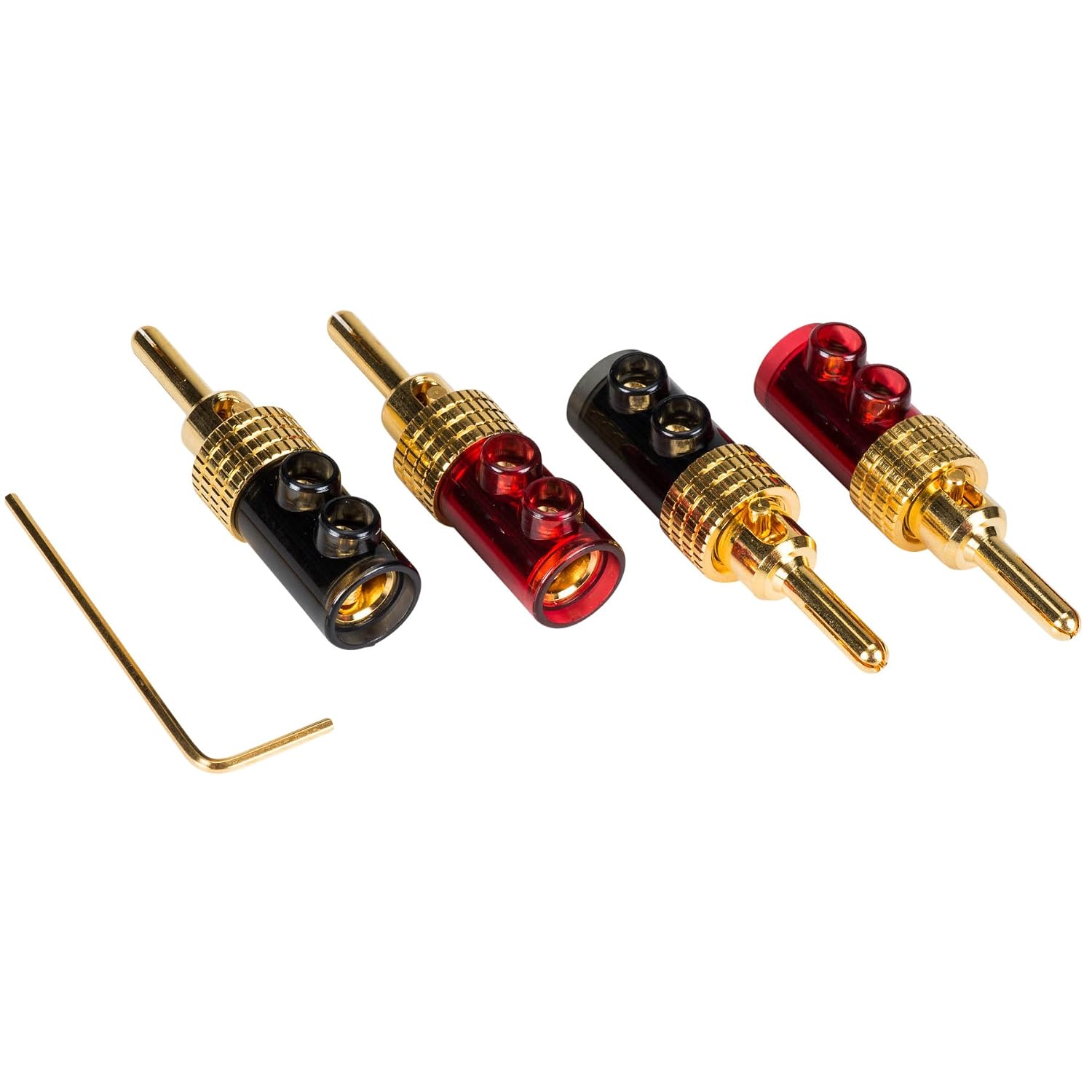
I prefer these low mass multi contact types, very affordable and do what is required and no more.
View attachment 1572055
The advantage these saw tooth bananas have over standard bananas is you can use a screwdriver on their barrel to make them wider so they fit tighter.
Last edited:
wyn palmer
Addicted Member
And the disadvantage is that if you do that a few times the "shell" gets brittle and can snap.The advantage these saw tooth bananas have over standard bananas is you can use a screwdriver on their barrel to make them wider so they fit tighter.
Well designed standard bananas (like the ones I use) act like the contact regions are springs and don't need to be adjusted.
Poultrygeist
Lunatic Member
And the disadvantage is that if you do that a few times the "shell" gets brittle and can snap.
Well designed standard bananas (like the ones I use) act like the contact regions are springs and don't need to be adjusted.
Saw tooth bananas are adjustable but try prying the springs up on standard bananas to make them larger and they'll break every time. I suppose if you're ham fisted you could break the shell of a saw tooth banana but I've never come close.
wyn palmer
Addicted Member
I've managed to break saw tooth bananas over time, and they were a b**ch to replace.
The quality bananas I currently use always apply positive force when being inserted due to their spring action, have not broken, are not showing any signs of damage, are easy to install, easy to replace, and have unmeasurably low (<10mohms) contact resistance. What's not to love?
The quality bananas I currently use always apply positive force when being inserted due to their spring action, have not broken, are not showing any signs of damage, are easy to install, easy to replace, and have unmeasurably low (<10mohms) contact resistance. What's not to love?
Poultrygeist
Lunatic Member
Bottom line one is adjustable and one is not.