• The move to the new server is done. There are some software and database maintenance updates in process. This has us passing the hat around to help out. We appreciate any donations. Seriously, even a dollar helps. The payment page may be found here - https://www.audiokarma.org/support.html

Magnavox Console Reel to Reel?

Turdherder

New Member
Craigslist ad shows a Magnavox Astro-Sonic with TT & reel to reel. I can't find any similar with a quickie AK and web search. Was the reel a Magnavox option?

3na3m13oc5Y55T55R5b5hc9b042983058112f.jpg


3nb3k23od5V05Y05W0b5h873b208faa8e1869.jpg
3n73m73ld5P45X15R0b5h3c0f92badef91359.jpg
 
Register to hide this ad
I am sure Magnavox didn't make that reel to reel. Looks like maybe a Viking or something. Nothing to write home about.
 
Those were common in upper end console systems back in the 60s - a time of euphoria for all things tape (the BluRay of its day!). Still, like much consumer gear, it was all made to a price point and sold first as furniture so functionality and build quality came out lower on the priority scale.

Cheers,

David
 
Had a GE unit like that. Basic deck design with single motor two heads. Good thing is/was that the deck probably has almost no run time on it. Might have had a demo tape that got played a couple times. Those were pretty good old stereo units, still decent too. Big speakers with horn mids/highs. Fun to play with but sure take up some room.
 
I am sure Magnavox didn't make that reel to reel. Looks like maybe a Viking or something. Nothing to write home about.

I've seen 1950's/60's Magnavox stereo consoles with Tape positions on their Selector knobs & jack plates (hidden inside, on the tuner/preamp chassis apron) for Tape In & Rec Out & an (also internal) AC accessory outlet on the Power/Amp chassis, but I've never seen one with a (presumably optional & presumably open-reel) deck actually installed. FM-MPX was also an optional accessory back then. Upgrade kits were available & intended to be simple enougfh for DIY installation with dealer installation available if needed. Presumably, the Tape option was similarly available. Certain cabinet panels inside (record storage bin & speaker selector escutcheon) being attached with easily accessible & clearly visible screws seem to indicate that the kits might have included replacement cabinet parts (escutcheons & trim, etc.) to provide a neat factory-original installed appearance. The tape units were possibly made for Magnavox by Collaro, my best guess since Magnavox used re-branded Collaro units as phono transports. They might have used Viking tape transports, of course, but Collaro seems to me to be the more likely supplier. My '61 Maggie 1ST208F console has those internal provisions for supplying power & signal for a tape transport that was never added. I've brought the signal connections for mine out via 1/8"-stereo-to-RCA cables whose 1/8" plugs are small enough in diameter to slip easily through two of the existing ventilation holes in the cabinet back, secured with clips inside for strain relief. An easily reversible mod in case I ever do score a Maggie-branded stereo open reel tape deck to add.
 
Magnavox in the day had tape as an option (usually rebranded Japanese made tape decks. Reel to reel, 8 track (most common) and cassette options could be had). Collaro tape decks were never offered outside of Europe to the best of my knowledge. I think Panasonic made the Magnavox reel to reel decks if I recall correctly.
 
Magnavox in the day had tape as an option (usually rebranded Japanese made tape decks. Reel to reel, 8 track (most common) and cassette options could be had). Collaro tape decks were never offered outside of Europe to the best of my knowledge. I think Panasonic made the Magnavox reel to reel decks if I recall correctly.

Prior to the Astro-Sonic era, I presumed Magnavox to have selected some European OEM to provide custom-badge third-party tape units over an (at the time) newcomer from Japan. My first guess of Collaro probably was unlikely, but I expected a preference for a British (or perhaps German) source for the open-reels of the early stereo era (circa 1958-1964 builds) over then-newcomers Matsushita, at least until they had established themselves as reasonably-close rivals to (the first Japanese electronics to be somewhat acceptable in quality) Sony. Panasonic, as I recall, hadn't really become much of a contender in terms of quality until circa 1968, but was certainly a cut above the other garbage brands like Delmonico (with its chewed-bubblegum chassis support grommets & other horrors hidden inside) by about 1972. Considering later well-known (NAP-era) Magnavox/Panasonic affiliation, I'm sure you're mostly correct, Kent, at least regarding later R/R and especially 8-track & Philips compact-cassette format transports. Can anyone confirm the same to be true of the origins of those earlier (1958-1964) tape options?
 
The earlier tape decks may have been European, but open reel only. I am mainly discussing the Astro-Sonic era when tape decks got much more available. The Collaro reel to reel machines never gained much of a following here in the USA. And I figure only Concert Grand and very expensive regular lines got tape offered as an option.
 
The earlier tape decks may have been European, but open reel only. I am mainly discussing the Astro-Sonic era when tape decks got much more available. The Collaro reel to reel machines never gained much of a following here in the USA. And I figure only Concert Grand and very expensive regular lines got tape offered as an option.

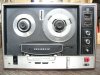
My best guess of the most-likely Panasonic tape deck model to have been offered as the top-of-the-line optional open-reel and re-branded as Magnavox during the Astro-Sonic era is this one. The auto-reverse RS790AD. I had one of these "back in the day" and used it for overdubbing with my bands, the second deck in my home studio back then being a Teac A1500. Two-head machines were ideal for track-bounce overdubs since the single R/P head would keep the monitoring & recording channels in perfect sync.

attachment.php


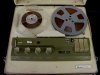
Some research has determined that the earlier Magnavox-branded open-reel machines were indeed British-made. The one pictured is a quarter-track monaural portable unit, but the track-selection pushbuttons verify that its monaural amplifier was paired with stereo-compatible heads. The same transport could easily have been paired with stereo R/P/E circuitry in a stereo deck suitable for the stereo tape option (factory-install or upgrade-kit) of consoles in the "Stereo Master" series (the "ST" models, such as my 1ST208F) having a Tape position on the Selector and provisions for signal and power connections hidden inside the cabinet on their Tuner/Preamp and Power/Amp chassis aprons. They might have been Collaro machines after all, unless there was another British-made R/R brand that was more likely to have been selected for export to the American market.

attachment.php


attachment.php


Notice how the cabinet panel to the left of the LP storage bin is attached with visible screws? That panel and the LP bin itself appear to have been designed for easy removal and re-purposing of the space. Most likely, a smaller storage bin and smaller panel for mounting the Ext Spkr selector were provided with the DIY tape upgrade kits.

attachment.php
 

Attachments

  • Pan_RS790AD.jpg
    Pan_RS790AD.jpg
    84.5 KB · Views: 95
  • Magnavox Tape 1.jpg
    Magnavox Tape 1.jpg
    28.4 KB · Views: 101
  • Magnavox Tape 2.jpg
    Magnavox Tape 2.jpg
    34.8 KB · Views: 99
  • LP Bin or Tape Deck Bay.jpg
    LP Bin or Tape Deck Bay.jpg
    41.7 KB · Views: 93
Update: The mono machine you have pictured began production in 1964, Magnavox's new UK Collaro division made it. Collaro was bought in 1964. These machines were sold as Magnavox, Collaro, and Truvox sold a variant with that transport. Mono and Stereo variants were offered. And the deck was made until 1967, when the Japanese Panasonic machines got rebadged by Magnavox.
 
Last edited:
Plus the panel with the exposed screws when removed will not give up enough depth for a R2R. Only Select series of Magnavox consoles got the option of a R2R. Usually the upper end Model 100's and possibly the larger sized 30's. Lift up that panel and you'll see the Horn or Tweeter in the Front mounted up high with the woofer mounted on the side. Be careful of the speaker selector switch tho. It can be fragile when manhandled.

Larry
 
Update: The mono machine you have pictured began production in 1964, Magnavox's new UK Collaro division made it. Collaro was bought in 1964. These machines were sold as Magnavox, Collaro, and Truvox sold a variant with that transport. Mono and Stereo variants were offered. And the deck was made until 1967, when the Japanese Panasonic machines got rebadged by Magnavox.

So, I guess Magnavox used some Collaro tape transports after all, but they were probably only factory-installed on the top of the line "Concert Grand" & only a seldom-added "available option" for models like the 1ST208F that obviously included at least electrical support for them, but whose upgrade kits mostly sat unsold on the shelves until the belts & idlers had turned to dripping goo or rotted away.

Plus the panel with the exposed screws when removed will not give up enough depth for a R2R. Only Select series of Magnavox consoles got the option of a R2R. Usually the upper end Model 100's and possibly the larger sized 30's. Lift up that panel and you'll see the Horn or Tweeter in the Front mounted up high with the woofer mounted on the side...

Larry

That's why I speculated that the R/R option was at the expense of a smaller selector panel and reduced-size or eliminated record storage bin. Presence of the Tape position on the Selector & the internal jack panel & AC outlet being included indicates to me that the 1ST208F was intended to support optional tape. A model early enough to use the earlier "Conquest" rather than the later "Micro-Matic" Collaro T/T would have pre-dated both the Lear 8-Track & Philips Compact-Cassette cartridge formats, leaving R/R by process of elimination. That being the case, positioning of an optional R/R unit in space gained from removing the original record bin & speaker selector panel would have meant a transport having much of its depth near the center of its panel footprint. There's about 4" of clearance below the speaker selector panel on the 1ST208F. Plenty for reel table pulleys, brakes, etc. provided that the motor, capstan flywheel, & R/P/E amp chassis were situated above the former record bin space where adequate clearance to well over 12" depth existed. With the tops of the reel table spindles at the height of the original speaker selector panel, the transport deck about an inch lower, that leaves 3" minimum clearance for drive components (pulleys, idlers, brakes, & linkages) below the deck surface across the first 4" of width of the left compartment (about half the width of the original speaker selector panel). Beyond 4" inward from the left end of the cabinet, clearance increases nearly the full 10" or more between the selector panel height & the magnet housing of the woofer's frame. About 8" from the left side wall, with the record storage bin also removed, full clearance to the cabinet bottom exists all the way over to the center partition. The upper edge of the tweeter frame is about 4" below the existing speaker selector panel surface; leaving, as I said, 3" clearance for drive mechanics with the transport deck recessed 1" below the position of the original speaker selector panel.
attachment.php
 
Last edited:
Back
Top Bottom