

You are using an out of date browser. It may not display this or other websites correctly.
You should upgrade or use an alternative browser.
You should upgrade or use an alternative browser.
Manifesto SE ... a single ended tube amplifier project
V4lve Lover
New Member
Try 6J9P-E or E180F trioded. EC86 is also very linear.

happybear
New Member
The major issue with triode connected tetrodes like 7C5 is the lack of power efficiency.Try 6J9P-E or E180F trioded. EC86 is also very linear.
Add some local output stage FBK to the same signal circuit in tetrode mode and the power output before clipping increases 4X and distortion is magnitudes lower.
These sort of tube circuits have limited usefulness. With high efficiency transducers, reasonable listening levels can provide an acceptable experience.
HB
happybear
New Member
Further refining the Manifesto SE by changing cathode bypass capacitors.
Sanyo OsCon 56uF 25V solid electrolytic capacitors were removed in favor of Epcos 50uF 630V DC Link low ESR film capacitors.
The new capacitors will be evaluated subjectively to see if they are a significant improvement or not.
Note: all signal wires are Kimber TCSS clear jacket - the minimum quality needed for SE tube amplifier signal circuit applications.
HB
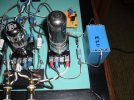
Sanyo OsCon 56uF 25V solid electrolytic capacitors were removed in favor of Epcos 50uF 630V DC Link low ESR film capacitors.
The new capacitors will be evaluated subjectively to see if they are a significant improvement or not.
Note: all signal wires are Kimber TCSS clear jacket - the minimum quality needed for SE tube amplifier signal circuit applications.
HB

Further refining the Manifesto SE by changing cathode bypass capacitors.
Sanyo OsCon 56uF 25V solid electrolytic capacitors were removed in favor of Epcos 50uF 630V DC Link low ESR film capacitors.
The new capacitors will be evaluated subjectively to see if they are a significant improvement or not.
Note: all signal wires are Kimber TCSS clear jacket - the minimum quality needed for SE tube amplifier signal circuit applications.
HB
View attachment 2928653
I would be interested in your assessment of electrolytic bypass caps versus that Epcos film cap.
happybear
New Member
Wima DC Link MKP 4 (4 pin version) would be the preferred brand to select for all SE tube amplifier applications (cathode bypass & power supply filter), if budget allows for their acquisition. The 4 pin caps will allow for easier bypassing of the main bypass cap with smaller uF cap values for "wideband" audio performance, if the end user deems that necessary.I would be interested in your assessment of electrolytic bypass caps versus that Epcos film cap.
Epcos is a more "budget-minded" brand of DC Link capacitor but should also be a good performer after the break-in period, whatever that is.
Sanyo OSCon are really nice for a low cost, small physical size cathode bypass capacitor.
All the SE tube amplifier projects HB has posted on this tube forum have used Sanyo OsCon to great effect.
HB

For cathode bypass and PS filtering, capacitor type makes no difference IF the capacitor fully bypasses signal AC to ground. If zero AC exists across the cap, Ohm's Law tells us it cannot impact signal integrity. So, rather than spending exorbitant amounts of money on ultra high quality capacitors in these positions, it might be wise to determine whether a larger value in a less expensive alternative might be just as effective.I would be interested in your assessment of electrolytic bypass caps versus that Epcos film cap.
Jack
Yes, I know. But, I was waiting for the poster to prove it "in the lab." At least Epcos are not outrageously expensive.For cathode bypass and PS filtering, capacitor type makes no difference IF the capacitor fully bypasses signal AC to ground. If zero AC exists across the cap, Ohm's Law tells us it cannot impact signal integrity. So, rather than spending exorbitant amounts of money on ultra high quality capacitors in these positions, it might be wise to determine whether a larger value in a less expensive alternative might be just as effective.
Jack
I try telling ppl this... but... it's just like arguments over $1000/meter cables....

Well, it's not just a matter of cost. Film caps also consume a lot more space than electrolytics (which is the same reason I seldom use oil). FWIW, I performed film VS electrolytic tests with SE output stages (6V6 and 6BQ5) more than 15 years ago. No one in my family (including two women with really excellent hearing) could detect any difference. In addition, I also performed tests on a number of electrolytics to determine why people were frequently bridging them with small film caps in power supplies. I'm guilty of using the same technique, but in fact, it's just something that makes me feel better. The frequency response of good electrolytics extands way above any energy that needs to be bypassed in a vacuum tube audio amplifier.Yes, I know. But, I was waiting for the poster to prove it "in the lab." At least Epcos are not outrageously expensive.
I try telling ppl this... but... it's just like arguments over $1000/meter cables....
Jack

Wima and Epcos film caps typically cost less than $15 depending on value, hardly exorbitant.For cathode bypass and PS filtering, capacitor type makes no difference IF the capacitor fully bypasses signal AC to ground. If zero AC exists across the cap, Ohm's Law tells us it cannot impact signal integrity. So, rather than spending exorbitant amounts of money on ultra high quality capacitors in these positions, it might be wise to determine whether a larger value in a less expensive alternative might be just as effective.
Jack
I'm glad you brought this up. The philosophy of bypassing big electrolytics cap with small value non-polar film caps always puzzled me. I like the KISS approach on amps. Less things to cause problems later.Well, it's not just a matter of cost. Film caps also consume a lot more space than electrolytics (which is the same reason I seldom use oil). FWIW, I performed film VS electrolytic tests with SE output stages (6V6 and 6BQ5) more than 15 years ago. No one in my family (including two women with really excellent hearing) could detect any difference. In addition, I also performed tests on a number of electrolytics to determine why people were frequently bridging them with small film caps in power supplies. I'm guilty of using the same technique, but in fact, it's just something that makes me feel better. The frequency response of good electrolytics extands way above any energy that needs to be bypassed in a vacuum tube audio amplifier.
Jack
Thanks, for this response. It reaffirms my faith in basic electronics.

If you have the room, I guess they won't hurt. Unless they have a failure rate worse than traditional practices.Wima and Epcos film caps typically cost less than $15 depending on value, hardly exorbitant.
That's not typical. Many of the types and sizes suitable for use in power supplies cost $30 to $40. But even at $15, it's not as though you can build an amplifier with one capacitor. Add up all the PS caps and cathode bypasses, and the difference can be very significant. None of this is really the point though. If a node is well-bypassed, the capacitor can't be heard. Use whatever you want, fine with me, but there won't be a difference in sound quality due to this.Wima and Epcos film caps typically cost less than $15 depending on value, hardly exorbitant.
Jack
happybear
New Member
Mr. B needs to "prove" it to himself by direct application.Yes, I know. But, I was waiting for the poster to prove it "in the lab." At least Epcos are not outrageously expensive.
I try telling ppl this... but... it's just like arguments over $1000/meter cables....
Typical tube amp measurement data won't cut it - too basic.
It starts with high efficiency transducers of excellent quality - Altec horns or similar would be the minimum standard or you will not be able to even hear the effect.
HB's last SE DC amplifier project had 5 capacitors of different values bypassing the finals Rk.
There was various reasons for doing that and it took a long time to format everything correctly.
Not sure if the Manifesto SE will need the same cathode bypass capacitor treatment as it has RC coupled stages.
HB

Well, it's not just a matter of cost. Film caps also consume a lot more space than electrolytics (which is the same reason I seldom use oil). FWIW, I performed film VS electrolytic tests with SE output stages (6V6 and 6BQ5) more than 15 years ago. No one in my family (including two women with really excellent hearing) could detect any difference. In addition, I also performed tests on a number of electrolytics to determine why people were frequently bridging them with small film caps in power supplies. I'm guilty of using the same technique, but in fact, it's just something that makes me feel better. The frequency response of good electrolytics extands way above any energy that needs to be bypassed in a vacuum tube audio amplifier.
Jack
Well, there's two mechanisms that can affect the behavior of electrolytic caps, in a way that can cause issues.
First is, hysteresis. Fortunately, this is usually only an issue near zero volts. So most polar caps won't have any issue here. BUT- anywhere that needs a non-polar cap- hysteresis can rear its ugly head, due to the way a non-polar electrolytic cap is made (back to back polar caps, in essence). Those will pass through zero volts every cycle. Bypassing one of these with a film cap, can "short out" some of that hysteresis effect, reducing overall distortion. Now, this has to be done thoughtfully and carefully- as sometimes, you can run into higher order effects, due to the interaction of the electrolytic cap and the film cap- which can cause different kinds of noise (higher harmonics, and such). So, it's a matter of being able to test, to see whether the bypass cap actually is improving the situation, or just proverbially "shuffling the deck chairs on the Titanic"...
Also, especially in larger electrolytic caps- there is inductance, due to the number of winding layers. This can increase the capacitor impedance at high frequencies. Now, this is all relative to the impedance of the surrounding circuit- but, in cases, where one wants to snub the switching transients of rectifiers- a small film bypass cap will reduce the rectifier noise to a great degree. Fortunately, though, in this case- modern high-speed/soft-recovery diodes don't have nearly so much problem with this... but I can still understand someone wanting to shunt a rectifier to ground, with a small film cap, even now...
Regards,
Gordon.
Aren't you doing a non-polar versus electrolytic bypass capacitor test?Mr. B needs to "prove" it to himself by direct application.
Typical tube amp measurement data won't cut it - too basic.
It starts with high efficiency transducers of excellent quality - Altec horns or similar would be the minimum standard or you will not be able to even hear the effect.
HB's last SE DC amplifier project had 5 capacitors of different values bypassing the finals Rk.
There was various reasons for doing that and it took a long time to format everything correctly.
Not sure if the Manifesto SE will need the same cathode bypass capacitor treatment as it has RC coupled stages.
HB

If not, it's my mistake. Sorry.
Wima 50/600 is $16. Smaller values/voltages are less.That's not typical. Many of the types and sizes suitable for use in power supplies cost $30 to $40. But even at $15, it's not as though you can build an amplifier with one capacitor. Add up all the PS caps and cathode bypasses, and the difference can be very significant. None of this is really the point though. If a node is well-bypassed, the capacitor can't be heard. Use whatever you want, fine with me, but there won't be a difference in sound quality due to this.
Jack
I understand those characteristics. Nevertheless, if the node is sufficiently bypassed such that no AC appears across the cap (or an amount so minuscule as to have no possibility of being audible), the internal workings of the caps are irrelevant.Well, there's two mechanisms that can affect the behavior of electrolytic caps, in a way that can cause issues.
Jack
Wima 100u/500V is $30. Epcos 100u/450V is $38. Vishay 100u/450V is $42. There are dozens like this. Maybe the cheap ones are junk.Wima 50/600 is $16. Smaller values/voltages are less.
Jack