Yep. To be exact, here's what I bought: CEC Industries #47 Bulbs, 6.3 V, 0.945 W, BA9s Base, T-3.25 shapeLooks like a #47 bulb to me.


You are using an out of date browser. It may not display this or other websites correctly.
You should upgrade or use an alternative browser.
You should upgrade or use an alternative browser.
Marantz Model 25 Project
- Thread starter bdondo
- Start date
-
- Tags
- marantz marantz model 25

Lavane
Lunatic Member
The part some don't take into account is the wattage when replacing a bulb.
There are sellers that sell 6v, 8v, etc bulbs and fuse lamps as a one size fits all. That can lead to melted lamp housings, etc. Especially when it comes to the fuse lamps. Marantz uses a lower wattage fuse lamp compared to some others. I've even used 6.3v bulbs in place of 8v pilot lights if they were too bright.
Now you need to find yourself a nice pair of Imperial 5 or Imperial 6 speakers to go with the 25.
I own both and like them a lot. Both speakers sound pretty much alike other than the 6's have better bass.
There are sellers that sell 6v, 8v, etc bulbs and fuse lamps as a one size fits all. That can lead to melted lamp housings, etc. Especially when it comes to the fuse lamps. Marantz uses a lower wattage fuse lamp compared to some others. I've even used 6.3v bulbs in place of 8v pilot lights if they were too bright.
Now you need to find yourself a nice pair of Imperial 5 or Imperial 6 speakers to go with the 25.
I own both and like them a lot. Both speakers sound pretty much alike other than the 6's have better bass.
For the bulb, I wasn't sure what wattage to use. The bulb just said "6V Royal" on it. I measured the diameter of the base and compared to what I could find online. Is 0.945 W correct? They were cheap, so I don't mind replacing them with something more correct. They're pretty dim, but I think that might be intentional.The part some don't take into account is the wattage when replacing a bulb.
There are sellers that sell 6v, 8v, etc bulbs and fuse lamps as a one size fits all. That can lead to melted lamp housings, etc. Especially when it comes to the fuse lamps. Marantz uses a lower wattage fuse lamp compared to some others. I've even used 6.3v bulbs in place of 8v pilot lights if they were too bright.
Now you need to find yourself a nice pair of Imperial 5 or Imperial 6 speakers to go with the 25.
I own both and like them a lot. Both speakers sound pretty much alike other than the 6's have better bass.
I had never thought of getting Marantz speakers to be honest. I'll look into them. With a quick search I see a few pairs for pretty cheap.
Lavane
Lunatic Member
Those bulbs should be just fine. The Imperial 6 speakers are one of my favorite speakers. They play nice with tube or SS. They aren't the best speaker ever made, but they sound really good and are easy to listen to, no ear fatigue. They're rated at 93db@1 watt@ 1 meter, so do well with lower powered amps. I've had a lot of speakers come and go, but the 6's aren't going anywhere, even though I do have better speakers. I have them hooked up to a 17wpc tube amp at the moment. I even tried them with a small single ended 5wpc tube amp I built. While they didn't get real loud, they still sounded good. The 5's sound very similar, but with a bit less bass since the woofer is 8" instead of 10", and the 5's roll off at 50hz. They still sound good though. Many here that have the 6's tend to keep them.For the bulb, I wasn't sure what wattage to use. The bulb just said "6V Royal" on it. I measured the diameter of the base and compared to what I could find online. Is 0.945 W correct? They were cheap, so I don't mind replacing them with something more correct. They're pretty dim, but I think that might be intentional.
I had never thought of getting Marantz speakers to be honest. I'll look into them. With a quick search I see a few pairs for pretty cheap.
My current speakers (Axiom Audio M22s) are a bit lacking in bass (but sound amazing otherwise), so I've been pondering getting something with a little more low-end. Hmm.Those bulbs should be just fine. The Imperial 6 speakers are one of my favorite speakers. They play nice with tube or SS. They aren't the best speaker ever made, but they sound really good and are easy to listen to, no ear fatigue. They're rated at 93db@1 watt@ 1 meter, so do well with lower powered amps. I've had a lot of speakers come and go, but the 6's aren't going anywhere, even though I do have better speakers. I have them hooked up to a 17wpc tube amp at the moment. I even tried them with a small single ended 5wpc tube amp I built. While they didn't get real loud, they still sounded good. The 5's sound very similar, but with a bit less bass since the woofer is 8" instead of 10", and the 5's roll off at 50hz. They still sound good though. Many here that have the 6's tend to keep them.
Lavane
Lunatic Member
You can always add a powered subwoofer.My current speakers (Axiom Audio M22s) are a bit lacking in bass (but sound amazing otherwise), so I've been pondering getting something with a little more low-end. Hmm.
Lavane
Lunatic Member
Just use a powered sub with speaker level inputs. Speaker wires from your receiver connect to the sub, then connect your speakers to the output terminals of the sub. The trick is to adjust the frequency and volume of the sub to mesh with your main speakers. The speakers I have mine connected to start to roll off at around 50hz and drops off at 30hz. I set my sub to around 50hz and adjusted the sub volume. The trick is to get the sub adjusted so that you really don't notice there is a sub connected until you turn it off. You want it to mesh well with your mains.
Next up was going to be the phono pre-amp, but I forgot to order a couple capacitors on that board, so I skipped to the FM-AM front end board, which only had one electrolytic capacitor, and the FM-AM IF & MPX board, which was quite a pain. Ran into a short due to an invisible solder trace that took a while to troubleshoot. There are a lot of tightly-packed components on this board, and in several cases there are three components soldered to the same solder pad, which made desoldering tricky with my old Radio Shack de-soldering iron thing.
But it works now..

But it works now..
Next up: big filter caps and resistors. The replacement caps I got are way shorter than the originals, and I did that on purpose so I could get more distance between them and the resistors (based on my understanding of this post by @ConradH). He also says he'd keep the caps if they test well, so I'm on the fence as to whether to do the replacement. I plan on keeping this receiver, but that could change -- if I sell it or give it away, I'd like it to be in the best condition possible for the long run.

Lavane
Lunatic Member
What brand are the original filter caps? There are a few brands that just don't age well. Marantz used one of those brands in some of there earlier SS gear. I replaced them in a model 16 power amp. They had drifted out of spec. I can't remember the spelling of the brand, but it started with a "S" and the font was some kind of groovy 70's style. They're known for not aging well at all. Even if they test within spec, the ESR probably isn't.Next up: big filter caps and resistors. The replacement caps I got are way shorter than the originals, and I did that on purpose so I could get more distance between them and the resistors (based on my understanding of this post by @ConradH). He also says he'd keep the caps if they test well, so I'm on the fence as to whether to do the replacement. I plan on keeping this receiver, but that could change -- if I sell it or give it away, I'd like it to be in the best condition possible for the long run.
Thanks! I'll do that.You've got the new caps and they'll allow getting more distance on those hot resistors, so I'd go ahead and replace them.
Would I still want to put heat-shrink or other insulator on the resistor leads? Seems like the insulator would be counter-productive to letting heat dissipate, but it also seems risky to have bare leads like that.You've got the new caps and they'll allow getting more distance on those hot resistors, so I'd go ahead and replace them.

ConradH
Lunatic Member
Depends on your comfort level. Lots of old General Radio Corp test equipment was wired with heavy bare bus wire. If there's no chance of deflection, bare might be OK. Insulation will prevent cooling. The trick is to have long enough wire so the resistor heat dissipates to some degree before getting to the caps. Putting a few zig-zags in it will help, but might look a bit odd.
Thanks, I'll try the bare-wire approach and see how it goes.Depends on your comfort level. Lots of old General Radio Corp test equipment was wired with heavy bare bus wire. If there's no chance of deflection, bare might be OK. Insulation will prevent cooling. The trick is to have long enough wire so the resistor heat dissipates to some degree before getting to the caps. Putting a few zig-zags in it will help, but might look a bit odd.
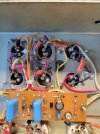
Maybe not my best work, but the new caps are in and I left the resistor legs bare. Before doing this, I ran the receiver at about 75% volume for 15 minutes and measured the temperature of the resistors between the capacitors. Surprisingly they were only about 65 degrees F. About the same at the capacitor solder lugs. I'll do the same test with the capacitors later.

Lavane
Lunatic Member
FYI, in the future you can use ring connectors used to crimp on the ends of wires on those snap in caps. Pick a small size and solder them to the cap leads. Then solder the wires to the rings. Thats what I did when I had to replace some funky Russian military caps.