

You are using an out of date browser. It may not display this or other websites correctly.
You should upgrade or use an alternative browser.
You should upgrade or use an alternative browser.
Marantz TT-15S1 spinning to fast after moving to EU
- Thread starter malotru007
- Start date


lini
just me...
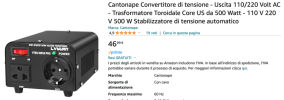
(...) that I needed a step-down transformer (...)
Have a pic or two of what you've bought for the purpose - or a link to it?
Impact on speed: With fewer field reversals in a second, the motor completes its rotations faster, leading to increased RPM. This, in turn, makes the turntable spin faster and play audio at a higher pitch.
That's the point, at which that nice gentleman made a mistake. Should be: Fewer field reversals per time -> slower rotation.
Greetings from Monaco di Baviera!
Manfred / lini
malotru007
New Member
transformer have multi tap output
Have a pic or two of what you've bought for the purpose - or a link to it?
That's the point, at which that nice gentleman made a mistake. Should be: Fewer field reversals per time -> slower rotation.
Greetings from Monaco di Baviera!
Manfred / lini
Attachments
analogadict
Active Member
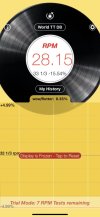
The information on the motor confirms that it shall run slower at 50Hz. It also gives the value for the phase shift capacitor to be used in case of 50 Hz supply. Have you replaced the capacitor with this value capacitor? Am not sure but an incorrect value cap may lead to change in the phase shift angle and thus , skipping of some poles . This would make the motor run faster.I would have think that it makes sense because it actually sounds to fast. and when measured with the app it confirms it.
Here what it looks like
I suggest that you get the correct value capacitor for 50 Hz in there.
Regards,
Anwesh

tnsilver
Stereo Puppy
I'm assuming that's correct. My intuition, however, says it's not. A 50Hz pulley is always larger than a 60Hz pulley. They can't have the same diameter, no matter what the part number is, or what the seller says.The pulley size is the correct one for EU, why is it still off-speed?
So, a long shot here, just in case this is some comedy of errors:
Are you using the correct step on the pulley for 33 RPM? The pulley should be installed with the larger diameter step on top. For 33 RPM use the smaller step that's on the bottom. It's in the manual.
malotru007
New Member
So it wasn't a long shot...I'm assuming that's correct. My intuition, however, says it's not. A 50Hz pulley is always larger than a 60Hz pulley. They can't have the same diameter, no matter what the part number is, or what the seller says.
So, a long shot here, just in case this is some comedy of errors:
Are you using the correct step on the pulley for 33 RPM? The pulley should be installed with the larger diameter step on top. For 33 RPM use the smaller step that's on the bottom. It's in the manual.
 . I haven't touched the turntable in 5 years and I thought I used the top pulley part for 33 rpm. That's highly embarassing.Nonetheless, I still have issue as it plays too slow and the pulley is too small. I'm looking into finding a correct pulley size (54mm) from perhaps Pro-Ject
Attachments
malotru007
New Member
I haven't replaced the capacitor but I was told it would be nice to do to decrease the vibrations. I will replace the pulley and perhaps take care of the capacitors down the road.The information on the motor confirms that it shall run slower at 50Hz. It also gives the value for the phase shift capacitor to be used in case of 50 Hz supply. Have you replaced the capacitor with this value capacitor? Am not sure but an incorrect value cap may lead to change in the phase shift angle and thus , skipping of some poles . This would make the motor run faster.
I suggest that you get the correct value capacitor for 50 Hz in there.
Regards,
Anwesh
tnsilver
Stereo Puppy
I shave with Occam's razor.So it wasn't a long shot...
Find the correct (larger) pulley and you'd be fine. The cap won't make a difference.
tnsilver
Stereo Puppy
Out of curiosity, I took a peek at the service manual. The users manual states a mandatory 120V power supply, but the service manual keeps pointing out it's a 100V motor. I've also noticed the motor comes stock with a proprietary power cord attached to a wall-wart type device (prolly a step-down transformer, but could be a motor starter too).
The odd thing is that according to the S.M, the 50Hz pulley is indeed 44mm in diameter vs. the 37mm of the 60Hz variant. You appear to have two 44mm pulleys for 50Hz. So unless this is a measuring mistake, and both pulleys are actually 37mm in diameter, the TT should be running at the correct speed, or very close to 33.3 RPM.
I'm beginning to think there's more to this motor than meets the eye, and that the wall-wart thingy isn't just a transformer. It's possible the motor is under-powered by a combination of the external step-down transformer and the stock wall-wart. It's also possible the wall-wart is the motor starter or control unit, and for some power grid related reason, acts funny. I'd like to know what it actually does.
Can you clear the mystery and post a good pic of the stock wall-wart labeling / sticker - whatever info is provided on it?
My next item of curiosity would be the output voltage of that external step-down transformer.
Any chance you got a meter capable of measuring mains AC voltage?
EDIT: further review of the SM reveals the wall-wart is just a 100V AC adapter. That's one mystery unveiled. This motor does not appear to be that complicated after-all. I actually think it's a synchronous motor, otherwise it's an induction motor that's bound to consume 3 times the specified 5 watts. Please measure the external step-down voltage, and it would help very much if you could get into the motor terminal strip and measure the feed voltage when it's running. I've seen it exposed already, so this shouldn't be too hard. Watch it though. Don't touch the probes by mistake, and take care not to short them.
The odd thing is that according to the S.M, the 50Hz pulley is indeed 44mm in diameter vs. the 37mm of the 60Hz variant. You appear to have two 44mm pulleys for 50Hz. So unless this is a measuring mistake, and both pulleys are actually 37mm in diameter, the TT should be running at the correct speed, or very close to 33.3 RPM.
I'm beginning to think there's more to this motor than meets the eye, and that the wall-wart thingy isn't just a transformer. It's possible the motor is under-powered by a combination of the external step-down transformer and the stock wall-wart. It's also possible the wall-wart is the motor starter or control unit, and for some power grid related reason, acts funny. I'd like to know what it actually does.
Can you clear the mystery and post a good pic of the stock wall-wart labeling / sticker - whatever info is provided on it?
My next item of curiosity would be the output voltage of that external step-down transformer.
Any chance you got a meter capable of measuring mains AC voltage?
EDIT: further review of the SM reveals the wall-wart is just a 100V AC adapter. That's one mystery unveiled. This motor does not appear to be that complicated after-all. I actually think it's a synchronous motor, otherwise it's an induction motor that's bound to consume 3 times the specified 5 watts. Please measure the external step-down voltage, and it would help very much if you could get into the motor terminal strip and measure the feed voltage when it's running. I've seen it exposed already, so this shouldn't be too hard. Watch it though. Don't touch the probes by mistake, and take care not to short them.
Last edited:

sqlsavior
Lunatic Member
I purchased my Marantz table about a dozen years ago from MusicDirect.
My top pulley (for 45 rpm) measures 44 mm across.
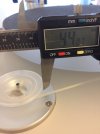
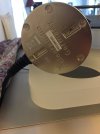
My motor was replaced under warranty; this is the replacement one.
Neither motor had anything besides a simple plug at the end of the cord - no wall wart or device. I looked for the box in the shed, but not for very long, sorry. It's cold out, and I'm still in my PJs. Hope this helps somehow.
My top pulley (for 45 rpm) measures 44 mm across.
My motor was replaced under warranty; this is the replacement one.
Neither motor had anything besides a simple plug at the end of the cord - no wall wart or device. I looked for the box in the shed, but not for very long, sorry. It's cold out, and I'm still in my PJs. Hope this helps somehow.
malotru007
New Member
I bought mine at MusicDirect as well and I have confirmation from a gentlemen in the UK that the EU version of the turntable also has a pulley that measures 44mm across. So this is confirmation indeed that the pulleys for the EU and US market are the same.I purchased my Marantz table about a dozen years ago from MusicDirect.
My top pulley (for 45 rpm) measures 44 mm across.
View attachment 3115801View attachment 3115815
My motor was replaced under warranty; this is the replacement one.
Neither motor had anything besides a simple plug at the end of the cord - no wall wart or device. I looked for the box in the shed, but not for very long, sorry. It's cold out, and I'm still in my PJs. Hope this helps somehow.
Thanks for facing the cold and yes, it does help tremendously! Cheers
malotru007
New Member
Thanks tnsilver for your investigation, really appreciated. I would need to buy something to measure the output. Could you direct me to the correct tool? ThanksOut of curiosity, I took a peek at the service manual. The users manual states a mandatory 120V power supply, but the service manual keeps pointing out it's a 100V motor. I've also noticed the motor comes stock with a proprietary power cord attached to a wall-wart type device (prolly a step-down transformer, but could be a motor starter too).
The odd thing is that according to the S.M, the 50Hz pulley is indeed 44mm in diameter vs. the 37mm of the 60Hz variant. You appear to have two 44mm pulleys for 50Hz. So unless this is a measuring mistake, and both pulleys are actually 37mm in diameter, the TT should be running at the correct speed, or very close to 33.3 RPM.
I'm beginning to think there's more to this motor than meets the eye, and that the wall-wart thingy isn't just a transformer. It's possible the motor is under-powered by a combination of the external step-down transformer and the stock wall-wart. It's also possible the wall-wart is the motor starter or control unit, and for some power grid related reason, acts funny. I'd like to know what it actually does.
Can you clear the mystery and post a good pic of the stock wall-wart labeling / sticker - whatever info is provided on it?
My next item of curiosity would be the output voltage of that external step-down transformer.
Any chance you got a meter capable of measuring mains AC voltage?
EDIT: further review of the SM reveals the wall-wart is just a 100V AC adapter. That's one mystery unveiled. This motor does not appear to be that complicated after-all. I actually think it's a synchronous motor, otherwise it's an induction motor that's bound to consume 3 times the specified 5 watts. Please measure the external step-down voltage, and it would help very much if you could get into the motor terminal strip and measure the feed voltage when it's running. I've seen it exposed already, so this shouldn't be too hard. Watch it though. Don't touch the probes by mistake, and take care not to short them.
Perhaps indeed the motor is the culprit. It's close to impossible to find a 54mm pulley and since Clearaudio/Marantz doesn't have one, my only remaining option is to use a machinist or 3D printing maybe.
tnsilver
Stereo Puppy
I'd point you to a Fluke and you don't want that for just this experiment, but thanks to @sqlsavior and your recent input, I don't think you'd need it anymore. It actually helps a lot. Both of you.Could you direct me to the correct tool? Thanks

With this info, we can only conclude that the NA and EU motors are different, with the Japanese variants identical to NA (with the possible exception of the 100V AC adapter). The EU motor may be identical but differently wired internally. It doesn't make sense to manufacture 3 different motors, so it's logical to assume they can be market specifically wired internally. Unfortunately, I can't figure this out over the interweb.
We also know these motors by clearaudio are
 spensive!!! We don't want to buy a new one!
So... Here's an alternative. The OP needs a larger pulley. Currently, with a 50Hz pulley, 44mm in diameter, the turntable runs at 28.15 RPM instead of 33.33. That's 15.54% slower. A proportionally 15.54% larger pulley, would get it up to snuff. So... a 50.83mm diameter pulley should do it.
Let's assume a 1% phone app speed error (the OP should at least verify with another phone) - so we can state a range of 50.5mm - 51.3mm diameter, double stepped pulley. If one can be found - problem solved!
However... Note this math refers to the 45 RPM step. Do the same math for the 33.3 RPM step and you'll have the specs of the pulley.
In the worst case scenario, I hear Italians are some of the best machinists in the world. Such a pulley could be custom manufactured, and I'm sure it will be more cost effective than a new motor.
tnsilver
Stereo Puppy
^ You've got two 44mm pulleys, which is good, because you could spare one at the worst case scenario for a little test. If you wrap a large enough o-ring, or a piece of garden hose, just 1mm thick around the 33 RPM step, it should get you closer to the desired speed. If it's still too slow, wrap some Teflon band or electrical tape around the hose, until you nail 33.3 RPM. It's flimsy for this nice turntable, but that's only a temporary test. When you nail it - measure the diameter with a caliper. You'll then know for sure what your pulley specs are.
ralphfcooke
Member
I've asked my sister, who lives in Germany, to get in touch with Clearaudio, who actually manufactures the Marantz turntable (as the Emotion SE)
and find out about the correct Pulley. I'll update asap.
and find out about the correct Pulley. I'll update asap.
malotru007
New Member
tnsilver Thanks so much for your calculation. The issue is that the pulley has an indent where the belt sits (it's a round belt not a flat one) trying to increase the size, even with teflon tape will result in the belt not staying on.^ You've got two 44mm pulleys, which is good, because you could spare one at the worst case scenario for a little test. If you wrap a large enough o-ring, or a piece of garden hose, just 1mm thick around the 33 RPM step, it should get you closer to the desired speed. If it's still too slow, wrap some Teflon band or electrical tape around the hose, until you nail 33.3 RPM. It's flimsy for this nice turntable, but that's only a temporary test. When you nail it - measure the diameter with a caliper. You'll then know for sure what your pulley specs are.
ralphfcooke is a tremendous gentlemen who has been extremely helpful and will make a test pulley to try out. We will keep you updated and hope it can help other Marantz/Clearaudio TT owner as it is a very popular TT and I've read about many people with current/frequency issues when moving countries.

jviss
Well-Known Member
And that would make it spin faster?Could it be as simple as dried up lubricant in the platter bearing.
Think of it this way. The TT worked properly when in a 60Hz country. Owner changed location to a 50Hz country. TT spins too fast now. Pulley that was on it was appropriate for 60Hz operation. Replacement pulley turns out to be the same size. So, the wrong replacement pulley was acquired. I don't think it's much more complicated or mysterious than that.
Marantz isn't the first or only belt driven TT to have different pulleys for 50 or 60Hz; the AR XA does that, as a matter of fact.
So, two choices: get the correct pulley, or feed it 60Hz power.