• The move to the new server is done. There are some software and database maintenance updates in process. This has us passing the hat around to help out. We appreciate any donations. Seriously, even a dollar helps. The payment page may be found here - https://www.audiokarma.org/support.html

Marantz TT-15S1 spinning to fast after moving to EU

And that would make it spin faster?

Think of it this way. The TT worked properly when in a 60Hz country. Owner changed location to a 50Hz country. TT spins too fast now. Pulley that was on it was appropriate for 60Hz operation. Replacement pulley turns out to be the same size. So, the wrong replacement pulley was acquired. I don't think it's much more complicated or mysterious than that.

Marantz isn't the first or only belt driven TT to have different pulleys for 50 or 60Hz; the AR XA does that, as a matter of fact.

So, two choices: get the correct pulley, or feed it 60Hz power.
From what i understand reading post 27 the OP used de wrong pulley side, 45rpm instead of 33rpm side.
He even posted a picture showing 28 rpm.
That would mean it runs to slow not to fast. Correct me if a'm wrong.
 
From what i understand reading post 27 the OP used de wrong pulley side, 45rpm instead of 33rpm side.
He even posted a picture showing 28 rpm.
That would mean it runs to slow not to fast. Correct me if a'm wrong.

Ah, maybe you're right, I don't know. But it's still the wrong pulley, no?
 
And that would make it spin faster?

Think of it this way. The TT worked properly when in a 60Hz country. Owner changed location to a 50Hz country. TT spins too fast now. Pulley that was on it was appropriate for 60Hz operation. Replacement pulley turns out to be the same size. So, the wrong replacement pulley was acquired. I don't think it's much more complicated or mysterious than that.

Marantz isn't the first or only belt driven TT to have different pulleys for 50 or 60Hz; the AR XA does that, as a matter of fact.

So, two choices: get the correct pulley, or feed it 60Hz power.
Correct, the table does not spin too fast: I had put it on the 45rpm indent. On the 33 indent, it runs 16% too slow which makes sense

As I said, I have confirmation from a member with a EU table that the pulley is the same for both EU and US. I called the UK shop and they also confirmed that the pulley that they sent me is the 50hz version and it is similar in diameter to the one that came with the table. tnsilver take on the motor being different for the 2 regions makes a lot of sense and is the only viable explanation.
 
Correct, the table does not spin too fast: I had put it on the 45rpm indent. On the 33 indent, it runs 16% too slow which makes sense

As I said, I have confirmation from a member with a EU table that the pulley is the same for both EU and US. I called the UK shop and they also confirmed that the pulley that they sent me is the 50hz version and it is similar in diameter to the one that came with the table. tnsilver take on the motor being different for the 2 regions makes a lot of sense and is the only viable explanation.
O.K., that's kind of interesting. So, it could be "fixed" with a custom pulley, then. I think I previously suggested trying a U.S. spec DC to AC power inverter, driven by a DC supply. I bought a true sine wave inverter based on this discussion (!), but I have yet to check the frequency accuracy. The inverter is $50 from Amazon,

DC 12V to AC120V Pure Sine Wave Power Inverter 600W with Dual sockets Output and DC 5V 2Amp USB Output. Ideal for Most Small Power appliances. (600W) Blue Brand: Fit4Less
 
Last edited:
Note posted on DIYaudio as well :
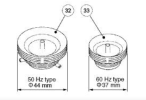
I am confused , assuming the speed was correct in the US using a 44 mm pulley running at 60 Hz you would need a (44 x 60) /50 = 52.8 mm pulley to get the same speed when running at 50 Hz .
The size ratio between the smaller pulley ( 37mm ) and the bigger pulley ( 44 mm ) is 1 : 1.2 which is the same as the ratio between the mains frequencies .
As these can be bought , I presume that these sizes are correct .
This however means that the US version should have been fitted with a " small " ( 37 mm ) pulley .


The premotec /airpax motor can run at 50 Hz / 250 rpm and at 60 Hz / 300 rpm , 220 v and 110 v versions are available .
The one you have got shows this on the label ( you have got a 110v version )
To run the table at 33.3 rpm the belt has to be on the smaller diameter of the stepped pulley

One question could you tell me what the diameter of platter is ?

Hope this helps , regards F.
 
Note posted on DIYaudio as well :
I am confused , assuming the speed was correct in the US using a 44 mm pulley running at 60 Hz you would need a (44 x 60) /50 = 52.8 mm pulley to get the same speed when running at 50 Hz .
The size ratio between the smaller pulley ( 37mm ) and the bigger pulley ( 44 mm ) is 1 : 1.2 which is the same as the ratio between the mains frequencies .
As these can be bought , I presume that these sizes are correct .
This however means that the US version should have been fitted with a " small " ( 37 mm ) pulley .


The premotec /airpax motor can run at 50 Hz / 250 rpm and at 60 Hz / 300 rpm , 220 v and 110 v versions are available .
The one you have got shows this on the label ( you have got a 110v version )
To run the table at 33.3 rpm the belt has to be on the smaller diameter of the stepped pulley

One question could you tell me what the diameter of platter is ?

Hope this helps , regards F.
the platter size is exactly: 296.86mm

The US version was fitted with the 44mm (total diameter pulley) as they shared the same l pulley size for EU and NA. As someone mentioned, the motor must be different between the 2 regions.
 
O.K., let's reset. This whole thread is giving me a headache, and making me crazy. Let's get back to fundamentals, and apply some logic, and also consult some documentation.

I found a service manual that covers the U.S. and Japanese versions of this. Here's the link where you can find and download it:

SERVICE TT-15S1 / MANUAL - · PDF

In the parts list, on the last page, the page numbered "4," you will find that there is only one motor, and it is described as "MOTOR ASSY WITH AC, ADAPTER 100V 50/60HZ."

Screenshot 2024-02-14 at 7.24.26 PM.png

You will also find that there are two pulleys. One is described as "PULLY FOR JAPAN 100V 50HZ," and the other is described as "PULLY FOR US 120V 60HZ."

Screenshot 2024-02-14 at 7.08.51 PM.png

Note that the two pulleys listed have different part numbers; they are not the same part! I have found in an alternate source that the 50Hz pulley is part number 90M31BW262010, and the 60Hz pulley is part number 90M31BW262020.

Screenshot 2024-02-14 at 7.38.27 PM.png

If you received a supposed 50Hz pulley that is the same as the 60Hz pulley that you already had, you received the wrong pulley!

With the 90M31BW262010 and the step-down transformer your TT will run at the correct speed.

You just have to source the right pulley. Try Midwest Appliance Parts:

90M31BW262010 Marantz PULLEY 110V 50HZ TT15S1

$118.12. (Ouch! - but free shipping!). In stock.

Here's the logic part. If you find that the turntable spins at a different speed with different line frequencies, and with different pulley steps, then there must be a pulley diameter that will spin it at the desired speed at your line frequency!

Q.E.D.

Good luck.
 
:rflmao:Well you can imagine my headache jviss... Thanks so much BTW for doing all that research, really appreciated.

The thing is, unless I'm mistaking, I've seen that manual and it is for the Japanese version of the turntable. I have the North American version and I've seen the EU version of the manual and they do not mention anything about 2 pulleys.

The Japanese market is quite peculiar due to the presence of 50hz in some regions and 60Hz in others. Thus they did 2 pulleys for this market.

Now, unless there is an error on the represented pulleys, the 50Hz pulley has a dimaeter of 44mm. Same one as the 60Hz US pulley that I have and same diameter as the 50 Hz EU version (as confirmed by at least 2 EU owners). I need a bigger pulley to run my 60Hz table at 50Hz. So securing the 50 Hz Japanese version of the pulley with its diameter of also 44mm, same diameter as the 60Hz NA and 50Hz EU, won't solve anything.

ralphfcooke has been so nice as to actually make a custom pulley for me that I will soon try out and we will let you know how it turns out.
 
:rflmao:Well you can imagine my headache jviss... Thanks so much BTW for doing all that research, really appreciated.

The thing is, unless I'm mistaking, I've seen that manual and it is for the Japanese version of the turntable. I have the North American version and I've seen the EU version of the manual and they do not mention anything about 2 pulleys.

The Japanese market is quite peculiar due to the presence of 50hz in some regions and 60Hz in others. Thus they did 2 pulleys for this market.

Now, unless there is an error on the represented pulleys, the 50Hz pulley has a dimaeter of 44mm. Same one as the 60Hz US pulley that I have and same diameter as the 50 Hz EU version (as confirmed by at least 2 EU owners). I need a bigger pulley to run my 60Hz table at 50Hz. So securing the 50 Hz Japanese version of the pulley with its diameter of also 44mm, same diameter as the 60Hz NA and 50Hz EU, won't solve anything.

ralphfcooke has been so nice as to actually make a custom pulley for me that I will soon try out and we will let you know how it turns out.
Yea, let me know how that works out. And you can then tell Marantz that you fixed it for them. :)
 
ralphfcooke has been so nice as to actually make a custom pulley for me that I will soon try out and we will let you know how it turns out.
Oh wow! That's super nice. :bowdown:

Thank you @ralphfcooke. I'd love to see how you've made the pulley.

This whole thread is giving me a headache, and making me crazy. Let's get back to fundamentals, and apply some logic, and also consult some documentation.
Yes, agreed. It is not clear how many variants of this turntable exist, and for which market. I've seen the same document you've posted. It lists two different diameter pulleys. That's not saying anything about a 220V variant for the EU, it only refers to Japan, and perhaps NA. It's very confusing. Nothing is determent.
 
Oh wow! That's super nice. :bowdown:

Thank you @ralphfcooke. I'd love to see how you've made the pulley.


Yes, agreed. It is not clear how many variants of this turntable exist, and for which market. I've seen the same document you've posted. It lists two different diameter pulleys. That's not saying anything about a 220V variant for the EU, it only refers to Japan, and perhaps NA. It's very confusing. Nothing is determent.
Yes, but...it's pretty good evidence that the TT speed is dependent on the line frequency and pulley size, and not the motor voltage.
 
^ That's where the headache begins because in Japan the grid voltage is uniformly 100V, while the line frequency varies geographically and is 50Hz or 60Hz. Hence, the same motor but different size pulleys, as in the Japanese printed S.M . It's possible Marantz can pull this off with the same motor, and a 60Hz pulley in the US too. The European 220V motor might be a different story altogether.
 
Unfortunately I didn't take any photos, but in my workshop I'm fortunate enough to have an old Harding HLV toolroom lathe
This is a collet lathe (5C collet) so I chucked up a piece of 50mm nylon rod in a 3 jaw chuck (too big for the collets) and turned it
to a little over the required dimension, then I center drilled it to 2.85mm. then to 2.95mm. and carefully pushed a piece of 3mm
chrome steel rod through the hole. At this point I removed the chuck, installed a 3mm collet and mounted the work;
this is a lot more accurate than a chuck and all work can be done without removing the pulley from the rod.
Using very sharp tools and low speed I turned the work to the requisite (I hope) size.
Having squared up all the dimensions ( the 3 jaw chuck isn't very accurate) I removed the 3mm rod, and reamed the hole to 3.00 mm.
As nylon is flexible the hole shrinks back a little after reaming so a push fit is all that is needed
I tested the fit on a motor of the same type the OP has, then put it in a jiffy bag and posted it to Italy. Now we wait and see :D
 
Last edited:
Unfortunately I didn't take any photos, but in my workshop I'm fortunate enough to have an old Harding HLV toolroom lathe
This is a collet lathe (5C collet) so I chucked up a piece of 50mm nylon rod in a 3 jaw chuck (too big for the collets) and turned it
to a little over the required dimension, then I center drilled it to 2.85mm. then to 2.95mm. and carefully pushed a piece of 3mm
chrome steel rod through the hole. At this point I removed the chuck, installed a 3mm collet and mounted the work;
this is a lot more accurate than a chuck and all work can be done without removing the pulley from the rod.
Using very sharp tools and low speed I turned the work to the requisite (I hope) size.
Having squared up all the dimensions ( the 3 jaw chuck isn't very accurate) I removed the 3mm rod, and reamed the hole to 3.00 mm.
As nylon is flexible the hole shrinks back a little after reaming so a push fit is all that is needed
I tested the fit on a motor of the same type the OP has, then put it in a jiffy bag and posted it to Italy. Now we wait and see :D
Wow, that's awesome, and so kind of you! I gave my lathe to my son a couple of years ago - a Clausing 12x36 gear head toolroom lathe. I had a Royal collet closer and a set of 5C collets, too. I would have done much the same as you to make the pulley.

Did you copy the form of the Marantz pulley, and put in the 45RPM step, too?

Screenshot 2024-02-15 at 6.42.29 PM.png
 
I'm obsessed now - see what you did, @malotru007 ? Ha, ha.

I did more research. See post #55 for a pic of the two pulleys. In the sales literature Marantz says this uses an asynchronous motor:

Screenshot 2024-02-15 at 7.06.10 PM.png

Don't be confused by the name. This type of motor's speed is governed by the line frequency:

Screenshot 2024-02-15 at 7.07.19 PM.png
For the full wikipedia article go here:
wikipedia: Induction motor

So, given 100 or 120 VAC your motor will spin according to the line frequency and the way the speed of the platter is determined is by the motor pulley diameter.

I'm a bit stumped by your measurements of the two pulleys you have. Which step are you measuring?

Update: I just realized that your motor will spin slower on 50Hz, so you will need the smaller pulley, no? So, perhaps the illustration I provided in post #55 has it backwards? But then, there are only two pulleys, you need the other one! Ha, ha.

Update 2: The pulley sizes in the illustration are correct.

My head still hurts.
 
Last edited:
^ Don't confuse 'synchronous' AC motor with 'asynchronous'. The later means 'not' synchronous. The classic Thorens Soncebos triangle motors, for example, are synchrounous motors, the TD-124 E50 motor is, on the other hand, a shaded pole induction motor that is 'asynchronous'. In synchronous motors the rotor rotates at the same speed as the magnetic field of the stator. This is the synchronous speed. The formula in the previous post applies to this type of motors. When they say 'asynchronous' in this context, it typically means an induction motor. With 'asynchronous' motors the rotor rotates at a speed that's lower than the synchronous speed and it has a 'slip' factor that's non-zero. The formula does not apply to 'asynchronous' motors without correction. They're still governed by line frequency, but it's not that simple.

EDIT: when I say the 'formula does not apply to 'asynchronous' motors without correction' - I mean it doesn't predict the final (rotor) speed.
 
Last edited:
Nothing clever about the pulley I made, just a piece of 50mm nylon rod, sadly too small to make the 45rpm side, with a reasonably tight fitting 3mm hole and what I hope is the right size 33.3 groove.
 
^ Don't confuse 'synchronous' AC motor with 'asynchronous'. The later means 'not' synchronous. The classic Thorens Soncebos triangle motors, for example, are synchrounous motors, the TD-124 E50 motor is, on the other hand, a shaded pole induction motor that is 'asynchronous'. In synchronous motors the rotor rotates at the same speed as the magnetic field of the stator. This is the synchronous speed. The formula in the previous post applies to this type of motors. When they say 'asynchronous' in this context, it typically means an induction motor. With 'asynchronous' motors the rotor rotates at a speed that's lower than the synchronous speed and it has a 'slip' factor that's non-zero. The formula does not apply to 'asynchronous' motors without correction. They're still governed by line frequency, but it's not that simple.

EDIT: when I say the 'formula does not apply to 'asynchronous' motors without correction' - I mean it doesn't predict the final (rotor) speed.
Thanks, but I don't think that's correct for very lightly loaded motors like this application. There's nothing else in this TT governing the speed except the motor, and it's designed to turn according to the line frequency, so no, or virtually no slip.

I've checked the service manuals, the power cord is coming straight out of the motor. The other end of the motor is connected to the pulley!

In addition, a synchronous motor requires brushes and a slip ring, which I don't think this has. Synchronous motors are also not self-starting, while asynchronous motors are.

Updated: BTW, see my previous post, Marantz says that this TT uses an asynchronous motor.

According to my calculations, assuming the OP's measurement of the platter diameter is correct [1], this is a 27 pole motor, and the effective diameters of the 33 1/3 50 and 60Hz pulleys are 44.55mm and 37.12mm, respectively.

[1] OP said the platter diameter is precisely 296.86mm.
 
Last edited:
Back
Top Bottom