NeilBEN
Well-Known Member
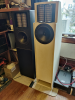
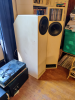
I have built two pairs of mass loaded transmission line speakers; both using 8" woofers. The bass and midrange clarity, and the bass extension are simply the best I have ever heard. I have been listening to hifi audio for over 32 years, and these speakers are as good as I could ever imagine.
I used an acoustic modeling program called Hornresp ( http://www.hornresp.net/ ) along with DataCAD, which I use in my day job, to settle on the designs, for the two woofers. The first used the Dayton Audio RS225P-4A, and the second has the SB Acoustics SB23RNXS45-4 - both are 92dB sensitivity, 4 ohm nominal, paper coned 8" woofers.
I have been using a miniDSP 2x4 HD active crossover initially. This is easy enough for me to refine the crossover to a fine level, and on the first speakers, I used the PEQ with a UMIK-1 calibrated mic and REW, to make custom filters to get very flat response.
On the second design, which I am calling MLTL-10 (after the Linaeum Model 10) I was able to use just the crossover and adjust the volume on the tweeters; as a model for an analog crossover. I have now done this, as well, and the parts are ordered. I used XSim to match the measured response of the speaker, using the individual driver response measurements. The crossover is 1st order on the tweeter, plus an L-pad to lower the level and balance the impedance - and 2nd order on the woofer.
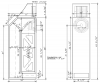

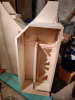
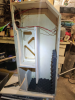



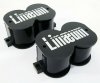
I used an acoustic modeling program called Hornresp ( http://www.hornresp.net/ ) along with DataCAD, which I use in my day job, to settle on the designs, for the two woofers. The first used the Dayton Audio RS225P-4A, and the second has the SB Acoustics SB23RNXS45-4 - both are 92dB sensitivity, 4 ohm nominal, paper coned 8" woofers.
I have been using a miniDSP 2x4 HD active crossover initially. This is easy enough for me to refine the crossover to a fine level, and on the first speakers, I used the PEQ with a UMIK-1 calibrated mic and REW, to make custom filters to get very flat response.
On the second design, which I am calling MLTL-10 (after the Linaeum Model 10) I was able to use just the crossover and adjust the volume on the tweeters; as a model for an analog crossover. I have now done this, as well, and the parts are ordered. I used XSim to match the measured response of the speaker, using the individual driver response measurements. The crossover is 1st order on the tweeter, plus an L-pad to lower the level and balance the impedance - and 2nd order on the woofer.
Last edited:


 .
.