• The move to the new server is done. There are some software and database maintenance updates in process. This has us passing the hat around to help out. We appreciate any donations. Seriously, even a dollar helps. The payment page may be found here - https://www.audiokarma.org/support.html

Mass Loaded Transmission Line Speakers

They do, and it is a custom version.

Companies use the term proprietary driver to thwart DIYers and justify a higher price but from the front it looks like it's off the shelf. Sometimes the difference is nothing more than a finned motor or cast frames. But MA's all have cast frames.

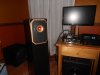
I use Mark Audio drivers in these Frugal Horns. Love their sound.

P1010015 4.jpeg
 
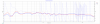
I have been tweaking the crossover in the MLTL-6 Dome speakers, based on the comments of everyone who has listened to them. First off, I realized that I missed a correction for the "lumpy" response in the crossover region, and that is reversing the polarity on the tweeter - this makes a big difference. Blue response is original, as people heard them, and the red is with the inverted wiring on the tweeter - I am learning as I go.
MLTL-6 Original vs Corrected Tweeter.png

Second, I am lowering the value of the resistors on the tweeter from 11 ohms to 9 ohms, which lifts the treble by about 1.5dB. I have an aversion to overtly bright speakers, but I erred on the side of being too polite. This tweeter is so smooth and extended - these responses are with the speaker pointed straight ahead, with the mic on my listening axis; so about 15-20 degrees off axis. Here is the revised response that put the Dome version on par with the Dipole Linaeum version (red is the original and blue is the revised):
MLTL-6 Corrected 01 vs 02.png

Here's the Dipole Linaeum in blue and the revised version of the Dome in red - they are effectively level up to ~2.5kHz and very similar up to about 4kHz. The dipole has more output from 4kHz-11kHz but the dome stays flatter up to about 16kHz. It is much flatter from 2kHz on up, and smoother in the 1kHz-2kHz, as well.
MLTL-6 Dipole vs Dome 02.png

I should mention that there are obvious differences in the response from ~1kHz and below, which points to the fact that measuring the lower midrange and especially the bass of any speaker in a room - is not going to be accurate.
 
Last edited:
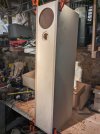
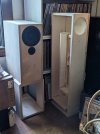
I am building my MLTL-6 Tower speakers - they use the same drivers as the stand mount, and should have a lower fundamental frequency - ~28Hz vs ~32Hz.

They are slimmer (8" x 13" vs 9" x 16"), and are 1 meter tall (plus any outrigger feet/base).

I will be cutting a rear access panel to mount the crossover and binding posts to. I will be using a series crossover with only 6 parts (2 coils, 2 caps (1 with a bypass cap) and 1 resistor. The coil values are much lower than in the parallel equivalent, so the sensitivity and dynamics should be a bit higher. The impedance curve is more benign, so would work better for tube amps, in particular.
MLTL-6 Tower.jpgPXL_20230801_112432887.jpgPXL_20230812_183017035.jpg
 
After years of wondering how series crossovers work, I found a clear explanation (John Broski's Tubecad). Very interesting, and he also notes the easier impedance curve and lowered coil values.
 
The other thing about series crossovers is they "automatically" blend the drivers - when you are working in XSim (or similar), the response kind of seesaws as you change the values. By definition, any power that is diverted away from one driver - goes to the other driver(s). Nothing is shunted to ground.

Series crossovers cannot be biwired/biamped, however.

They cost less, because there are typically fewer parts and lower value parts.
 
I've never biwired or biamped so that isn't a problem for me. Lower cost isn't a problem for me, either. Though it appears to be for some people...
 
The other side of the cost thing, is you can get better quality parts for the same/similar money. Larger gauge air core coils are always a good thing, and better caps, too.
 
After years of wondering how series crossovers work, I found a clear explanation (John Broski's Tubecad). Very interesting, and he also notes the easier impedance curve and lowered coil values.
Could you provide a link to that particular entry. I found his Tube CAD Journal but no way to search through the large number of entries.
 
I googled series crossover and came across Series vs Parallel Crossovers, which was post 402, Nov. 2017. He continues the topic over several issues, getting into higher level crossovers and so on, including SPICE simulations, which I found illuminating.
 
I lost the original I calculated but quickly made this up....

View attachment 2401780
Nice work, this is what my project advisor pointed out to me, the l/4 - Fb analogy.
You can lower the bump by making the box smaller, or tune a bit lower.
This response shape is referred to as an extended bass shelf alignment I believe due to
the lower Qts. If you have the option to add some series resistance in that program
you can raise the effective Qts but you will trade off efficiency because it lowers the
passband level. The dB scale is fairly expanded so it is less than 2 dB even at the
bottom of the sag point.
 
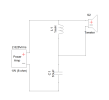
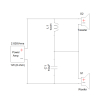
This is a 2-way series crossover, that is a 2nd order for both drivers.

The next two images show the circuit for the tweeter and the woofer. A tweeter level resistor goes typically on the leg between L1 and the positive on the tweeter.

The last image is a generic 3-way series crossover, that I believe is a 2nd order on the tweeter and the woofer, and 2nd order on the midrange above and below?
Generic 2-Way Crossover - 2nd Order.pngGeneric 2-Way Crossover - Tweeter Circuit.pngGeneric 2-Way Crossover - Woofer Circuit.pngGeneric 3-Way Crossover - 2rd Order.png
 
Glad to see this thread pop up again.
I like what you're doing.

Just thought I'd mention SB Acoustics SB20FRPC30-8 drivers if you ever wanna try something full range.
Haven't used them myself [yet], but they do have fans.
There's a 30 page thread on 'em over at DIY Audio.
They cost around $60 each at Madisound.
Definitely a bang for the buck option.
 
That does look like a very decent full range, and in a TL I'll bet it would be a good speaker. The drivers I am using cost only about $30 more.
SB Acoustics also make a very decent looking coaxial driver - that probably would drop into my MLTL-6 cabinets:

https://www.madisoundspeakerstore.c...cr25-4-coax-6-paper-cone-coaxial-4-ohm-round/

I have some family events happening Saturday, so I hopefully will still get some time to try and finish the MLTL-6 Tower pair.
 
Is there potential in looking at an MLTL for something like a Lowther PM 6? I have a pair in Radio People of Hong Kong cabinets that are back loaded horns - they sound good, but are large, and originally meant to be horizontally oriented on those tapered feet beloved by some MCM devotees (I think they are horrid), and, because my room is small, I need the speakers to be vertically oriented (driver up top), or even the seated listener is too close to hear any treble. And the cabinets, which have gold anodized punched aluminum grills, so are already a bit challenging, only have veneer on three of the sides, so one speaker has plywood visible (a first world interior decorator problem, I realize).
The back horn gives contributes to their well known dynamism (and coloration, which, fortunately, is on the euphonic side). While a subwoofer will always be desirable with a small light driver, I wonder if I might be able to answer several of my desires at once with an MLTL.
I know that some Lowther users think a ported cabinet is a better choice than any horn, but I have not tried such an implementation,
 
Is there potential in looking at an MLTL for something like a Lowther PM 6? I have a pair in Radio People of Hong Kong cabinets that are back loaded horns - they sound good, but are large, and originally meant to be horizontally oriented on those tapered feet beloved by some MCM devotees (I think they are horrid), and, because my room is small, I need the speakers to be vertically oriented (driver up top), or even the seated listener is too close to hear any treble. And the cabinets, which have gold anodized punched aluminum grills, so are already a bit challenging, only have veneer on three of the sides, so one speaker has plywood visible (a first world interior decorator problem, I realize).
The back horn gives contributes to their well known dynamism (and coloration, which, fortunately, is on the euphonic side). While a subwoofer will always be desirable with a small light driver, I wonder if I might be able to answer several of my desires at once with an MLTL.
I know that some Lowther users think a ported cabinet is a better choice than any horn, but I have not tried such an implementation,
I am not familiar with that driver, but it is quite possible; since there are a number of back/bass horn designs for it? If the Thiele/Small data is available for it, then it can be "plugged in" to Hornresp to get a rough idea of the possible response. The general layout of my towers is a good stating point, I think.

A transmission line is "in between" a back horn and a ported design. I like drivers with a high(er) sensitivity, low(er) Fs, and low(er) Mms. Having a higher Qts is apparently better for TLs, but I haven't been able to see this for sure.
 
Hmm. Loudspeaker Database has the parameters, but Hornresp seems to be only for Windows computers.
My pair is from the 60s, though, so parameters may have changed a bit. I assume manufacture date based on the decayed flat foam suspension which reminded me of Wharfedale's early isocyanate foam suspensions. The spider was a black foam triangle, and I replaced both surround and spider with a kit from AES, a German company that made Lowther clones.
They sounded great - especially when I had a Decca London cartridge. But low base wasn't really there, and response was uneven.
Spl is 92.5 (I assume this is one watt), Fs is 45 hz and Mms (including air load) is 12.75 grams. Does this sound promising at all?
 
Hmm. Loudspeaker Database has the parameters, but Hornresp seems to be only for Windows computers.
My pair is from the 60s, though, so parameters may have changed a bit. I assume manufacture date based on the decayed flat foam suspension which reminded me of Wharfedale's early isocyanate foam suspensions. The spider was a black foam triangle, and I replaced both surround and spider with a kit from AES, a German company that made Lowther clones.
They sounded great - especially when I had a Decca London cartridge. But low base wasn't really there, and response was uneven.
Spl is 92.5 (I assume this is one watt), Fs is 45 hz and Mms (including air load) is 12.75 grams. Does this sound promising at all?
Nat, you would need to measure those drivers, with a Dayton Audio DATS V3 or similar. The suspension makes a big difference to all the T/S parameters. But yes, those are all decent specs - in my opinion, the bass response of a driver in a TL is likely to be lower than any other speaker design.
 
Back
Top Bottom