• The move to the new server is done. There are some software and database maintenance updates in process. This has us passing the hat around to help out. We appreciate any donations. Seriously, even a dollar helps. The payment page may be found here - https://www.audiokarma.org/support.html

Mass Loaded Transmission Line Speakers

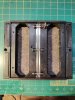
They are essentially the same, yes. The physical layout of the magnets and the voice "coil" and the dipole "leaf" elements are based on the same design. The Radio Shack made version uses a plastic frame, and I think the Linaeum built versions are more sturdy.

On the larger (6" high) TLS (true line source) driver also functions in essentially the same way. Though there are monopole and dipole versions - the dipole being even more rare. Their "hidden secret" is that they effectively narrow their width as the frequency rises - so they approach being a line source. This keeps the horizontal dispersion wider than it would typically be. At the lower frequencies they cover, these drivers have a greater surface area, so they "engage" with the air more at the lower frequencies.

Because the voice "coil" on these drivers is on a flat rectangular plastic film - so it has virtually no inductance. This means that the impedance of the driver is very even, and is almost flat across their entire range. On the ET-6A tweeter that is the most common one made by Radio Shack et. al. is about 7.2 - 7.4 ohms; depending on the unit.
The TLS dipole looks just like the TLS monopole, but has identical plastic film voice coils on the front and rear of the driver? Is that correct?
 
Linaeum drivers are nice - can be very natural sounding. BTW - Not trying to be argumentative - just helpful, but I don't think that physical alignment of VC's automatically assures time alignment. Other factors also play into "time aignment" such as weight of the cone/dome or diaphragm; strength of force generated vs. the driver mass, etc. I believe you have to align "acoustical centers" of two drivers in order to get them to be "time aligned". You have to look at impulse response time difference and then offset based upon that distance (not necessarily congruent with VC alignment).

You are probably correct - I am a newbie. I will probably have to listen and/or measure things with this 6" woofer. The voice coil is actually quite long from where it attaches to the cone all the way back to the midpoint (front to back) of the voice coil is well over an inch. It has holes around its circumference to vent air from inside it; rather than a vent out the back plate of the magnet structure, like its 8" "sibling". The back of the spider is open on both SB Acoustics (which is the one lack of the Dayton Audio woofer I used in the MLTL-11).

I have just assumed that the midpoint of the voice coil is the acoustical center - but I should confirm that.

And yes, the dipole version of the 6" high TLS driver has a mirror of the front "leaves" - I think the front and the back of each side is actually one piece arced 360 degrees. And you can see where they simply cut the B lobes off the back of the frame.

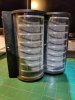
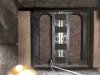
On the two pairs of monopole drivers, that we have, the ones from the LS2 speakers are suspending the voice "coil" with 3 small strands of what looks like a silicon filament on the front, and 3 more on the back. The pair from the LT1000 have some of the same little studs that hold the filament - but instead are suspended on the back only with 4 pieces of what looks like black foam tape.
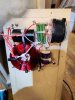
IMG_20201231_192845.jpg IMG_20201231_192919.jpgLinaeum LT1000 - 04.jpg
I have removed the thick felt pads, now. And added a thin felt strip on the front face of the bar magnets - after this picture was taken. It covers the 3 silicon filament pieces.
IMG_20211108_095535.jpg
 
Last edited:
You are probably correct - I am a newbie. I will probably have to listen and/or measure things with this 6" woofer. The voice coil is actually quite long from where it attaches to the cone all the way back to the midpoint (front to back) of the voice coil is well over an inch. It has holes around its circumference to vent air from inside it; rather than a vent out the back plate of the magnet structure, like its 8" "sibling". The back of the spider is open on both SB Acoustics (which is the one lack of the Dayton Audio woofer I used in the MLTL-11).

I have just assumed that the midpoint of the voice coil is the acoustical center - but I should confirm that.

Great looking project :-). I probably wouldn't (and maybe shouldn't) comment except that those Lineaum drivers are sooo good and so very interesting to me. You see I invested a good amount of money in a Demo set of the Lineaum successor speaker (Airfoil) and spent a day or two with the Inventor / designer (Paul Paddock) at my audio store (about 20 years ago now) when Paul helped me "set-up" my set of Airfoil speakers. Paul was (hopefully is) a heck of a nice guy and his drivers are very interesting.
Anyway ...

Position of the voice coil is fairly irrelevant. You need to mount the two drivers on a flat baffle surface and put a microphone at a typical listening distance (say 2M) exactly perpendicular to the baffle and on axis with the tweeter (if the speaker is intended to be listened to on the tweeter axis). Then run an impulse response on each driver individually. The impulse measurement will tell you how long it took for the electrical impulse to be converted into sound that reaches the microphone. It will be different for each driver. Subtract the woofer impulse time (milliseconds) from the tweeter impulse time (milliseconds) to determine the acoustical difference via applying the speed of sound at your altitude, temperature and humidity conditions. It will probably be a negative number and that's how far back the tweeter needs to offset from the woofer for "time alignment". Now, that isn't the end of it, as any passive crossover in a real circuit may introduce phase shift (phase = time) that will further modify things. Add to that problems with diffraction caused by cabinet elements introduced by trying to physically align drivers - and you have a whole new set of problems. I'll stop now as I'm getting to the end of what I know. Suffice it to say that most speaker engineers are less interested in "time alignment" these days, but phase alignment and minimizing cabinet diffraction effects still seem to be considered very important. As always, there are differing opinions out there so???? Maybe some of the highly experienced speaker builders in the group can chime in to assist NeilBEN in this very interesting and promising project. I don't mean to be critical, and I hope you don't take it that way. I wish you a great experience with your project and many hours of pleasurable listening :-) I'm sure it will be a ton of fun - and sound great.
 
I appreciate the specifics. My method is probably unorthodox - I use a miniDSP 2x4 HD as a digital crossover - biamped for my 2-way designs. And after listening and adjusting, I then measure the drivers and the speaker response, and use XSim to get the analog crossover that closely matches what I ended up with on the digital crossover. As I said, I am a newbie speaker designer.

As far as I know, Paul Paddock is still working - he is at a company called MC Audiotech (Mark Conti) and their only product is called the Forty-10. It is the 40th anniversary design of the TLS driver - now called WBLS - wideband line source; and each speaker uses 10 of them, in a partial spherical array. That sits on top of an H-frame open baffle subwoofer, that has two 18" woofers. They are selling the Forty-10 for a cool $35K / pair.

About a year ago, I emailed them, asking about the possibility that they sell a modern mass loaded transmission line with a single WBLS in it - an updated version of the LT1000. And their answer was essentially a flat "no". I am hoping to get my MLTL-11 (with the 6" high TLS driver) and MLTL-10 (with the 1.5" high Radio Shack made ET-6A) playing for enough people to drum up enough interest - for them to change their minds!
 
Last edited:
I appreciate the specifics. My method is probably unorthodox - I use a miniDSP 2x4 HD as a digital crossover - biamped for my 2-way designs. And after listening and adjusting, I then measure the drivers and the speaker response, and use XSim to get the analog crossover that closely matches what I ended up with on the digital crossover. As I said, I am a newbie speaker designer.

As far as I know, Paul Paddock is still working - he is at a company called MC Audiotech (Marc Conti) and their only product is called the Forty-10. It is the 40th anniversary design of the TLS driver - now called WBLS - wideband line source; and each speaker uses 10 of them, in a partial spherical array. That sits on top of an H-frame open baffle subwoofer, that has two 18" woofers. They are selling the Forty-10 for a cool $35K / pair.

About a year ago, I emailed them, asking about the possibility that they sell a modern mass loaded transmission line with a single WBLS in it - an updated version of the LT1000. And their answer was essentially a flat "no". I am hoping to get my MLTL-11 (with the 6" high TLS driver) and MLTL-10 (with the 1.5" high Radio Shack made ET-6A) playing for enough people to drum up enough interest - for them to change their minds!
I saw and heard the MC Audiotech speakers (at RMAF 2019) and I am aware that Paul is involved. I had a very hard time getting past the aesthetics of that speaker. The Airfoil Bending Wave Speakers were very nice looking (artistic almost), but the MC Audiotech iteration looks like a 1960's Television to me. To each his/her own :-) Regardless I'm glad he's still at it. I remember being very impressed with his Lineaum line array plus subwoofer columns at the Stereophile show in NYC back in about 1991 or 1992. The Airfoil Bending Wave had a similar sweet and very "you are there" sound to it as well. A lot of potential in the driver technology.
 
Agreed on the aesthetics of the Forty-10. The price of that speaker is way beyond what many/most people can contemplate. That is why I am hoping that the WBLS dipole driver could be had, in a two driver 2-way, with an 8" woofer in a mass loaded transmission line - for about $3500/pair.

That would be my ultimate speaker.
 
Agreed on the aesthetics of the Forty-10. The price of that speaker is way beyond what many/most people can contemplate. That is why I am hoping that the WBLS dipole driver could be had, in a two driver 2-way, with an 8" woofer in a mass loaded transmission line - for about $3500/pair.

That would be my ultimate speaker.
I haven't seen the earlier pages, so I may be asking something already covered. How low of a frequency can you set the cross-over for the WBLS dipole driver?
 
I haven't seen the earlier pages, so I may be asking something already covered. How low of a frequency can you set the cross-over for the WBLS dipole driver?

In the Forty-10 speaker, with the array of 10 WBLS drivers, they are crossed over to the woofers at 100Hz - which Mark Conti emphasized works because there are 10 drivers. The LT1000 speakers I have, were spec'd at 400Hz. The WBLS driver is probably at / about 400Hz, or possibly slightly lower.

So, a 10" woofer would be fine, I would think. But the 8" SB Acoustics woofer has an Fs of 27Hz, and in the latest MLTL design I did, it has a fundamental frequency of 25Hz. With room lift, this is for all intents and purposes full range. The terminus opening is at the floor, at the lower back corner of the cabinet, so with the wall behind the speakers, the room lift is greater than in most designs. The version I built has the fundamental frequency at 27Hz, with the terminus opening on the bottom of the front of the speaker. Bass quality is outstanding.
 
How does the lt1000 compare to the lm1000 that I have? I think neil said the crossover point is at 200 which is lower than the lt.
 
In the Forty-10 speaker, with the array of 10 WBLS drivers, they are crossed over to the woofers at 100Hz - which Mark Conti emphasized works because there are 10 drivers. The LT1000 speakers I have, were spec'd at 400Hz. The WBLS driver is probably at / about 400Hz, or possibly slightly lower.

So, a 10" woofer would be fine, I would think. But the 8" SB Acoustics woofer has an Fs of 27Hz, and in the latest MLTL design I did, it has a fundamental frequency of 25Hz. With room lift, this is for all intents and purposes full range. The terminus opening is at the floor, at the lower back corner of the cabinet, so with the wall behind the speakers, the room lift is greater than in most designs. The version I built has the fundamental frequency at 27Hz, with the terminus opening on the bottom of the front of the speaker. Bass quality is outstanding.
I didn't know they could go that low!!! Considering that the Orchestra tuning note (middle of the "meat" of musical range) is A-440Hz, X-over's in that frequency range have to be perfect so as to not be easily "audible". A well known brand's current offerings cross at about 400Hz and they suffer for it IMHO. Their earlier line crossed lower and sounded considerably better to me. At least you have a lot of x-over frequency options with the SB 8" woofers - they are excellent.
 
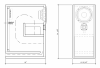
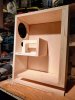
I have designed and built a pair of stand mount speakers - the MLTL-6. This first pair has a 1" dome, and the next with have the Linaeum ET-6A tweeters.MLTL-6 Drawing - 05.png MLTL-6 Hornresp - 05.png IMG_20220121_195121.jpg IMG_20220125_130138.jpg
I am listening with the miniDSP 2x4 HD as the crossover, and biamping the woofers and the tweeters.
 
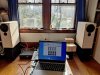
I finished the analog crossover for the MLTL-6 Dome speakers, and I am very happy with the results. I used a Solen 14AWG coil and cap on the woofer, and a ClarityCap, Mundorf metal oxide resistors (in an L-pad) and a Madisound 16AWG coil on the tweeter. They are incredibly dynamic and full, with wonderful clarity bottom to top. Very wide and deep soundstage with good recordings.
IMG_20220217_222827_Bokeh.jpg IMG_20220217_144625.jpg

Edit: I need to design and build some stands for these speakers. Do you know of a good design, that is constructed with Baltic birch? I think they need to be between 14" and 18" high.
 
Last edited:
Interesting post. i too have built my own TL loudspeakers. Externally my bass cabinets look similar to the OP photographs. Internally they are completely different. I worked on the principle of a lined shaped cavity behind the driver at the top front of the cabinet which leads into a folded tapered line with a slight expansion at the end. The tapered line folds horizontally inside the cabinet forming 4 horizontal sections with a final vertical section at the front with an exit point directly below the driver on the front of the cabinet. The line length is calculated to be 92% of the 1/4 wave length of the 8" driver Fs (29Hz). The taper allows for the 8% length reduction. I have 2 heavily damped removable steel cover plates on teh rear of the cabinet to permit access to all parts of the line for future damping modification. The mid and HF drivers are in a separate cabinet which sits on top of the bass unit.
The bass/midrange crossover point on my system is 240Hz using 24dB/Octave active filters which means that the higher frequency notching that TL cabinets are renown for does not apply as those frequencies don't exist in this set up. This enabled me to concentrate on the general 6dB/Octave bass rolloff that a correctly tuned TL line should provide and ensuring that any output from the line exit was in phase with the driver at low frequencies.

Maintaining separate cabinets and fully active amplification also obviates mechanical, rear energy acoustic and electrical interference between the drivers.

In terms of materials used, mine are made from layered MDF with most panels being 36mm thick and the bass baffle being 50mm thick. These things are very heavy and solid i.e. non-resonant. The internal line components makes this a very stiff structure. The linings are generally a layer or matalised butimen with 15mm of campressed felt, all glued and stapled. The line is filled with variable fibre length polyamide fibre teased out and supported with neoprene banding as required to prevent sagging. the last 3rd of the line is not damped.

The overall result is a very clean and unconstrained bass response which sounds effortless. The midrange cabinet is a damped port design where I have aimed for minimal rear pressure of an OB, but without the foldback.
 
I am relatively new to this, and when I first was looking into transmission lines trying to learn about them, the "rules of thumb" designs were how things were done. The driver was always at the closed end. But with the evolution of computer acoustic modeling, with programs like Hornresp, things have gotten considerably easier, and better. So many factors are accounted for in the computer model, that could not even be considered, let alone calculated.

As I mentioned, the woofer is located up to about 1/3rd of the way from the closed end, and the taper / reduction in area, and where and how much polyfil is needed - and the Path length between the woofer and the terminus opening on the outside of the cabinet - are all accounted for, in the design model.
 
Last edited:
Oh, very much so - they use different taper pattern than I have seen, but they are definitely in the TL family, so to speak.
 
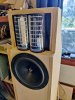
I finished building the cabinets of the MLTL-6 Dipole speakers yesterday, and I am now listening to them with the miniDSP 2x4 HD digital crossover. So far, I have lowered the crossover point from about 1.7kHz to about 1.5kHz, and the Linaeum tweeters are not as sensitive as the SB Acoustics, so instead of -9dB that I used on the 1" domes, it is possibly not going to need any reduction at all. Which would be neat to avoid any induction roll off at the top end.IMG_20220222_145845_Bokeh.jpg IMG_20220222_191351.jpg

I need to build some proper stands; rather than using the Sony SS-CS5 speakers ... two under each of the MLTL-6 speakers. They are a bit over 13" high, so I think the stands should be 14" to 18" max.
 
That would be interesting - I just saw a review of the Pearl Acoustics Sibelius speakers, and they certainly seem to be my kind of speaker. The challenge is that they use a custom made driver. My other concern is that the highest frequencies are going to get narrow dispersion, no matter what. Pushing a single driver that much is super challenging.

It is hard enough getting a 2-way to be full range. :-)

I cannot emphasize enough how amazing the Linaeum tweeter is. As the MLTL-6 Dipole speakers are breaking in, they are opening up, and on many recordings, they utterly "disappear". The clarity bottom to top is often breathtaking, and the dynamics are startling.

These speakers have bass extension "flat" down to about 32Hz. They have punch and clarity and detail - without any excessive "brightness". The music on good recordings sounds effortless. The depth and width and height of the soundstage is as big as it can be - it goes well outside of the speakers.

 
That would be interesting - I just saw a review of the Pearl Acoustics Sibelius speakers, and they certainly seem to be my kind of speaker. The challenge is that they use a custom made driver. My other concern is that the highest frequencies are going to get narrow dispersion, no matter what. Pushing a single driver that much is super challenging.

It is hard enough getting a 2-way to be full range. :)

I cannot emphasize enough how amazing the Linaeum tweeter is. As the MLTL-6 Dipole speakers are breaking in, they are opening up, and on many recordings, they utterly "disappear". The clarity bottom to top is often breathtaking, and the dynamics are startling.

These speakers have bass extension "flat" down to about 32Hz. They have punch and clarity and detail - without any excessive "brightness". The music on good recordings sounds effortless. The depth and width and height of the soundstage is as big as it can be - it goes well outside of the speakers.

Last time I checked Pearl Acoustics used Mark Audio drivers.
 
Back
Top Bottom