• The move to the new server is done. There are some software and database maintenance updates in process. This has us passing the hat around to help out. We appreciate any donations. Seriously, even a dollar helps. The payment page may be found here - https://www.audiokarma.org/support.html

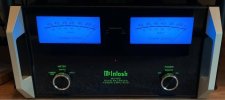
MC2600 - Is it the Big Dog?

the 452 is definitely a great amp. Best bargain in the line today I believe. Sure, they don't knock the shine off of say a 1.2K, but if you don't have the space and aren't willing to spend the money, the 452 is a great amp, plus you don't have those annoying Molex barrier strips on the back. Its nice looking though I sometimes wish it had endcaps like the 352, thats of course not a deal breaker. it's ( ever so lightly) easier to move it around than the 2500 was.
 
The MC2600 continues to have a cult following, long after its production run ended (almost 30yrs ago now). Why is that? I have a few ideas . . .

A few facts . . .

Production on the MC2600 ended in 1995. When first introduced in 1990, the amplifier had a retail price of $5,300. By the end of production, that had risen to $6,000. It was the last of the BIG McIntosh power amplifiers to utilize the 6 rack space tall, fan cooled 19" wide rack mount chassis - MI-350 / MC3500, MC2300, and MC2500 were the others. The MC500, introduced in 1994, was destined to replace it.

According to members here that worked for McIntosh dealers when the amp was introduced, the MC2600 was a significant step up from the MC2500 as it had two new features - high current capability and autoformers designed to facilitate delivery of that to the loads. The MC2500 was rated to deliver 55A/ch whereas the new MC2600 was rated at nearly double that at 100A/ch. From an engineering standpoint, this was surely an accomplishment. The speaker output barrier strips were upgraded to specially designed ones which could accommodate cables up to 4 AWG in size and the amp included both XLR and TRS input jacks in addition to the RCAs.

The fan cooling is thermostatically controlled and particularly difficult to trigger in a domestic setting. [I'm sure in my house party days we would have had the fans running in HI.] I can tell you first hand that this is true. The combination of fans, heat sink mass, the chassis layout, and the autoformers made the amp equally suited to the rigors of professional and industrial applications. According to McIntosh at the time, The McIntosh MC 2600 is truly the finest amplifier produced by McIntosh.

Some opinion . . .

I've owned a pair of these amplifiers for some time. I remember vividly reading Bascom King's assessment of the MC2600 as it graced the cover of Audio Magazine BITD. He measured some 850wpc at the onset of Power Guard. Crazy. I was determined to own one at some point. After a decade of looking, I found my first in 2014 (2nd pic - #6 off of the production line). They are quite unique. Some time ago, I penned a thread on the MC2500 as being the best value in used McIntosh. My opinion on that hasn't changed. While the MC2600 is certainly the most unique power amplifier I've ever owned, its capabilities are simply not needed by most. I run my pair bridged mono to a pair of XRT22s, mainly because I can. They mostly mock me - even during spirited listening sessions. They have bigger balls than I, and significantly. If you believe you own a pair of loudspeakers that could tax an MC2600 in a domestic setting, you'd be wrong. However, there is some level of understanding required here to understand how to lever the amp's capabilities.

Firstly, you should understand how McIntosh derives its current capability ratings for this amplifier as well as the dynamic power capabilities. Read #3 and #4 carefully from the specs I copied from the inside of the OM. You can't replicate that with any pair of loudspeakers in a domestic setting and no pair of speakers I know of can handle that kind of power to begin with. Then, when it comes to tap selection, see the pic with the graphs. This is copied from the MC7300 Owners Manual, but Mc did not supply this with the MC2600. Then, keep in mind that the MC7300 simply doesn't have the thermal capabilities of the MC2600 (no fan cooling, much less heat sink mass, etc.). Show me a case in a domestic setting where one would choose anything other than the 8 Ohm taps on an MC2600 - regardless of the speakers connected.

Given what I've attained with even a single MC2600 in my listening space, I've always wondered what an MC602 would be like as it reportedly has even greater capabilities. [I did own an MC500 for a period of time.] However, the MC602 lacks the thermal management system of the MC2600.

Now, if you compare the MC2600 to the MC2500 which it replaced, the differences are subtle in a domestic setting. In my space, it is possible to drive a single MC2500 to levels which can flicker the Power Guard Lamps, but not often as you really have to try. And we're talking about playback levels which I would deem as uncofortable for most. I've been unable to ever do this with an MC2600. Rich Andrews (long ago member here) uncovered some manufacturing changes in the latest MC2500s which involved the relocation of a harness internally which brought the S/N closer to that of an MC2600 but I've never seen the need to do this in any of the four MC2500s I own.

If you own loudspeakers which are particularly difficult to drive, amps beginning with the MC7200 are more suited to drive them than prior designs. I've never admired such speakers, as Infinity Kappa 9s for example, whereas the impedance curve is IMHO more of a result of improper crossover network design than a mettle test for a power amplifier. However, I would love the chance to power a pair with one of my MC2600s - that may be a match made in heaven.

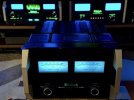
Last pic is my pair.

This is really interesting info, thanks!

And I love your room/setup, very very nice.
 
The MC2600 continues to have a cult following, long after its production run ended (almost 30yrs ago now). Why is that? I have a few ideas . . .

A few facts . . .

Production on the MC2600 ended in 1995. When first introduced in 1990, the amplifier had a retail price of $5,300. By the end of production, that had risen to $6,000. It was the last of the BIG McIntosh power amplifiers to utilize the 6 rack space tall, fan cooled 19" wide rack mount chassis - MI-350 / MC3500, MC2300, and MC2500 were the others. The MC500, introduced in 1994, was destined to replace it.

According to members here that worked for McIntosh dealers when the amp was introduced, the MC2600 was a significant step up from the MC2500 as it had two new features - high current capability and autoformers designed to facilitate delivery of that to the loads. The MC2500 was rated to deliver 55A/ch whereas the new MC2600 was rated at nearly double that at 100A/ch. From an engineering standpoint, this was surely an accomplishment. The speaker output barrier strips were upgraded to specially designed ones which could accommodate cables up to 4 AWG in size and the amp included both XLR and TRS input jacks in addition to the RCAs.

The fan cooling is thermostatically controlled and particularly difficult to trigger in a domestic setting. [I'm sure in my house party days we would have had the fans running in HI.] I can tell you first hand that this is true. The combination of fans, heat sink mass, the chassis layout, and the autoformers made the amp equally suited to the rigors of professional and industrial applications. According to McIntosh at the time, The McIntosh MC 2600 is truly the finest amplifier produced by McIntosh.

Some opinion . . .

I've owned a pair of these amplifiers for some time. I remember vividly reading Bascom King's assessment of the MC2600 as it graced the cover of Audio Magazine BITD. He measured some 850wpc at the onset of Power Guard. Crazy. I was determined to own one at some point. After a decade of looking, I found my first in 2014 (2nd pic - #6 off of the production line). They are quite unique. Some time ago, I penned a thread on the MC2500 as being the best value in used McIntosh. My opinion on that hasn't changed. While the MC2600 is certainly the most unique power amplifier I've ever owned, its capabilities are simply not needed by most. I run my pair bridged mono to a pair of XRT22s, mainly because I can. They mostly mock me - even during spirited listening sessions. They have bigger balls than I, and significantly. If you believe you own a pair of loudspeakers that could tax an MC2600 in a domestic setting, you'd be wrong. However, there is some level of understanding required here to understand how to lever the amp's capabilities.

Firstly, you should understand how McIntosh derives its current capability ratings for this amplifier as well as the dynamic power capabilities. Read #3 and #4 carefully from the specs I copied from the inside of the OM. You can't replicate that with any pair of loudspeakers in a domestic setting and no pair of speakers I know of can handle that kind of power to begin with. Then, when it comes to tap selection, see the pic with the graphs. This is copied from the MC7300 Owners Manual, but Mc did not supply this with the MC2600. Then, keep in mind that the MC7300 simply doesn't have the thermal capabilities of the MC2600 (no fan cooling, much less heat sink mass, etc.). Show me a case in a domestic setting where one would choose anything other than the 8 Ohm taps on an MC2600 - regardless of the speakers connected.

Given what I've attained with even a single MC2600 in my listening space, I've always wondered what an MC602 would be like as it reportedly has even greater capabilities. [I did own an MC500 for a period of time.] However, the MC602 lacks the thermal management system of the MC2600.

Now, if you compare the MC2600 to the MC2500 which it replaced, the differences are subtle in a domestic setting. In my space, it is possible to drive a single MC2500 to levels which can flicker the Power Guard Lamps, but not often as you really have to try. And we're talking about playback levels which I would deem as uncofortable for most. I've been unable to ever do this with an MC2600. Rich Andrews (long ago member here) uncovered some manufacturing changes in the latest MC2500s which involved the relocation of a harness internally which brought the S/N closer to that of an MC2600 but I've never seen the need to do this in any of the four MC2500s I own.

If you own loudspeakers which are particularly difficult to drive, amps beginning with the MC7200 are more suited to drive them than prior designs. I've never admired such speakers, as Infinity Kappa 9s for example, whereas the impedance curve is IMHO more of a result of improper crossover network design than a mettle test for a power amplifier. However, I would love the chance to power a pair with one of my MC2600s - that may be a match made in heaven.

Last pic is my pair.
Wanted to add many domestic loudspeakers would require the 4/2 ohm tap for proper load matching.

Also from previous replies i know the 2600 can drive lower impedance from its 8 ohm tap , experimenting around will determine best tap to use for sonics, driving into an impedance mismatch load can sound off or not ..

Regards
 
Last edited:
Edited my post to address properly
Mismatch? If you don't like the results of an amp like this one driving your speakers via the 8 Ohm taps, you really just don't like your speakers. Finding more pleasing results from the 4 or 2 Ohm taps would dramatically alter the frequency response. Of course, that may be preferable given the environment.

Think how an amp like the 2600 would compare to any other brand of amplifier which did not have autoformers ... this is maybe the most oft overlooked detail when comparing to direct coupled designs. Using anything but the 8 Ohm taps in such a comparison would tilt results in favor of the direct coupled amp.

In the case of the 2600, very low impedance loads could be driven from the 4 or 2 Ohm taps - and easily. Look at the graphs above as they pertain to power vs load impedance. The autoformers on this amp really serve more to manage heat than to improve coupling to the load.
 
Although the autoformers do match the output impedance to the speakers (load), the more important function is matching the load to the output transistors. This is the magic part and why it doesn’t really matter that your “8 Ohm”: nominal speakers might dip to 2 and rise to 10 over the response spectrum, ... the OPT is still presenting a matched load to the output transistors and keeps them operating in their linear range among other benefits.
 
Yes impedance mismatch is a thing with transformers there is no way the 2600 is gonna drive a 2ohm load better thru its 8 tap than a direct coupled amp.

I cant see that happening. I would start with the 2 ohm tap and possibly later try the 4 ohm tap. Driving a 2 ohm load with the 8 ohm tap could damage the amp outputs or transformer , this is what used to happen to earlier mac’s .

Of course all of this is speaker dependent as to sensitivity and impedance curves and phase angles , if the loudspeaker is only 2 ohm in a very narrow region and the speakers are high sensitivity the 2600 may just Cruise thru at any tap ..!

Regards
 
The impedance curve of a loudspeaker may in fact dip to 2 Ohms at a certain frequency but what of the rest of it? You really want to sacrifice power at other frequencies by choosing a tap complementary to a single point on the curve? With a 2600, you don't have to. That's the very nature of its design - soak in the graphs I supplied. The 2 Ohm taps would be ideal for industrial applications though ... 2 Ohm loads of a resistive nature, wildly reactive loads where impedance dips to a fraction of an Ohm, etc.

I'll put a single 2600 up against any direct coupled power amp out there in a domestic setting. The dynamic capability of the 2600 is on par with any amp ever sold for domestic use. Only the Proton D1200 could likely compare.

And I'm certainly not worried about damaging it.
 
Isn't this about the time someone usually brings up the big Yamaha PC 5002M?

;-)

I got no dog in this fight (at least not at that level) but I will say I am very fond of both my MC501s and my PC2002M.
And I did own two PC4002s at one point and can definitely say that some loudspeakers really benefit from an amp with more current. The difference from 2002 to 4002 in the same system was immediately noticeable.

Jblnut
 
Isn't this about the time someone usually brings up the big Yamaha PC 5002M?

;-)

I got no dog in this fight (at least not at that level) but I will say I am very fond of both my MC501s and my PC2002M.
And I did own two PC4002s at one point and can definitely say that some loudspeakers really benefit from an amp with more current. The difference from 2002 to 4002 in the same system was immediately noticeable.

Jblnut
I almost bought one 6mos ago. But the notion that it was 115lbs with all sharp corners and would require a full electrical restoration ... I came to my senses.
 
A 2600 was like having two 7300's on one chassis so I can believe its capability driving lower impedances. Though the ones I installed never went below 4 ohms. I used them one time to drive 70.7 volt lines in a commercial installation but had to put HP filters set at 40 HZ so they wouldn't burn up the step down trans formers on the speakers and to prevent the amps seeing a short from the speakers step down transformers we would put massive coupling capacitors on the amplifiers output terminals.

I will say a 602 sounds a bit more defined than a 2600. But that can be a good and it can also be a bad thing depending on the speakers and the source material. Personnally those were some great sounding amps used with Alte and JBL speakers driven by the famous Bozak disco mixer from the 70's and used on into the 90's. The mixers are very collectable. They sounded great and when combined with Mac amps made discos sound just great no matter how loud the music. They made Altec 3156 woofers get up and bark when called upon to do so. I have forgotten the Gauss and JBL numbers. Seemed like JBL had a new and better model every time you looked.
 
Last edited:
I almost bought one 6mos ago. But the notion that it was 115lbs with all sharp corners and would require a full electrical restoration ... I came to my senses.

I doubt that LOL :-) We all are way beyond help here....

The only other "grail" amp that many of us chased was the HK Citation XX. I got close a few times but never landed one in the boat. But it is nowhere near as powerful as the arc welders we are discussing now.

jblnut
 
Another nasty beast I came very close to buying once. A Krell FPB-600. With the works. A complete system of the very best that Krell ever made.

The Amp, a KRC-HR Pre, and a KPS 20i CD Player, all mint, perfect, low hours, boxes, the whole smear, $16K. I offered $14K, no can do. It was a good deal at $16K, but thought about that Amp that would need a fork lift to lug around, and also use up juice like Doc Brown's Guitar Amp. LOL

 
We'll be expecting a new thread from you soon on this one!
After disassembling it to nothing (how else would I know the power transformer weighs more than 45 lbs and each autoformer is over 21 lbs) it’s sporting fresh glass, new handles and new lamps. (I didn’t do LED conversion, Audio Classics told me they stopped offering it because it could cause some noise issues with the amp)

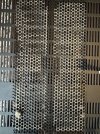
If the 1 picture of the dust bunnies is any indication of how dusty it was.. she’s now cleaner than new amps roll out of Binghamton, I assure you that.

I still need to transfer the blue meter glass from the old face or order new stuff from McIntosh and get some foam and adhesive to install the diffuser for the bulbs behind the logo, but it’s a functioning amp again.
 

Attachments

  • IMG_9984.jpeg
    IMG_9984.jpeg
    221.3 KB · Views: 49
  • IMG_5778.jpeg
    IMG_5778.jpeg
    66.4 KB · Views: 44
After disassembling it to nothing (how else would I know the power transformer weighs more than 45 lbs and each autoformer is over 21 lbs) it’s sporting fresh glass, new handles and new lamps. (I didn’t do LED conversion, Audio Classics told me they stopped offering it because it could cause some noise issues with the amp)

If the 1 picture of the dust bunnies is any indication of how dusty it was.. she’s now cleaner than new amps roll out of Binghamton, I assure you that.

I still need to transfer the blue meter glass from the old face or order new stuff from McIntosh and get some foam and adhesive to install the diffuser for the bulbs behind the logo, but it’s a functioning amp again.
Man, start a new thread on this bad boy and give us all the details!!
 
Back
Top Bottom