• The move to the new server is done. There are some software and database maintenance updates in process. This has us passing the hat around to help out. We appreciate any donations. Seriously, even a dollar helps. The payment page may be found here - https://www.audiokarma.org/support.html

MF-300 & Remote Control Acquired

Great progress Joe.

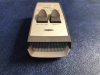
Side note of sorts - I spotted a really old remote at my local thrift / junk / treasure what have you store, so I bought it for two bucks. A Magnavox Phantom remote with station and loudness buttons. I got it home and hoping it would have some guts that would be of use to you I opened it up. It has a bellows and some sort of spray nozzles in it! I guess it wont help you. On the bright side, it looks like I can make a $5 profit on eBay.
 
Matt;

Yes, Magnavox used bellows to blow air across tuned ports to cause an ultrasonic sound to be emitted. It was another interesting method to create useful signals. The more typical tuning rod method was used by many companies. I think Zenith was the first to use that method. Others did so as well and there are still examples of those showing up on the auction site.

One thing about both of the mechanical methods is that at least no effort to align the hand units was ever needed. Tuning rods and tuned ports are not going to ever change in frequency.

Joe
 
I connected two 470K ohm resistors to the base of Q4 and Q5 in Matt's RK-20 receiver. I used my oscilloscope probe attached to either Q4 or Q5 base to vary the trimmer capacitor and the inductor in the hand unit while activating both volume and channel tuning functions. That allowed me to look at both volume and channel tuning and peak the hand unit to the best reception in the RK-20 receiver. Varying the inductor produced the highest peak to peak signal at the base of Q4, the volume function detector. Then the trimmer, C30, in the hand unit can be adjusted to deliver the highest peak to peak signal at the base of Q5 channel function detector.

I am going to do some more testing of Matt's unit today and if all is OK I will be getting it ready to send back to him.:jump:

Having two units to work with has been very helpful. Now both his RK-20 and my RK-20 respond very well to the output of his remote hand unit. That let me know that the crux of any problems with my unit is strictly with my hand unit.

Joe
 
Arthritis is a Gold Plated Bitch, ain't it Joe. Not that I've got anything to talk about. I have trouble with stairs anymore (in my Hip Joints) and carrying anything over 25lbs.
Good job on the MF-300/RK-20 so Far. As Mush Morton(C.o. of the WAHOO WWII) used to say to his exec Dick O'Kane, later of TANG, "Tenacity Dick, don't let any of the bastards get away!"
 
Larry;

Yes, Arthur and Ritis have both been visiting.. I wish they would leave.:( Like you I have trouble dealing with anything over 25lbs. I am also working on my Scott Radio Laboratories 800B. The tuner chassis weighs 46lbs. and the FM IF/Pwr Supply/Audio Out chassis weighs 34lbs. I have to get my youngest son to move them for me unless I want to pay for it with back pain and headaches for several days. On top of that my balance is not so good any more. Quick movements of my head can result in dizziness and I have to just freeze in place until it stops. Such is life!
I am pleased that I am going to be able to wrap up Matt's remote pieces and send them back to him soon. Having a second unit to compare against in multiple measurements and tests was very helpful. It is unfortunate that so much Fisher service information was lost after the company changed hands. I am sure that Fisher had complete RK-20 alignment information at the factory that was much more detailed than what they shared with the service industry. This has been a task of reverse engineering that I was glad to tackle. No one else seems to have pursued these models in detail, or if they did they did not share the information gained. None of us knows how long we will live and I wanted to leave some additional information on them for posterity.
 
Since we know that Admiral made the remote control units for Fisher, these images show an Admiral tuning rod type remote hand unit. Note the similarities to the Fisher hand unit case:
Admiral hand unit 01.jpg
Admiral hand unit 02.jpg
Admiral hand unit 04.jpg
Admiral hand unit 05.jpg
Admiral hand unit 08.jpg
This shows the tuning rods of this remote hand unit which was made for an Admiral television. This is typical of remote systems of the mechanical units.

Joe
 
Yeah, what in the world do those tuning rods do? I remember playing with one of these and wondering that very question and that was like 55 years ago.
 
They emit ultrasonic sounds that only some animals such as dogs and cats may be able to hear. The frequencies are above human hearing: 38 & 40kHz region. Tuned circuits in a remote control receiver detect them after pickup by a microphone and suitable amplification before going to the tuned detector circuits. Relays were typically used driven by transistors to apply 115VAC or other AC voltage to motors actuating desired functions in a radio or television. In the case of the Fisher MF-300 the RK-20 volume control is rotated to increase volume or decrease volume and a search tune motor is actuated in the FM tuner. Audio cables from the MF-300 audio out jacks go to the audio in jacks of the RK-20. The RK-20 has audio out jacks to go to a preamp tuner or aux input, or even to a power amplifier as described below.

The Fisher RK-20 remote control receiver has an accessory AC outlet on the back and can turn on and off a device connected to it as the volume control is rotated by the motor. If you plug a preamp with separate audio amplifier into the AC outlet on the back you can use the volume control in the remote receiver to vary the audio level going to a power amplifier connected to your preamp. By doing this you are able to turn on a complete stereo system, adjust its volume up or down and turn it off. If the MF-300 is connected to the preamp tuner or aux inputs and uses an accessory AC outlet on the back of the preamp to turn the FM tuner on (tuner's local on-off control being left permanently on), it will come on when the preamp is turned on, and also respond to tune up or down the FM band from the hand held ultrasonic transmitter. The audio output of the preamp is connected to the RK-20 audio in jacks while the RK-20 audio out jacks are fed to the power amplifier. It makes a very useful addition to a stereo system.

Joe

Joe
 
Final checkout of Matt's RK-20 remote receiver and his hand transmitter while attached to my MF-300 tuner revealed that while the volume worked both up and down, the tune function did not. I had to remove the cover from the K3 reverse relay and clean the contacts. I also did the same for the K1 tune relay. After that I reconnected the RK-20 to the MF-300 and tried again. One tune direction worked and one did not although I could hear the relays clicking inside the RK-20. I cleaned the contacts in the plug of the interconnect cable and tried again and that restored operation of tune up and tune down while working with my MF-300.

My MF-300 displays a little bit of reluctance to switch to FM Stereo when in fully automatic multiplex operation, but that is likely going to be part of replacing some electrolytics in the tuner and possible touch-up of the ratio detector secondary. It switches to stereo in tune down mode quicker than in the tune up mode. That is an indication that the secondary tuning of the ratio detector may not be correctly centered. Another possibility is the drive motor in the tuner may not be releasing quick enough in tuner up mode to stop the tuning right on dead center of a station. It could possibly be a problem with the lubrication of the motor rotor shaft and bearings. On my outside FM only antenna the MF-300 is finding stations all up and down the dial. It is nice to see one of these systems work properly again.
 
Last edited:
Another item of interest:
I discovered that my MF-300 has a WX multiplex circuit installed in it. This leads me to wonder just when it was made. I need to look at some components on the chassis and see what date codes I find.

Joe
 
It's possible that FISHER used up overstocked parts for the MF-300 and other small production number units, as long as they fit physically and electronically. IIRC Dave said the WX were preferable to the MPX-65's in that they changed the circuits slightly on the '65's from the WX's to accomodate the 12ax7's used in all spots on the MPX-65.
 
Another item of interest:
I discovered that my MF-300 has a WX multiplex circuit installed in it. This leads me to wonder just when it was made. I need to look at some components on the chassis and see what date codes I find.

Joe

Hi Joe. Looking real good!

You got me curious so I took a look at mine and it has the WX multiplex as well. These are exceptionally sensitive tuners when aligned. I did a test tonight after a 15 minute warm up. Keeping every knob on "normal" except the left knob on "automatic", and using the tuning buttons I was able to get 43 stations across the dial! I know there are a lot of stations as I live about 40 miles south Los Angeles but it does seem more sensitive than most, if not all of my other Fisher tuners. That was with a small "T" dipole wire antenna attached with jumper wires. I've made videos of some of my other Fisher tuners going across the dial using the same antenna and I'm going to compare them. The MF-300 is exceptional and a real sleeper.

As far as dates go this came out of a 64 president. I also want to thank you for the nice note and I'm looking forward to getting my remote equipment rebuilt :)

MF300 WX.jpg
 
Last edited:
My MF-300 is serial no. 10176A

Here is what I found when I looked for date codes:
1st IF Xfmr ZZ 662-117A 119-62-21
2nd IF Xfmr ZZ 2987Y 119-62-42
3rd IF Xfmr ZZ 50210-2Y 119-62-42
4th IF Xfmr ZZ 50210-2Y 119-63-06
5th IF Xfmr L 935122 119-63-11
Ratio Det ZZ 50210-9AX 119-63-20

WX MPX Ckt.:
19kHz ZZ 50210-34 119-62-40
38kHz ZZ 50210-33 119-62-46

Pwr. Xfmr T-998-115-C 926 32 94

All tubes are OEM Fisher
V1 6DJ8 1022-302 West Germany
V10 6DJ8 1022-202 West Germany
V6 6EJ7 3-05 Holland

Later today I plan to connect the tuner into my stereo system and see how it sounds and how it performs when using its auto-search tuning commanded by its front push-buttons.

Joe
 
I believe the MF-300 was introduced in September of 1963, so that would make it a 1964 model. It was tested in the High Fidelity magazine September 1963 issue and got a good report.

Joe
 
I did listen to my MF-300 and it does have plenty of sensitivity and it managed to pull in my favorite station which is over 60 miles away without interference from the local alternate frequency station that is 4.5 miles from my house. This is nothing short of phenomenal for a tube type tuner. It is in full quieting. Now of course if the distant station's signal drops compared to the local one, then it may begin to have interference, but I am quite pleased with its performance so far. When the auto-tune up or down buttons are pushed it moves to the next station while the audio is muted and comes on after settling on the next station. My distant station has to be approached from one direction as the local station causes it to skip over the desired station while tuning up, but finds it OK when tuning down from above the offending local station.

Stereo image is great and sound is full-bodied, no lacking in bass or treble. It has that 3D effect when listening to a good recording from a good station.

Joe
 
Joe -- The WX chassis was used in ALL of the tuner only applications, as the audio circuit B+ is low in those applications (about 135 vdc). The MPX-65 was developed strictly for receiver/console applications, with it's audio circuits needing and happy to operate from 300 vdc or more. The only exception to this is the 500B receiver, which also used the WX chassis, and required a separate decoupling point in the power supply to supply the low B+ voltage it needed to operate from. In developing the MPX-65, the separate B+ decoupling point was no longer needed, since the audio circuits could then operate from the phase inverter power supply point. As such, the MPX-65 allowed Fisher to save a few pennies in their later receiver units.

Dave
 
Dave;

I remember noting that the Fisher 500-B and 800-B used the WX multiplex sub-chassis and that the tuners used the WX unit too. It is easy to forget details like that and be pleasantly surprised and reminded of the difference when it is found in a unit.

The performance of the MF-300 is similar to that I experienced with the Fisher 202-R tuner, which has one more IF stage (6) and a narrower ratio detector. I am going to get Matt's RK-20 in shipment today and then I can get back to work on my RK-20 and the custom WX type multiplex detector for my 202-R tuner.

Joe
 
I am modifying an existing MPX-65 to be a WX version built into a Bud Box with its own filament and power transformer & B+ filtering. That will go with my Fisher 202-R AM/FM tuner. I need to get that operational soon so I can get back to this MF-300 and its RK-20 remote system.

I put Matt's RK-20 system in shipment through UPS this morning. He is anxious to get it back. Now he will be taking a look at his MF-300 tuner.

Joe
 
I found an article today in the May 1964 issue of Radio Electronics on the MF-320, which is the MF-300 chassis paired with the RK-20 remote control chassis in one cabinet with a single face plate. In the article it states that the "buzz" that the RK-20 receiver detects for tune down and volume down functions is operating at 250Hz instead of the 60Hz I thought. In looking at the modulated CW tone on my scope, it appears that the 250Hz is modulating the CW at about 80% in Matt's remote transmitter unit. That is what I hope to achieve in my hand transmitter too.

Joe
 
Back
Top Bottom